

The Effects of AAS on Gene Expression in Skeletal Muscle

ChemBB

Member
Stumbled across this recent interesting paper, which looked at changes in anabolic/catabolic genes recorded in medical literature over the years for various AAS.

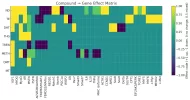
The tables in the paper were hard to read so I converted it into a visual heatmap:
1759439690506.webp

Legend: ↑ up, ↓ down, 0 no change, ± mixed/context-dependent
  • Nandrolone decanoate (ND): IGF1↑ (injury/castration), MYOG↑, MyoD↑, AR↑ (with overload), Notch1↑, Numb↑, MuRF1↓, MAFbx/FBXO32↓, REDD1↓, PGC1a↓, ACTA1↑ (injury), CCND1↑, EIF2AK3/PERK↑, MSTN0, MHC isoforms±, IL6±, TNFα±, TGFB1±, MYF5↑.
  • Testosterone esters (TE): IGF1↑, MYOG↑, AR↑ (older men), MuRF1↓ (prevents ORX-↑), ActRIIb↓, GLUT4↑, CPT1↑, WISP2↑, GR↓ (prevents ORX-↑), Myf6↑, c-Myc↑, MEOX2↑, c-Met↑, MSTN±, MyoD0, MAFbx0, MHC isoforms0, FSTN0.
  • Dihydrotestosterone (DHT): MyoD↑, IGF1↑ (reverses ORX-↓), Notch↑, Pax7↑ (transient), Sox8↑, Sox9↓, Delta↓, AMD1↑, MSTN±.
  • Tetrahydrogestrinone (THG): MyoD↑, AR signaling↑, MSTN↑.
  • Trenbolone enanthate (TREN): MSTN↓, ActRIIb↓, IGF1↑, MuRF1↓, MAFbx↓, GR↓, AR0, FSTN0, WISP2 0.
  • Methandienone (METH): MyoD↑, IGF1↑, AR↓, Smad3↓, IL6↓(with EX), TNFα↓(with EX), MHC↓(with EX), MYOG0, IL100, MSTN±, FSTN±, Smad7±.
  • Desoxymethyltestosterone (DMT): MSTN↑, IGF1↑.
 
This doesn't show us a whole lot we didn't already know, but it does objectively illustrate a few unexpected things:

- Nandrolone + Tren have a high degree of synergistic/complementary gene activity

- Dianabol has unique anti-inflammatory properties (see the purple grouping around the SMAD/IL6/TNFa area)
 
Here's a fun one to try to come up with an explanation for...

"Testosterone and trenbolone enanthate increase mature myostatin protein expression despite increasing skeletal muscle hypertrophy and satellite cell number in rodent muscle"


The androgen-induced alterations in adult rodent skeletal muscle fibre cross-sectional area (fCSA), satellite cell content and myostatin (Mstn) were examined in 10-month-old Fisher 344 rats (n = 41) assigned to Sham surgery, orchiectomy (ORX), ORX + testosterone (TEST; 7.0 mg week−1) or ORX + trenbolone (TREN; 1.0 mg week−1). After 29 days, animals were euthanised and the levator ani/bulbocavernosus (LABC) muscle complex was harvested for analyses. LABC muscle fCSA was 102% and 94% higher in ORX + TEST and ORX + TREN compared to ORX (p < .001). ORX + TEST and ORX + TREN increased satellite cell numbers by 181% and 178% compared to ORX, respectively (p < .01), with no differences between conditions for myonuclear number per muscle fibre (p = .948). Mstn protein was increased 159% and 169% in the ORX + TEST and ORX + TREN compared to ORX (p < .01). pan-SMAD2/3 protein was ~30–50% greater in ORX compared to SHAM (p = .006), ORX + TEST (p = .037) and ORX + TREN (p = .043), although there were no between-treatment effects regarding phosphorylated SMAD2/3. Mstn, ActrIIb and Mighty mRNAs were lower in ORX, ORX + TEST and ORX + TREN compared to SHAM (p < .05). Testosterone and trenbolone administration increased muscle fCSA and satellite cell number without increasing myonuclei number, and increased Mstn protein levels. Several genes and signalling proteins related to myostatin signalling were differentially regulated by ORX or androgen therapy.

We can see that AAS have varying effects on MSTN in the heatmap.
It seems like the effect might be context/time-dependent?

Myostatin acts as a metabolic "brake" for anabolism/hypertrophy.

We might be seeing the body trying to maintain homeostasis and regulate/balance?

Also, this might explain it a bit:

"Androgens accelerate myoblast proliferation → differentiation. During this progression MSTN shows a biphasic pattern and can increase as cells exit proliferation to limit overgrowth. Seen in C2C12 with DHT: early drop, later rise"
 
Stumbled across this recent interesting paper, which looked at changes in anabolic/catabolic genes recorded in medical literature over the years for various AAS.
...
The tables in the paper were hard to read so I converted it into a visual heatmap:
Thank you very much for putting in the effort to do so. I guess that I will have to read this quite a few times, to be able to draw any at least somewhat meaningful conclusion from it.
The way you placed the colour blocks on the cells could suggest that there is some kind of overlap between adjacent genes, if one is activated, the one next to it, will also be activated to some degree. Is that the case, or am I misinterpreting this?

I have never created such a heatmap, let alone from such data, so I may be missing something (again), but why didn't you swap the X and Y axis?
That would make it way better readable, according to my very limited understanding of the subject.


- Nandrolone + Tren have a high degree of synergistic/complementary gene activity
- Dianabol has unique anti-inflammatory properties (see the purple grouping around the SMAD/IL6/TNFa area)
So every cycle should at least have Test, Nandrolone, Tren and Dbol in it?^^
 
Back
Top