It is a commonly accepted rule among those who are in the business of argument, especially online, that he or she who invokes Adolf Hitler, either in oratory or essays, automatically forfeits the argument.
The reference is deemed far too extreme, too explosive, too far beyond rational correlation. No matter how bad a present-day politician, not one of them has charted or is charting a course to exterminate millions of innocent people as an act of ethnic cleansing.
Hitler stands alone in this regard, without rival, a warning to the world about how evil and lethal human beings can be, a warning that what he did can never be allowed again.
That said, there are strategies that Hitler used to secure power and rise — things that allowed his murderous reign — that can teach us about political theory and practice. And very reasonable and sage comparisons can be drawn between Hitler’s strategies and those of others.
According to James Murphy’s translation of Hitler’s “Mein Kampf”:
“In the big lie there is always a certain force of credibility; because the broad masses of a nation are always more easily corrupted in the deeper strata of their emotional nature than consciously or voluntarily; and thus in the primitive simplicity of their minds they more readily fall victims to the big lie than the small lie, since they themselves often tell small lies in little matters but would be ashamed to resort to large-scale falsehoods.”
The text continues:
“It would never come into their heads to fabricate colossal untruths, and they would not believe that others could have the impudence to distort the truth so infamously. Even though the facts which prove this to be so may be brought clearly to their minds, they will still doubt and waver and will continue to think that there may be some other explanation. For the grossly impudent lie always leaves traces behind it, even after it has been nailed down, a fact which is known to all expert liars in this world and to all who conspire together in the art of lying.”
This demonstrates a precise understanding of human psychology, but also the dangerously manipulative nature that operates in the mind of a demon.
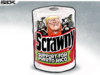
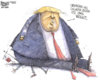
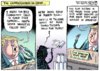
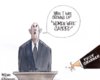
And yet, as many have noted, no person of sound reason or even cursory political awareness can read this and not be immediately struck by how similar this strategy of lying is to Donald Trump’s seeming strategy of lying: Tell a lie bigger than people think a lie can be, thereby forcing their brains to seek truth in it, or vest some faith in it, even after no proof can be found.
Trump is no Hitler, but the way he has manipulated the American people with outrageous lies, stacked one on top of the other, has an eerie historical resonance. Demagogy has a fixed design.
One of those lessons is about how purposeful lying can be effectively used as propaganda. The forthcoming comparison isn’t to Hitler the murderer, but to Hitler the liar.