Will you gain muscles from pump only?

Nutpuncher

Member
AnabolicLab.com Supporter
My rep range has been very high, 15 - 30 reps with lower weights. Last few reps are very difficult for me.

lets say for bench I do 5 sets of 135x25. Will I continue grow muscles? Of course once 25 reps is easily accomplished I would increase weight but still do 25 reps.

I love da pump that I get with lower weights and high reps. But goal is to grow.

Thanks
 
Am sure you will still grow. As long as the pump is hard then you will be tearing muscle fibres.

Look at the condition Bruce lee was in. Never lifted weights. Just squeezed his muscle. Not big by any measure. But well above average physique;)
 
Am sure you will still grow. As long as the pump is hard then you will be tearing muscle fibres.

Look at the condition Bruce lee was in. Never lifted weights. Just squeezed his muscle. Not big by any measure. But well above average physique;)

Thanks. I'll continue with high reps. I'd be ok if I look like Bruce + 25lbs lean muscles lol.

I love the look on people's faces when they see me put on 95lbs for warm up and to stretch and then replace with 1 plate and rep 25.
 
Ignore where I said Bruce lee never lifted weights, he did, what I meant was he would simply tense and hold as part of his strength training. Watched a documentary on him years back. And for the size of him he had one hell of a lat spread.
 
No kidding Bruce had crazy lat spread. Probably be able to use as a wing suit.


Edit: I thought pump is your muscles fuller of blood. Maybe that's why Bruce was muscular but not bb muscular. Not fair to say because he was natty? So maybe high volume will chisel and define muscles but won't grow much because your not tearing the fibers down?

@Docd187123
 
Last edited:
Training with high rep schemes is often called sarcoplasmic hypertrophy. Simpler to say fluid hypertrophy. Yes its very popular among the bb circle but it has its limits. For example training these particular muscle fibers doesn't recruit the type 2 dense fibers often worked when you lift heavy. Light training is effective but in the long run strength training will still have to be a main stay in a productive program.
 
Long post below........

Lets make this thread interesting instead of another traditional "can you grow from the pump" thread. It's an AAS board, lots of guys probably train for the pump and grow from it. It's the new thing these days, since intensity has fallen out of favor over the years.

A better question to ask would be, is training for the pump or with very high rep sets the most efficient/sustainable/effective/viable path to growth?

Here I will attempt to prove why training exclusively in VERY high-rep ranges (20+) is not ideal unless you have joint or tendon issues that prevent you from training in a higher intensity pain free.

Few things first...
  • Fast twitch motor units / high threshold motor units are responsible for most of your size and power.
  • High rep sets are not really efficient at recruiting and exhausting fast twitch / HTMU's. Only the reps closest to failure will get into this corridor of MU's.
  • Higher intensities are far more efficient at recruiting and exhausting HTMU's.
  • High rep sets / low intensities are more efficient at training slow twitch mu's (until you get close to failure).
The real bitch is this: Certain training styles can cause muscle fiber conversion and can change your overall muscle fiber composition. Using a training style that is primarily training slow twitch MU's can cause conversion to these MU's, which could include your delicious fast twitch fibers being converted...not good.

This conversion, if it occurs, can potentially slow down long term progress...if fibers that are responsible for most of your size and power are being converted to ones that play a lesser role in a strength athlete, then that is hardly ideal for long term progress.

There are a few studies that prove different training styles (some were strength, some were done on sprinters, etc) can lead to fiber conversions.

Increase in the proportion of fast-twitch muscle fibres by sprint training in males. - PubMed - NCBI

Muscle hypertrophy and fast fiber type conversions in heavy resistance-trained women. - PubMed - NCBI

Mammalian skeletal muscle fiber type transitions. - PubMed - NCBI

There is a far more comprehensive paper I have that demonstrates how a conversion in fibers occurs, it actually included a chart with fiber composition. It was done on untrained athletes and those that did primarily endurance work saw a greater conversion and increase in slow twitch after a period of time than the other groups. The amount of slow twitch fibers was even increased from baseline (before they started training) and I believe number of fast twitch mu's in some instances was decreased. I'm going off my head here, I'll try and find it later. Doc might have it on hand or know which one it is, it makes specific mention to the fact that muscle fibers exist on a continuum and that there is actually a lot of them.

Fast twitch mu's will give a lifter most of their size and power but even though when we are training with very high rep sets we are exposing our muscles to a good spectrum of MU's that get recruited AND EXHAUSTED (maximal effort will recruit everything but only htmu's get recruited and exhausted / trained I believe), only the reps CLOSEST TO FAILURE will recruit and exhaust fast twitch mu's when you're using low intensities.

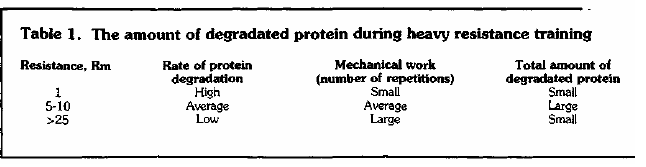
Then there is the time component of this kind of training. The amount of protein degraded with such low intensity is very low obviously, but even if you do a lot of reps, well, the amount of protein degraded is STILL LOW compared to what you could have done with a 5-10 rep set. That means it takes LONGER to get the same amount of hypertrophy with such an inefficient rep range.

This chart explains it, where protein degradation = hypertrophy.

prO8sUt.png


Based on this, it would indicate a moderate intensity is the most time efficient for hypertrophy. This is nothing new, but shit if you're going to spend more time to get the same hypertrophy, why not use the highest intensity you can get away with and at least reap the athletic / performance benefits?

125 reps of work with a 25 RM might be the same amount of degraded protein than 30-50 reps with a 10RM. That is inefficient as hell. (I pulled those numbers out of my ass, they are simply there to illustrate my point, not exact comparisons).

I'm not going to discount the pump as a factor that can contribute to growth, but I think there is strong enough evidence that suggests training exclusively for the pump or with VERY high rep sets is far from efficient. But then again, we're on gear, so anything can be made viable.

 
Last edited:
Long post below........

Lets make this thread interesting instead of another traditional "can you grow from the pump" thread. It's an AAS board, lots of guys probably train for the pump and grow from it. It's the new thing these days, since intensity has fallen out of favor over the years.

A better question to ask would be, is training for the pump or with very high rep sets the most efficient/sustainable/effective/viable path to growth?

Here I will attempt to prove why training exclusively in VERY high-rep ranges (20+) is not ideal unless you have joint or tendon issues that prevent you from training in a higher intensity pain free.

Few things first...
  • Fast twitch motor units / high threshold motor units are responsible for most of your size and power.
  • High rep sets are not really efficient at recruiting and exhausting fast twitch / HTMU's. Only the reps closest to failure will get into this corridor of MU's.
  • Higher intensities are far more efficient at recruiting and exhausting HTMU's.
  • High rep sets / low intensities are more efficient at training slow twitch mu's (until you get close to failure).
The real bitch is this: Certain training styles can cause muscle fiber conversion and can change your overall muscle fiber composition. Using a training style that is primarily training slow twitch MU's can cause conversion to these MU's, which could include your delicious fast twitch fibers being converted...not good.

This conversion, if it occurs, can potentially slow down long term progress...if fibers that are responsible for most of your size and power are being converted to ones that play a lesser role in a strength athlete, then that is hardly ideal for long term progress.

There are a few studies that prove different training styles (some were strength, some were done on sprinters, etc) can lead to fiber conversions.

Increase in the proportion of fast-twitch muscle fibres by sprint training in males. - PubMed - NCBI

Muscle hypertrophy and fast fiber type conversions in heavy resistance-trained women. - PubMed - NCBI

Mammalian skeletal muscle fiber type transitions. - PubMed - NCBI

There is a far more comprehensive paper I have that demonstrates how a conversion in fibers occurs, it actually included a chart with fiber composition. It was done on untrained athletes and those that did primarily endurance work saw a greater conversion and increase in slow twitch after a period of time than the other groups. The amount of slow twitch fibers was even increased from baseline (before they started training) and I believe number of fast twitch mu's in some instances was decreased. I'm going off my head here, I'll try and find it later. Doc might have it on hand or know which one it is, it makes specific mention to the fact that muscle fibers exist on a continuum and that there is actually a lot of them.

Fast twitch mu's will give a lifter most of their size and power but even though when we are training with very high rep sets we are exposing our muscles to a good spectrum of MU's that get recruited AND EXHAUSTED (maximal effort will recruit everything but only htmu's get recruited and exhausted / trained I believe), only the reps CLOSEST TO FAILURE will recruit and exhaust fast twitch mu's when you're using low intensities.

Then there is the time component of this kind of training. The amount of protein degraded with such low intensity is very low obviously, but even if you do a lot of reps, well, the amount of protein degraded is STILL LOW compared to what you could have done with a 5-10 rep set. That means it takes LONGER to get the same amount of hypertrophy with such an inefficient rep range.

This chart explains it, where protein degradation = hypertrophy.

prO8sUt.png


Based on this, it would indicate a moderate intensity is the most time efficient for hypertrophy. This is nothing new, but shit if you're going to spend more time to get the same hypertrophy, why not use the highest intensity you can get away with and at least reap the athletic / performance benefits?

125 reps of work with a 25 RM might be the same amount of degraded protein than 30-50 reps with a 10RM. That is inefficient as hell. (I pulled those numbers out of my ass, they are simply there to illustrate my point, not exact comparisons).

I'm not going to discount the pump as a factor that can contribute to growth, but I think there is strong enough evidence that suggests training exclusively for the pump or with VERY high rep sets is far from efficient. But then again, we're on gear, so anything can be made viable.


Will you marry me?
 
If you think about it that's an oxymoron. As the reps get higher the weight must drop and conversely, when the weight gets higher the reps must drop.

Agreed. However, I've found that doing drop sets starting from about 85% of my max and just dropping 10-20 pounds at a time allows me to use as heavy weight as possible while still getting 15+ reps per set.
 
Long post below........

Lets make this thread interesting instead of another traditional "can you grow from the pump" thread. It's an AAS board, lots of guys probably train for the pump and grow from it. It's the new thing these days, since intensity has fallen out of favor over the years.

A better question to ask would be, is training for the pump or with very high rep sets the most efficient/sustainable/effective/viable path to growth?

Here I will attempt to prove why training exclusively in VERY high-rep ranges (20+) is not ideal unless you have joint or tendon issues that prevent you from training in a higher intensity pain free.

Few things first...
  • Fast twitch motor units / high threshold motor units are responsible for most of your size and power.
  • High rep sets are not really efficient at recruiting and exhausting fast twitch / HTMU's. Only the reps closest to failure will get into this corridor of MU's.
  • Higher intensities are far more efficient at recruiting and exhausting HTMU's.
  • High rep sets / low intensities are more efficient at training slow twitch mu's (until you get close to failure).
The real bitch is this: Certain training styles can cause muscle fiber conversion and can change your overall muscle fiber composition. Using a training style that is primarily training slow twitch MU's can cause conversion to these MU's, which could include your delicious fast twitch fibers being converted...not good.

This conversion, if it occurs, can potentially slow down long term progress...if fibers that are responsible for most of your size and power are being converted to ones that play a lesser role in a strength athlete, then that is hardly ideal for long term progress.

There are a few studies that prove different training styles (some were strength, some were done on sprinters, etc) can lead to fiber conversions.

Increase in the proportion of fast-twitch muscle fibres by sprint training in males. - PubMed - NCBI

Muscle hypertrophy and fast fiber type conversions in heavy resistance-trained women. - PubMed - NCBI

Mammalian skeletal muscle fiber type transitions. - PubMed - NCBI

There is a far more comprehensive paper I have that demonstrates how a conversion in fibers occurs, it actually included a chart with fiber composition. It was done on untrained athletes and those that did primarily endurance work saw a greater conversion and increase in slow twitch after a period of time than the other groups. The amount of slow twitch fibers was even increased from baseline (before they started training) and I believe number of fast twitch mu's in some instances was decreased. I'm going off my head here, I'll try and find it later. Doc might have it on hand or know which one it is, it makes specific mention to the fact that muscle fibers exist on a continuum and that there is actually a lot of them.

Fast twitch mu's will give a lifter most of their size and power but even though when we are training with very high rep sets we are exposing our muscles to a good spectrum of MU's that get recruited AND EXHAUSTED (maximal effort will recruit everything but only htmu's get recruited and exhausted / trained I believe), only the reps CLOSEST TO FAILURE will recruit and exhaust fast twitch mu's when you're using low intensities.

Then there is the time component of this kind of training. The amount of protein degraded with such low intensity is very low obviously, but even if you do a lot of reps, well, the amount of protein degraded is STILL LOW compared to what you could have done with a 5-10 rep set. That means it takes LONGER to get the same amount of hypertrophy with such an inefficient rep range.

This chart explains it, where protein degradation = hypertrophy.

prO8sUt.png


Based on this, it would indicate a moderate intensity is the most time efficient for hypertrophy. This is nothing new, but shit if you're going to spend more time to get the same hypertrophy, why not use the highest intensity you can get away with and at least reap the athletic / performance benefits?

125 reps of work with a 25 RM might be the same amount of degraded protein than 30-50 reps with a 10RM. That is inefficient as hell. (I pulled those numbers out of my ass, they are simply there to illustrate my point, not exact comparisons).

I'm not going to discount the pump as a factor that can contribute to growth, but I think there is strong enough evidence that suggests training exclusively for the pump or with VERY high rep sets is far from efficient. But then again, we're on gear, so anything can be made viable.

That was a perfect write up brother. Beautiful thesis if I may say so.
 
Long post below........

Lets make this thread interesting instead of another traditional "can you grow from the pump" thread. It's an AAS board, lots of guys probably train for the pump and grow from it. It's the new thing these days, since intensity has fallen out of favor over the years.

A better question to ask would be, is training for the pump or with very high rep sets the most efficient/sustainable/effective/viable path to growth?

Here I will attempt to prove why training exclusively in VERY high-rep ranges (20+) is not ideal unless you have joint or tendon issues that prevent you from training in a higher intensity pain free.

Few things first...
  • Fast twitch motor units / high threshold motor units are responsible for most of your size and power.
  • High rep sets are not really efficient at recruiting and exhausting fast twitch / HTMU's. Only the reps closest to failure will get into this corridor of MU's.
  • Higher intensities are far more efficient at recruiting and exhausting HTMU's.
  • High rep sets / low intensities are more efficient at training slow twitch mu's (until you get close to failure).
The real bitch is this: Certain training styles can cause muscle fiber conversion and can change your overall muscle fiber composition. Using a training style that is primarily training slow twitch MU's can cause conversion to these MU's, which could include your delicious fast twitch fibers being converted...not good.

This conversion, if it occurs, can potentially slow down long term progress...if fibers that are responsible for most of your size and power are being converted to ones that play a lesser role in a strength athlete, then that is hardly ideal for long term progress.

There are a few studies that prove different training styles (some were strength, some were done on sprinters, etc) can lead to fiber conversions.

Increase in the proportion of fast-twitch muscle fibres by sprint training in males. - PubMed - NCBI

Muscle hypertrophy and fast fiber type conversions in heavy resistance-trained women. - PubMed - NCBI

Mammalian skeletal muscle fiber type transitions. - PubMed - NCBI

There is a far more comprehensive paper I have that demonstrates how a conversion in fibers occurs, it actually included a chart with fiber composition. It was done on untrained athletes and those that did primarily endurance work saw a greater conversion and increase in slow twitch after a period of time than the other groups. The amount of slow twitch fibers was even increased from baseline (before they started training) and I believe number of fast twitch mu's in some instances was decreased. I'm going off my head here, I'll try and find it later. Doc might have it on hand or know which one it is, it makes specific mention to the fact that muscle fibers exist on a continuum and that there is actually a lot of them.

Fast twitch mu's will give a lifter most of their size and power but even though when we are training with very high rep sets we are exposing our muscles to a good spectrum of MU's that get recruited AND EXHAUSTED (maximal effort will recruit everything but only htmu's get recruited and exhausted / trained I believe), only the reps CLOSEST TO FAILURE will recruit and exhaust fast twitch mu's when you're using low intensities.

Then there is the time component of this kind of training. The amount of protein degraded with such low intensity is very low obviously, but even if you do a lot of reps, well, the amount of protein degraded is STILL LOW compared to what you could have done with a 5-10 rep set. That means it takes LONGER to get the same amount of hypertrophy with such an inefficient rep range.

This chart explains it, where protein degradation = hypertrophy.

prO8sUt.png


Based on this, it would indicate a moderate intensity is the most time efficient for hypertrophy. This is nothing new, but shit if you're going to spend more time to get the same hypertrophy, why not use the highest intensity you can get away with and at least reap the athletic / performance benefits?

125 reps of work with a 25 RM might be the same amount of degraded protein than 30-50 reps with a 10RM. That is inefficient as hell. (I pulled those numbers out of my ass, they are simply there to illustrate my point, not exact comparisons).

I'm not going to discount the pump as a factor that can contribute to growth, but I think there is strong enough evidence that suggests training exclusively for the pump or with VERY high rep sets is far from efficient. But then again, we're on gear, so anything can be made viable.

Just got home from work and finally had a chance to read this in its entirety, and I'm glad I did. I knew about the different muscle fibers and best ways to work one or the other, but I was jot aware of the possibility of conversion if worked too much one way or the other. So thanks, I learned something new today!
 
Long post below........

Lets make this thread interesting instead of another traditional "can you grow from the pump" thread. It's an AAS board, lots of guys probably train for the pump and grow from it. It's the new thing these days, since intensity has fallen out of favor over the years.

A better question to ask would be, is training for the pump or with very high rep sets the most efficient/sustainable/effective/viable path to growth?

Here I will attempt to prove why training exclusively in VERY high-rep ranges (20+) is not ideal unless you have joint or tendon issues that prevent you from training in a higher intensity pain free.

Few things first...
  • Fast twitch motor units / high threshold motor units are responsible for most of your size and power.
  • High rep sets are not really efficient at recruiting and exhausting fast twitch / HTMU's. Only the reps closest to failure will get into this corridor of MU's.
  • Higher intensities are far more efficient at recruiting and exhausting HTMU's.
  • High rep sets / low intensities are more efficient at training slow twitch mu's (until you get close to failure).
The real bitch is this: Certain training styles can cause muscle fiber conversion and can change your overall muscle fiber composition. Using a training style that is primarily training slow twitch MU's can cause conversion to these MU's, which could include your delicious fast twitch fibers being converted...not good.

This conversion, if it occurs, can potentially slow down long term progress...if fibers that are responsible for most of your size and power are being converted to ones that play a lesser role in a strength athlete, then that is hardly ideal for long term progress.

There are a few studies that prove different training styles (some were strength, some were done on sprinters, etc) can lead to fiber conversions.

Increase in the proportion of fast-twitch muscle fibres by sprint training in males. - PubMed - NCBI

Muscle hypertrophy and fast fiber type conversions in heavy resistance-trained women. - PubMed - NCBI

Mammalian skeletal muscle fiber type transitions. - PubMed - NCBI

There is a far more comprehensive paper I have that demonstrates how a conversion in fibers occurs, it actually included a chart with fiber composition. It was done on untrained athletes and those that did primarily endurance work saw a greater conversion and increase in slow twitch after a period of time than the other groups. The amount of slow twitch fibers was even increased from baseline (before they started training) and I believe number of fast twitch mu's in some instances was decreased. I'm going off my head here, I'll try and find it later. Doc might have it on hand or know which one it is, it makes specific mention to the fact that muscle fibers exist on a continuum and that there is actually a lot of them.

Fast twitch mu's will give a lifter most of their size and power but even though when we are training with very high rep sets we are exposing our muscles to a good spectrum of MU's that get recruited AND EXHAUSTED (maximal effort will recruit everything but only htmu's get recruited and exhausted / trained I believe), only the reps CLOSEST TO FAILURE will recruit and exhaust fast twitch mu's when you're using low intensities.

Then there is the time component of this kind of training. The amount of protein degraded with such low intensity is very low obviously, but even if you do a lot of reps, well, the amount of protein degraded is STILL LOW compared to what you could have done with a 5-10 rep set. That means it takes LONGER to get the same amount of hypertrophy with such an inefficient rep range.

This chart explains it, where protein degradation = hypertrophy.

prO8sUt.png


Based on this, it would indicate a moderate intensity is the most time efficient for hypertrophy. This is nothing new, but shit if you're going to spend more time to get the same hypertrophy, why not use the highest intensity you can get away with and at least reap the athletic / performance benefits?

125 reps of work with a 25 RM might be the same amount of degraded protein than 30-50 reps with a 10RM. That is inefficient as hell. (I pulled those numbers out of my ass, they are simply there to illustrate my point, not exact comparisons).

I'm not going to discount the pump as a factor that can contribute to growth, but I think there is strong enough evidence that suggests training exclusively for the pump or with VERY high rep sets is far from efficient. But then again, we're on gear, so anything can be made viable.
Bravo!
 
Agreed. However, I've found that doing drop sets starting from about 85% of my max and just dropping 10-20 pounds at a time allows me to use as heavy weight as possible while still getting 15+ reps per set.

Ain't no way you are pushing 15+ reps at 85% of your 1rm. 85% would be your 4-6 rep ranges at failure and you 3 rep range for working sets. But I get what you are saying you go as heavy as you can for 15 reps then lower the weight and repeat correct? Also @weighted chinup you are a champion in my book I love how you can just conjure up these awesome studies on a whim! One day I aspire to have my archive of study links that full :D
 
Ain't no way you are pushing 15+ reps at 85% of your 1rm. 85% would be your 4-6 rep ranges at failure and you 3 rep range for working sets. But I get what you are saying you go as heavy as you can for 15 reps then lower the weight and repeat correct? Also @weighted chinup you are a champion in my book I love how you can just conjure up these awesome studies on a whim! One day I aspire to have my archive of study links that full :D
Hahah nah bro, just bad communication on my part, I could have worded that better. I wish I was doing 15 reps at 85%, but I guess If I was it wouldn't be 85% anymore lol. I was trying to say doing drop sets starting at my 85% blasting out as many as I can while keeping form, dropping 20 lbs off the bar and immediately getting back under the bar and cranking out another however many controlled reps I can do, then repeat that until I've gotten the desired amount of reps.. Idk if that makes sense. for me after I drop the weight and get right back on it, that 20 lbs (and it doesn't have to be twenty that's just an example weight.) Less than that first "sub set" feels pretty close to the 85%.
 
Genetics play a huge role in the number of fast twitch / slow twitch fibers from person to person as well. Another very important variable for growth... SLEEP. This is a major hindrance for a lot of people. Very good info on this board
 
Back
Top