Juiced_lizard
Member
I’m confused by all of that honestly. I don’t quite understand the different buffers. So it depends on recipe that makes up the HGH right?And my apology. I could not make out the link you had shared there. Yep, that's the one.

MESO-Rx
Anabolic Steroids

Follow along with the video below to see how to install our site as a web app on your home screen.
Note: This feature may not be available in some browsers.
I’m confused by all of that honestly. I don’t quite understand the different buffers. So it depends on recipe that makes up the HGH right?And my apology. I could not make out the link you had shared there. Yep, that's the one.

I hope you share the igf results. 2iu seems like a small dose even for serostim. Do you have your baseline numbers also?Starting week 4. So far so good. Nothing noticeable.
Week 1: 1.5 IU/d
Week 2: 1.8 IU/d
Week 3: 2 IU/d
Week 4: " "
Will pull IGF-1 soon.
Thanks for asking.
Baseline:I hope you share the igf results. 2iu seems like a small dose even for serostim. Do you have your baseline numbers also?
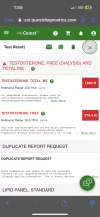
100 ng/ml today after almost 7 years on androgens. Z score is minus 0.5.
Pre TRT it was about 200. I am investigating GH as next add on. Would be a big jump as GH ain't winning you any longevity points.
Yes, monomer stability does seem to be a strong function of excipient recipe for reconstituted GH. Similar to lyophilized GH.I’m confused by all of that honestly. I don’t quite understand the different buffers. So it depends on recipe that makes up the HGH right?
Ok I was just curious. For 8 months roughly I’ve used 40IU vials at 2-5 IU a day and always reconstituted then put into a fridge and never had problems that I know of. With good results. All UGL obviously.Yes, monomer stability does seem to be a strong function of excipient recipe for reconstituted GH. Similar to lyophilized GH.
Storage temp plays a huge role.
Damn, I guess 2iu might be something for you then. 100 seems low.Baseline:
Will do.
100 ain't high, that's for sure.Damn, I guess 2iu might be something for you then. 100 seems low.
Awesome. Sounds like you did it right!Ok I was just curious. For 8 months roughly I’ve used 40IU vials at 2-5 IU a day and always reconstituted then put into a fridge and never had problems that I know of. With good results. All UGL obviously.
Who knows could always be better I’m sure. I’m no expert in that by any means. just curious what others were doing. I know there are a lot of different views on the matter.Awesome. Sounds like you did it right!

Hmm...well maybe degradation explains my low IGF-1 results with Opti Greys.Very nice summary. I assume you were trying to link this material:
Ive seen the Janoshik report of GH losing almost 50% potency after being reconstituated and left at room temperature for 6 days, but do you think 12-16 hours @ room temp will have much of a degradation effect? Cant really find any info on how quickly it starts degrading
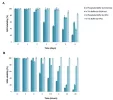
Fig.1
hGH stability in Tris and phosphate buffers (0.05 M, pH=7.4) analyzed by HPLC and ELISA tests. A. At 5 ± 2℃ and B. At 37 ± 1℃. hGH; Human growth hormone, HPLC; High performance liquid chromatography, and ELISA; Enzyme-linked immunosorbent assay
See the...
- readalot
Absolutely great point on the excipient comments. We know alot from the studies on the effect of excipients on lyophilized GH shelf life and degradation. Less seems to have been published on what happens after reconstitution. The material posted above shows worst case scenario for GH in buffered solutions. Like you said pharma GH labeling allows for 10 to 14 day storage in fridge after reconstitution.
Curious why you are doing this?I've been reconstituting 2 vials and then combining both of those into one of the vials to pull from for injections. Lasts ~8 days.

Saves time vs reconstituting a vial every 4 days.Curious why you are doing this?

I’m just starting to learn about HGH, so there might be mistakes in my response, and I could be wrong in some areas. That said, here’s my take on it.
I checked out the full study, and while it provides useful data, I don’t think it directly applies to how pharma HGH is stored and used in real life.
From what I gathered, the study tested HGH in basic buffer solutions (Tris and phosphate) without stabilizers and looked at chemical and physical degradation over time.
1. In a phosphate buffer at 5°C, it seemed chemically stable for 4+ days, but ELISA results showed possible aggregation after day 2.
2. In a Tris buffer at 5°C, HGH stayed stable for 4+ days without major degradation.
Why I don’t think this fully applies to pharma HGH:
1. Pharma HGH (Genotropin, Norditropin, Humatrope, etc.) contains stabilizers like m-cresol and glycerin, which help it stay stable much longer.
2. Companies like Pfizer, Novo Nordisk, and Lilly state that HGH remains good for 14–28 days at 2–8°C, and they base this on HPLC testing and real-world bioassays.
3. If HGH really lost 80% potency in 7 days at 2–8°C, pharma companies wouldn’t approve month-long use periods post-reconstitution.
4. Stability studies on actual pharma HGH show minimal degradation over weeks, not days, when stored properly.
How this relates to UGL HGH:
1. UGL HGH doesn’t always have the same stabilizers, so it breaks down faster than pharma versions. From what I’ve seen, most people say it starts losing potency after 10–14 days, which is why many try to use it quickly.
2. The typical UGL HGH formulation (Lobster) includes:
- 5g Mannitol - Helps with lyophilization (freeze-drying) but doesn’t stabilize HGH.
- 16.8 mg Sodium Dihydrogen Phosphate & 51.12 mg Disodium Hydrogen Phosphate – Basic phosphate buffer that helps with pH balance but doesn’t prevent aggregation or extend stability.
Some vendors add glycine before lyophilization, which might help slow degradation, but it’s unclear how much it actually extends shelf life compared to pharma-grade stabilizers like m-cresol.
Unlike pharma HGH, most UGL versions still lack preservatives that significantly extend post-reconstitution stability.
This is why UGL HGH is best used within 10-14 days after mixing, while pharma HGH remains stable for weeks.
Final thoughts
The study looked at HGH in simple buffer solutions, not the kind of formulations used in pharma HGH. Pharma HGH is designed to last weeks, not just days, because of added stabilizers.
For UGL HGH, we now know that some vendors add glycine before lyophilization, which might help with stability, but it’s still not the same as pharma HGH with preservatives like m-cresol. Degradation still happens faster, which is why users report noticeable potency loss after 10-14 days.
If I misunderstood something, I’m open to correction, but based on what I’ve read, the idea that HGH loses 80% in 7 days at 2-8°C doesn’t match real-world data - unless we’re talking about UGL HGH without proper stabilizers, which does degrade faster.

I doubt adding them both to the same vial has much negative affect, but for good measure I wouldnt do that just in case (it is more mechanical stress on the liquid to unnecessarily transfer on vial to the other).Hmm...well maybe degradation explains my low IGF-1 results with Opti Greys.
Jumped to 3iu in November 2024 and since then I've been reconstituting 2 vials and then combining both of those into one of the vials to pull from for injections. Lasts ~8 days.
All bloodwork results below were with Opti Greys.
Unreconstituted and reconstituted both stored in the fridge in dark containers.
Feb 2025: IGF-1 209 - Z-score 0.9 (3iu) (27.4% increase over baseline)
Oct 2024: IGF-1 195 - Z-score 0.7 (2iu) (18.9% increase over baseline)
May 2024: IGF-1 164 - Z-score 0.3 (Baseline - no HGH and no previous use)
Titrating up to 4iu now.

I have been using GA 36iu vial and I use it within 10 days and my blood work says no issues with this time frame. I did just run an experiment using the fact that GA's HGH makes my hands swell. I left the last dose for 20 days and had no hand swell at all after taking that last dose. Not very "scientific" but I will now not go over 10 days before using a vile up.I do. 40IU Vial at 5iu a day lasts me 8 days. I’ve never had a problem. Not saying that’s the best way to do it but just what I do.
All great questions and things I've considered.I doubt adding them both to the same vial has much negative affect, but for good measure I wouldnt do that just in case (it is more mechanical stress on the liquid to unnecessarily transfer on vial to the other).
Also, I have never had degradation problems carrying a refrigerated vial over the weekend (when doing 5/2, 2 iu) which puts me at 7 total days per vial. My numbers are in the 400's on 2iu (although I am a hyper responder).
A few ideas:
1) are you refrigerating to under 46F?
2) are you reconstituting properly (not shaking the vial, legit bac water, etc)
3) when did you buy it? I always buy my GH in the fall/winter due to heat in-transit in the summer. Small thing...maybe it doesnt matter...but why take a chance.
4) how old are the vials? I bought a boatload of really good UGL GH one time and kept it refrigerated. However, after a year and a half in the fridge, it lost almost all of its value (based on testing). I had to toss several kits. Lesson: UGL GH is not as durable as pharma IMO. I only buy 6 -8 months max at a time
Just some thoughts....it could also be that you are a low responder to GH. Have you used other brands with better results?

I also may just be a low responder.
It's possible. Both of your IGF1 tests are less than the Meso average per IU of GH/d.
Can't wait to hear the rational protest to this idea.QSC, probably the single largest supplier of UGL HGH, used mannitol. No buffer to control PH, nothing.
Seems "no vacuum", therefore air filled vials are acceptable now too, according to some members, despite the methionine present in HGH oxidizing when coming into contact with oxygen. The primary effect of this according to studies is to rapidly speed up degradation.
It's safer to assume "worst case scenario", the most unstable HGH possible, is what's in your vial unless proven otherwise, and any comparison to pharma is ridiculous when almost no one even knows the PH of their reconstituted HGH. That's just, you know, one of the top three factors determining stability, with a 1 PH difference potentially increasing instability by 10x, and no one's paying attention to it.
It's time to start demanding the list of excipients used, and having Jano verify during routine tests, otherwise most vendors couldn't care less. A freshly reconstituted vial without a good excipient recipe can still show a good purity test result,
By the way, this applies to peptides of all types, except for the oxygen sensitivity, which is applicable if methionine (MET) is present. You can just look up a peptide formula to check.