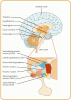
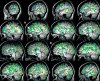
Several pioneering studies have begun examining the relationship between brain activity and political attitudes, but none have characterized brain structure. Political attitudes are typically captured on a single-item measure in which participants self-report using a five-point scale ranging from ‘‘very liberal’’ to ‘‘very conservative.’’ Despite the simplicity of such a scale, it accurately predicts voting behaviors of individuals and has been used successfully to determine genetic contributions to political orientation. Psychological differences between conservatives and liberals determined in this way map onto self-regulatory processes associated with conflict monitoring. Moreover, the amplitude of event-related potentials reflecting neural activity associated with conflict monitoring in the anterior cingulate cortex (ACC) is greater for liberals compared to conservatives. Thus, stronger liberalism is associated with increased sensitivity to cues for altering a habitual response pattern and with brain activity in anterior cingulate cortex.
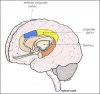
Here researchers explored this relationship further by examining whether political attitudes correlated not just with function but also with anatomical structure of these regions. To test the hypothesis that political liberalism (versus conservatism) is associated with differences in gray matter volume in anterior cingulate cortex, they recorded structural magnetic resonance imaging (MRI) scans from 90 healthy young adults (61% female) who self-reported their political attitudes confidentially on a five-point scale from ‘‘very liberal’’ to ‘‘very conservative.’’ They then used voxel-based morphometry (VBM) analyses to investigate the relationship between these attitudes, expressed as a numeric score between one and five, and gray matter volume. They found that increased gray matter volume in the anterior cingulate cortex was significantly associated with liberalism (R = 22.71, T(88) = 2.633, p = 0.010 corrected). They regressed out potential confounding variables of age and gender in the analysis, therefore, their findings are not attributable to these factors.
Apart from the anterior cingulate cortex, other brain structures may also show patterns of neural activity that reflect political attitudes. Conservatives respond to threatening situations with more aggression than do liberals and are more sensitive to threatening facial expressions. This heightened sensitivity to emotional faces suggests that individuals with conservative orientation might exhibit differences in brain structures associated with emotional processing such as the amygdala. Indeed, voting behavior is reflected in amygdala responses across cultures. They therefore further investigated the structural MRI data to evaluate whether there was any relationship between gray matter volume of the amygdala and political attitudes. They found that increased gray matter volume in the right amygdala was significantly associated with conservatism (R = 0.23, T(88) = 22.22, p < 0.029 corrected). No significant correlation was found in the left amygdala (R = 0.15, T(88) = 21.43, p = 0.15 corrected).
Kanai R, Feilden T, Firth C, Rees G. Political Orientations Are Correlated with Brain Structure in Young Adults. Current biology : CB. Current Biology - Political Orientations Are Correlated with Brain Structure in Young Adults
Substantial differences exist in the cognitive styles of liberals and conservatives on psychological measures [1]. Variability in political attitudes reflects genetic influences and their interaction with environmental factors [2, 3]. Recent work has shown a correlation between liberalism and conflict-related activity measured by event-related potentials originating in the anterior cingulate cortex [4]. Here we show that this functional correlate of political attitudes has a counterpart in brain structure. In a large sample of young adults, we related self-reported political attitudes to gray matter volume using structural MRI. We found that greater liberalism was associated with increased gray matter volume in the anterior cingulate cortex, whereas greater conservatism was associated with increased volume of the right amygdala. These results were replicated in an independent sample of additional participants. Our findings extend previous observations that political attitudes reflect differences in self-regulatory conflict monitoring [4] and recognition of emotional faces [5] by showing that such attitudes are reflected in human brain structure. Although our data do not determine whether these regions play a causal role in the formation of political attitudes, they converge with previous work [4, 6] to suggest a possible link between brain structure and psychological mechanisms that mediate political attitudes. º Political liberalism and conservatism were correlated with brain structure º Liberalism was associated with the gray matter volume of anterior cingulate cortex º Conservatism was associated with increased right amygdala size º Results offer possible accounts for cognitive styles of liberals and conservatives
Here researchers explored this relationship further by examining whether political attitudes correlated not just with function but also with anatomical structure of these regions. To test the hypothesis that political liberalism (versus conservatism) is associated with differences in gray matter volume in anterior cingulate cortex, they recorded structural magnetic resonance imaging (MRI) scans from 90 healthy young adults (61% female) who self-reported their political attitudes confidentially on a five-point scale from ‘‘very liberal’’ to ‘‘very conservative.’’ They then used voxel-based morphometry (VBM) analyses to investigate the relationship between these attitudes, expressed as a numeric score between one and five, and gray matter volume. They found that increased gray matter volume in the anterior cingulate cortex was significantly associated with liberalism (R = 22.71, T(88) = 2.633, p = 0.010 corrected). They regressed out potential confounding variables of age and gender in the analysis, therefore, their findings are not attributable to these factors.
Apart from the anterior cingulate cortex, other brain structures may also show patterns of neural activity that reflect political attitudes. Conservatives respond to threatening situations with more aggression than do liberals and are more sensitive to threatening facial expressions. This heightened sensitivity to emotional faces suggests that individuals with conservative orientation might exhibit differences in brain structures associated with emotional processing such as the amygdala. Indeed, voting behavior is reflected in amygdala responses across cultures. They therefore further investigated the structural MRI data to evaluate whether there was any relationship between gray matter volume of the amygdala and political attitudes. They found that increased gray matter volume in the right amygdala was significantly associated with conservatism (R = 0.23, T(88) = 22.22, p < 0.029 corrected). No significant correlation was found in the left amygdala (R = 0.15, T(88) = 21.43, p = 0.15 corrected).
Kanai R, Feilden T, Firth C, Rees G. Political Orientations Are Correlated with Brain Structure in Young Adults. Current biology : CB. Current Biology - Political Orientations Are Correlated with Brain Structure in Young Adults
Substantial differences exist in the cognitive styles of liberals and conservatives on psychological measures [1]. Variability in political attitudes reflects genetic influences and their interaction with environmental factors [2, 3]. Recent work has shown a correlation between liberalism and conflict-related activity measured by event-related potentials originating in the anterior cingulate cortex [4]. Here we show that this functional correlate of political attitudes has a counterpart in brain structure. In a large sample of young adults, we related self-reported political attitudes to gray matter volume using structural MRI. We found that greater liberalism was associated with increased gray matter volume in the anterior cingulate cortex, whereas greater conservatism was associated with increased volume of the right amygdala. These results were replicated in an independent sample of additional participants. Our findings extend previous observations that political attitudes reflect differences in self-regulatory conflict monitoring [4] and recognition of emotional faces [5] by showing that such attitudes are reflected in human brain structure. Although our data do not determine whether these regions play a causal role in the formation of political attitudes, they converge with previous work [4, 6] to suggest a possible link between brain structure and psychological mechanisms that mediate political attitudes. º Political liberalism and conservatism were correlated with brain structure º Liberalism was associated with the gray matter volume of anterior cingulate cortex º Conservatism was associated with increased right amygdala size º Results offer possible accounts for cognitive styles of liberals and conservatives
Last edited: