


Hallengren E, Almgren P, Engstrom G, et al. Fasting levels of high-sensitivity growth hormone predict cardiovascular morbidity and mortality: the Malmo Diet and Cancer study. J Am Coll Cardiol 2014;64(14):1452-60. https://www.sciencedirect.com/science/article/pii/S0735109714057180
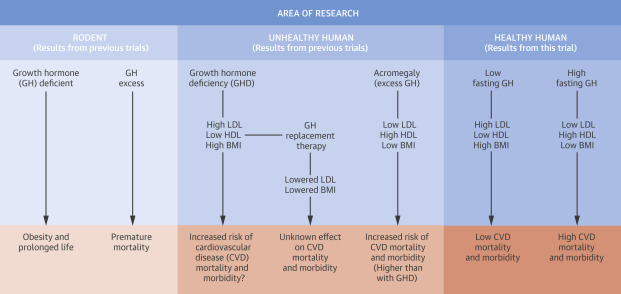
BACKGROUND: Both pathological excess and deficiency of growth hormone (GH) are associated with cardiovascular mortality.
OBJECTIVES: The goal of this study was to test whether fasting levels of growth hormone measured with a high-sensitivity assay (hs-GH) predict cardiovascular morbidity and mortality at the population level.
METHODS: We studied 4,323 participants (age 46 to 68 years; mean age 58 years; 59% women) of the Swedish, population-based Malmo Diet and Cancer study examined in 1991 to 1994. Using multivariate-adjusted Cox proportional hazards models, we related baseline levels of fasting hs-GH to incidence of coronary artery disease, stroke, congestive heart failure, all-cause mortality, and cardiovascular mortality.
RESULTS: During a median follow-up of 16.2 years, hs-GH (hazard ratio
/SD increment of natural logarithm of fasting hs-GH) was independently associated with
· increased risk of coronary artery disease (397 events; HR: 1.11; 95% confidence interval [CI]: 1.01 to 1.23; p = 0.04),
· stroke (251 events; HR: 1.18; 95% CI: 1.04 to 1.34; p = 0.01),
· congestive heart failure (107 events; HR: 1.25; 95% CI: 1.03 to 1.52; p = 0.02),
· all-cause mortality (645 events; HR: 1.17; 95% CI: 1.08 to 1.26; p < 0.001) and
· cardiovascular mortality (186 events; HR: 1.43; 95% CI: 1.24 to 1.66; p < 0.001).
The addition of hs-GH to a model with conventional cardiovascular risk factors significantly reclassified risk, with a category-free net reclassification improvement (>0) of 0.542 (95% CI: 0.205 to 0.840) in cardiovascular mortality.
CONCLUSIONS: Higher values of hs-GH were associated with an increased risk of cardiovascular morbidity and mortality.
BACKGROUND: Both pathological excess and deficiency of growth hormone (GH) are associated with cardiovascular mortality.
OBJECTIVES: The goal of this study was to test whether fasting levels of growth hormone measured with a high-sensitivity assay (hs-GH) predict cardiovascular morbidity and mortality at the population level.
METHODS: We studied 4,323 participants (age 46 to 68 years; mean age 58 years; 59% women) of the Swedish, population-based Malmo Diet and Cancer study examined in 1991 to 1994. Using multivariate-adjusted Cox proportional hazards models, we related baseline levels of fasting hs-GH to incidence of coronary artery disease, stroke, congestive heart failure, all-cause mortality, and cardiovascular mortality.
RESULTS: During a median follow-up of 16.2 years, hs-GH (hazard ratio
/SD increment of natural logarithm of fasting hs-GH) was independently associated with
· increased risk of coronary artery disease (397 events; HR: 1.11; 95% confidence interval [CI]: 1.01 to 1.23; p = 0.04),
· stroke (251 events; HR: 1.18; 95% CI: 1.04 to 1.34; p = 0.01),
· congestive heart failure (107 events; HR: 1.25; 95% CI: 1.03 to 1.52; p = 0.02),
· all-cause mortality (645 events; HR: 1.17; 95% CI: 1.08 to 1.26; p < 0.001) and
· cardiovascular mortality (186 events; HR: 1.43; 95% CI: 1.24 to 1.66; p < 0.001).
The addition of hs-GH to a model with conventional cardiovascular risk factors significantly reclassified risk, with a category-free net reclassification improvement (>0) of 0.542 (95% CI: 0.205 to 0.840) in cardiovascular mortality.
CONCLUSIONS: Higher values of hs-GH were associated with an increased risk of cardiovascular morbidity and mortality.




 . I don't understand in the healthy human category High LDL, Low HDL, High BMI is a healthy human? I don't think I am following the flow of the chart right.


