

Trenbolone

Re: OnLine First

Model For The Mechanism Of The Anabolic Action Of Steroid Hormones

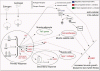
At a time when the increase in muscle mass had already become apparent, researchers interrogated high-throughput gene expression data from muscle samples using two recently published co-expression based network inference approaches called Partial Correlation coefficient with Information Theory (PCIT) and Regulatory Impact Factor (RIF), and the promoter structure of the differentially expressed genes. Their results point to a dramatic and unexpected induction of muscle oxytocin (OXT) expression also measurable in the plasma at the protein level. They hypothesise that the increased expression of OXT may account for the increased muscle mass.

Estrogen and androgen bind to intracellular receptors, which in turn bind to promoter regions of specific genes to either induce or repress expression of the primary response to steroid treatment. Muscle is composed of a mixture of cell types, which are likely to respond differently to the exposure to steroids.

As part of the response, a group of fat metabolism genes is down-regulated via an unknown mechanism, which may simply reflect a decrease in the lipid storage activity of intramuscular adipocytes due to the increased bio-energetic demand of supporting enhanced muscle growth. Also as part of the response, a group of genes encoding collagen subunits is up-regulated by an unknown mechanism, probably in the mature muscle cells. It is most likely that the increase in cell cycle gene expression occurs in the muscle satellite cells, as differentiated muscle cells do not divide and the activity of adipocytes storing lipid is decreased, which is not consistent with increased cell numbers.

The small increase in expression of IGF1 is consistent with IGF1 playing a role in the increase in muscle growth. However, the Regulatory Impact analysis (RIF) analysis more strongly supports the oxytocin receptor, OXTR, than the IGF1 receptor IGF1R, as a key driver in the phenotype induced by the steroid treatment. The signalling cascade downstream of the receptor remains somewhat enigmatic. Based on the experiments described here a much more comprehensive and more detailed picture is now available of the mechanisms by which the steroid treatment leads to the observed phenotypes of increased average daily gain.

Future studies should evaluate the association between increased OXT levels and other traits related to Hormone Growth Promotant (HGP) treatment including increased bone density, increased meat toughness and reduced intramuscular fat content. It is likely that these mechanisms will be at least partially applicable across the mammals. There are still many gaps in our understanding, not the least of which is, does oxytocin alone have an anabolic activity?


49-gif.8905


Schematic diagram of a possible mechanism whereby the sex-steroid hormones trenbolone acetate and estradiol could drive skeletal muscle growth. The solid lines represent direct actions for which the authors have supporting evidence and the broken lines represent either indirect actions or incomplete evidence. Double headed arrows indicate known protein-protein interactions.


De Jager N, Hudson NJ, Reverter A, et al. Chronic exposure to anabolic steroids induces the muscle expression of oxytocin and a more than fifty fold increase in circulating oxytocin in cattle. Physiol Genomics. http://physiolgenomics.physiology.org/content/early/2011/02/15/physiolgenomics.00226.2010.abstract

Molecular mechanisms in skeletal muscle associated with anabolic steroid treatment of cattle are unclear and we aimed to characterise transcriptional changes. Cattle were chronically exposed (68 ± 20 days) to a steroid hormone implant containing mg trenbolone acetate and 20mg estradiol (Revalor-H). Biopsy samples from 48 cattle (half treated) from Longissimus dorsi muscle (LD) under local anaesthesia were collected and gene expression levels were profiled by microarray, covering 44 unique bovine genes. One hundred and twenty one genes were differentially expressed (DE) due to the implant (99.99% posterior probability of not being false positives). Among DE genes, a decrease in expression of a number of fat metabolism associated genes, likely reflecting the lipid storage activity of intramuscular adipocytes, was observed. The expression of IGF1 and genes related to the extra-cellular matrix, slow twitch fibres and cell cycle (including SOX8, a satellite cell marker) was increased in the treated muscle. Unexpectedly, a very large 21- (microarray) to 97- (real time quantitative PCR) fold higher expression of the mRNA encoding the neuropeptide hormone oxytocin was observed in treated muscle, We also observed an ~50-fold higher level of circulating oxytocin in the plasma of treated animals at the time of biopsy. Using a co-expression network strategy OXTR was identified as more likely than IGF1R to be a major mediator of the muscle response to Revalor-H. A re-investigation of in vivo cattle LD muscle samples during early to mid-fetal development identified a > fold increased expression of OXT, coincident with myofibre differentiation and fusion. We propose that oxytocin may be involved in mediating the anabolic effects of Revalor-H treatment.
 

Attachments
  • 49.gif
    49.gif
    105.1 KB · Views: 54
Last edited:
Chung KY, Baxa TJ, Parr SL, Luque LD, Johnson BJ. Administration of estradiol, trenbolone acetate, and trenbolone acetate/estradiol implants alters adipogenic and myogenic gene expression in bovine skeletal muscle. J Anim Sci 2012;90(5):1421-7. http://jas.fass.org/content/early/2011/12/01/jas.2010-3496.abstract

Twenty crossbred yearling steers (421 kg) were used to evaluate the effects of implanting with trenbolone acetate (TBA; 120 mg), estradiol-17beta (E(2); 25.7 mg), and a combination (120 mg of TBA and 24 mg of E(2)) on adipogenic and myogenic mRNA concentrations. Animals were blocked by BW and within each block were assigned to 1 of 4 treatments. Animals were housed and fed in individual pens with 5 animals per treatment. All animals were weighed weekly, and muscle biopsy samples were taken from the LM of each steer on d 0 (before implantation), 7, 14, and 28. Total RNA was isolated from each sample and real-time quantitative PCR was used to measure the quantity of C/EBPbeta, PPARgamma, stearoyl CoA desaturase (SCD), myogenin, and 3 isoforms of bovine myosin heavy chain (MHC) mRNA. Total BW gain from the 28-d period was adjusted to d 0 by use of covariant analysis, and steers in the implant groups tended (P = 0.09) to have increased BW gain compared with nonimplanted control steers. Analysis of the gene expression of MHC showed that neither implant nor day (P > 0.20) had a significant effect on the expression of type I or IIX MHC mRNA There was also no treatment effect (P > 0.20) on MHC-IIA and myogenin, but increasing days on feed increased (P = 0.05) the expression of MHC-IIA mRNA. Relative mRNA abundance of C/EBPbeta, PPARgamma, and SCD increased (P < 0.05) during days of feed but PPARgamma decreased (P < 0.05) with the treatment of combined TBA/E(2) implant. Results of this study indicate that implanting with TBA, E(2), or both increased BW gain and decreased adipogenic gene expression of finishing steers without significantly affecting the concentration of type I, IIA, or IIX MHC mRNA. Increasing days on feed increased both MHC-IIA and adipogenic gene expression in bovine skeletal muscle biopsy samples. We conclude that administration of steroidal implants had no effect on the proportion of the 3 MHC mRNA isoforms but decreased C/EBPbeta, PPARgamma, and SCD mRNA in bovine skeletal muscle.
 
Trenbolone & Renal Function

Has anyone ever found any kind of credible information regarding this?

Even though I think the concept of nephrotoxicity related to trenbolone use has always been out there, I feel the idea particularly hit mainstream when the great Author L. Rea stated it in his AAS publications & eBooks. However, I have never read even one peer-review publication on the potential nephrotoxic effect related to trenbolone. Please let me know if anyone has found peer-review related information on trenbolone "directly" damaging the kidneys and share with us all on the forum please!

PS- Directly means that trenbolone damages the kidneys directly, outside of factors such as potentially increasing BP in individuals.
 
Re: Trenbolone & Renal Function

i had a blood test done whilst on tren a and had significantly 'raise levels' according the doc. i went back to normal after the cycle
 
Re: Trenbolone & Renal Function

Raised levels of what in blood?

Don't you have to give urine to have kidneys checked?

Mine have always been fine

Some people are just prone to side effects ..

I never read anything on Tren causing kidney
damage...

I did read "Tren causes kidney damage" all over the
internet, but never explained how... Well, except for
letting your body dehydrate which is what I say..

High BP maybe over a long period..
 
Re: Trenbolone & Renal Function

As BR suggested no direct causal relationship exists that I'm aware of. Agreed MW a lot of Internet and forum dogma but heck AAS also causes "macular degeneration" and "Alzheimer's disease", lol!
Regards
Jim
 
Re: Trenbolone & Renal Function

Not hydrating enough while using trenbolone can make people think that the trenbolone is causing nephrotoxicity..
 
Re: Trenbolone & Renal Function

Neither do I but apparently those in the study were taking to much of it, lol!
 
Re: Trenbolone & Renal Function

there doesnt seem to be many studies done for Human Consumption, but after reading, it seems the two metabolites of Trenbolone are not toxic
 
Pegolo S, Cannizzo FT, Biolatti B, Castagnaro M, Bargelloni L. Transcriptomic profiling as a screening tool to detect trenbolone treatment in beef cattle. Res Vet Sci. Transcriptomic profiling as a screening tool to detect trenbolone treatment in beef cattle

The effects of steroid hormone implants containing trenbolone alone (Finaplix-H), combined with 17beta-oestradiol (17beta-E; Revalor-H), or with 17beta-E and dexamethasone (Revalor-H plus dexamethasone per os) on the bovine muscle transcriptome were examined by DNA-microarray.

Overall, large sets of genes were shown to be modulated by the different growth promoters (GPs) and the regulated pathways and biological processes were mostly shared among the treatment groups. Using the Prediction Analysis of Microarray program, GP-treated animals were accurately identified by a small number of predictive genes.

A meta-analysis approach was also carried out for the Revalor group to potentially increase the robustness of class prediction analysis. After data pre-processing, a high level of accuracy (90%) was obtained in the classification of samples, using 105 predictive gene markers.

Transcriptomics could thus help in the identification of indirect biomarkers for anabolic treatment in beef cattle to be applied for the screening of muscle samples collected after slaughtering.
 
[Rats] 17beta-Trenbolone, An Anabolic-Androgenic Steroid As Well As An Environmental Hormone, Contributes To Neurodegeneration

Highlights
· The widely used anabolic–androgenic steroid 17β-trenbolone has neurotoxicity.
· 17β-trenbolone crosses the blood brain barrier and placental barrier.
· Rat has high level of 17β-trenbolone in hippocampus after intramuscular injection.
· 17β-trenbolone induces apoptosis of primary hippocampal neurons.
· 17β-trenbolone affects Alzheimer's disease-related proteins Aβ42 and presenilin-1.

Ma F, Liu D. 17beta-trenbolone, an anabolic-androgenic steroid as well as an environmental hormone, contributes to neurodegeneration. Toxicol Appl Pharmacol. https://www.sciencedirect.com/science/article/pii/S0041008X14004220

Both genetic and environmental factors contribute to neurodegenerative disorders. In a large number of neurodegenerative diseases (for example, Alzheimer's disease (AD)), patients do not carry the mutant genes. Other risk factors, for example the environmental factors, should be evaluated.

17beta-trenbolone is a kind of environmental hormone as well as an anabolic-androgenic steroid. 17beta-trenbolone is used as a growth promoter for livestock in the USA. Also, a large portion of recreational exercisers inject 17beta-trenbolone in large doses and for very long time to increase muscle and strength. 17beta-trenbolone is stable in the environment after being excreted.

In the present study, 17beta-trenbolone was administered to adult and pregnant rats and the primary hippocampal neurons. 17beta-trenbolone's distribution and its effects on serum hormone levels and Abeta42 accumulation in vivo and its effects on AD related parameters in vitro were assessed.

17beta-trenbolone accumulated in adult rat brain, especially in hippocampus, and in the fetus brain. It altered Abeta42 accumulation. 17beta-trenbolone induced apoptosis of primary hippocampal neurons in vitro and resisted neuroprotective function of testosterone.

Presenilin-1 protein expression was down-regulated while beta-amyloid peptide 42 (Abeta42) production and caspase-3 activities were increased. Both androgen and estrogen receptors mediated the processes. 17beta-trenbolone played critical roles in neurodegeneration.

Exercisers who inject large doses of trenbolone and common people who are exposed to 17beta-trenbolone by various ways are all influenced chronically and continually. Identification of such environmental risk factors will help us take early prevention measure to slow down onset of neurodegenerative disorders.
 
ok, the last one is scary, I feel like I am not as intelligent as I was years back, I don't learn as fast or as easily as I used to

I'm off the tren now, but keep thinking of going back on but there are many reasons not to go back on, and this study now brings a new reason for me
 
doe
[Rats] 17beta-Trenbolone, An Anabolic-Androgenic Steroid As Well As An Environmental Hormone, Contributes To Neurodegeneration

Highlights
· The widely used anabolic–androgenic steroid 17β-trenbolone has neurotoxicity.
· 17β-trenbolone crosses the blood brain barrier and placental barrier.
· Rat has high level of 17β-trenbolone in hippocampus after intramuscular injection.
· 17β-trenbolone induces apoptosis of primary hippocampal neurons.
· 17β-trenbolone affects Alzheimer's disease-related proteins Aβ42 and presenilin-1.

Ma F, Liu D. 17beta-trenbolone, an anabolic-androgenic steroid as well as an environmental hormone, contributes to neurodegeneration. Toxicol Appl Pharmacol. https://www.sciencedirect.com/science/article/pii/S0041008X14004220

Both genetic and environmental factors contribute to neurodegenerative disorders. In a large number of neurodegenerative diseases (for example, Alzheimer's disease (AD)), patients do not carry the mutant genes. Other risk factors, for example the environmental factors, should be evaluated.

17beta-trenbolone is a kind of environmental hormone as well as an anabolic-androgenic steroid. 17beta-trenbolone is used as a growth promoter for livestock in the USA. Also, a large portion of recreational exercisers inject 17beta-trenbolone in large doses and for very long time to increase muscle and strength. 17beta-trenbolone is stable in the environment after being excreted.

In the present study, 17beta-trenbolone was administered to adult and pregnant rats and the primary hippocampal neurons. 17beta-trenbolone's distribution and its effects on serum hormone levels and Abeta42 accumulation in vivo and its effects on AD related parameters in vitro were assessed.

17beta-trenbolone accumulated in adult rat brain, especially in hippocampus, and in the fetus brain. It altered Abeta42 accumulation. 17beta-trenbolone induced apoptosis of primary hippocampal neurons in vitro and resisted neuroprotective function of testosterone.

Presenilin-1 protein expression was down-regulated while beta-amyloid peptide 42 (Abeta42) production and caspase-3 activities were increased. Both androgen and estrogen receptors mediated the processes. 17beta-trenbolone played critical roles in neurodegeneration.

Exercisers who inject large doses of trenbolone and common people who are exposed to 17beta-trenbolone by various ways are all influenced chronically and continually. Identification of such environmental risk factors will help us take early prevention measure to slow down onset of neurodegenerative disorders.
does this mean tren has a negative impact on brain and intelligence?
 
Highlights
· Trenbolone treatment significantly reduces adiposity.
· Trenbolone treatment improves circulating lipid profile and insulin sensitivity.
· No adverse cardiac or hepatic effects were observed with trenbolone treatment.
· Like other androgens, trenbolone treatment causes benign prostate hyperplasia.
· Trenbolone may prove to be an effective and safe weight loss agent in other models.

Donner DG, Beck B, Bulmer AC, Lam AK, Du Toit EF. Improvements in Body Composition, Cardiometabolic Risk Factors and Insulin Sensitivity with Trenbolone in Normogonadic Rats. Steroids. https://www.sciencedirect.com/science/article/pii/S0039128X14003109

Trenbolone (TREN) is used for anabolic growth-promotion in over 20 million cattle annually and continues to be misused for aesthetic purposes in humans.

The current study investigated TREN's effects on body composition and cardiometabolic risk factors; and its tissue-selective effects on the cardiovascular system, liver and prostate.

Male rats (n = 12) were implanted with osmotic infusion pumps delivering either cyclodextrin vehicle (CTRL) or 2mg/kg/day TREN for six weeks. Dual Energy X-ray Absorptiometry assessment of body composition; organ wet weights and serum lipid profiles; and insulin sensitivity were assessed. Cardiac ultrasound examinations were performed before in vivo studies assessed myocardial susceptibility to ischemia-reperfusion (I/R) injury. Circulating sex hormones and liver enzyme activities; and prostate and liver histology were examined.

In six weeks, fat mass increased by 34+/-7% in CTRLs (p<0.01). Fat mass decreased by 37+/-6% and lean mass increased by 11+/-4% with TREN (p<0.05). Serum triglycerides, HDL and LDL were reduced by 62, 57 and 78% (p<0.05) respectively in TREN rats. Histological examination of the prostates from TREN-treated rats indicated benign hyperplasia associated with an increased prostate mass (149% compared to CTRLs, p<0.01). No evidence of adverse cardiac or hepatic effects was observed.

In conclusion, improvements in body composition, lipid profile and insulin sensitivity (key risk factors for cardiometabolic disease) were achieved with six week TREN treatment without evidence of adverse cardiovascular or hepatic effects that are commonly associated with traditional anabolic steroid misuse. Sex hormone suppression and benign prostate hyperplasia were confirmed as adverse effects of the treatment.
 
Highlights
· Trenbolone treatment significantly reduces adiposity.
· Trenbolone treatment improves circulating lipid profile and insulin sensitivity.
· No adverse cardiac or hepatic effects were observed with trenbolone treatment.
· Like other androgens, trenbolone treatment causes benign prostate hyperplasia.
· Trenbolone may prove to be an effective and safe weight loss agent in other models.

Donner DG, Beck B, Bulmer AC, Lam AK, Du Toit EF. Improvements in Body Composition, Cardiometabolic Risk Factors and Insulin Sensitivity with Trenbolone in Normogonadic Rats. Steroids. https://www.sciencedirect.com/science/article/pii/S0039128X14003109

Trenbolone (TREN) is used for anabolic growth-promotion in over 20 million cattle annually and continues to be misused for aesthetic purposes in humans.

The current study investigated TREN's effects on body composition and cardiometabolic risk factors; and its tissue-selective effects on the cardiovascular system, liver and prostate.

Male rats (n = 12) were implanted with osmotic infusion pumps delivering either cyclodextrin vehicle (CTRL) or 2mg/kg/day TREN for six weeks. Dual Energy X-ray Absorptiometry assessment of body composition; organ wet weights and serum lipid profiles; and insulin sensitivity were assessed. Cardiac ultrasound examinations were performed before in vivo studies assessed myocardial susceptibility to ischemia-reperfusion (I/R) injury. Circulating sex hormones and liver enzyme activities; and prostate and liver histology were examined.

In six weeks, fat mass increased by 34+/-7% in CTRLs (p<0.01). Fat mass decreased by 37+/-6% and lean mass increased by 11+/-4% with TREN (p<0.05). Serum triglycerides, HDL and LDL were reduced by 62, 57 and 78% (p<0.05) respectively in TREN rats. Histological examination of the prostates from TREN-treated rats indicated benign hyperplasia associated with an increased prostate mass (149% compared to CTRLs, p<0.01). No evidence of adverse cardiac or hepatic effects was observed.

In conclusion, improvements in body composition, lipid profile and insulin sensitivity (key risk factors for cardiometabolic disease) were achieved with six week TREN treatment without evidence of adverse cardiovascular or hepatic effects that are commonly associated with traditional anabolic steroid misuse. Sex hormone suppression and benign prostate hyperplasia were confirmed as adverse effects of the treatment.

So you're saying, I should run tren???
 

Sponsors

Back
Top