Coronavirus affecting everyone and everything

Lots of issues to discuss with this. CORI checks have to be run to allow any new healthcare professional to be hired. Most states have been scrambling to get remote access to employees so this work can continue from home. This isn't an easy task. Massachusetts has over 120,000 CORI checks monthly. Mobilizing this isn't an easy, nor has this been thought of before. Networks aren't setup for this, internal state processes aren't either.

One of the last things I have done for the state of Massachusetts is set up vtc operations in a handful of makeshift NOC locations, maybe 10/11 in total. Basically every major greater Boston area had started prepping for this a month ago, and they're still augmenting their workflow to get these checks done. I believe they are doing their best to keep up.

This issues has really pushed our civil servants past where they ever expected to be. It's truly an epic thing to live through. Lots of shit to sift through after the dust settles.

Well fuck, I thought I had a simple solution! [emoji2369]

I just don’t want to see doctors and nurses and other healthcare providers being overworked and still not being able to get to everyone. All while able people are forced to sit idle at home.
 
I saw 75% or so depending on the study. It’s too early to roll out any drug though, INCLUDING a vaccine
I read something similar but a CDC statement was directly quoted after saying that wasn't correct. No clue what's what anymore. I hope it is that effective but they are just speaking out of caution.
 
They’ll always be overworked unfortunately. What we can do is stay the fuck home if symptoms arise and you aren’t an at risk group. Only go to the hospital if shit is serious. Most of us will get mild symptoms and recover fully.
 
Well fuck, I thought I had a simple solution! [emoji2369]

I just don’t want to see doctors and nurses and other healthcare providers being overworked and still not being able to get to everyone. All while able people are forced to sit idle at home.
It may just be my state that's not allowing the additional stuff without the checks, no clue. It's wild how much red tape we have just to be able to function as a society. It's a good working model for regular life, but it has bottlenecked at just about every turn during this.
 
One thing this shit is doing is proving who can and can’t interpret statistics and think for themselves. the panic and fear spreading of misinformation is ridiculous...
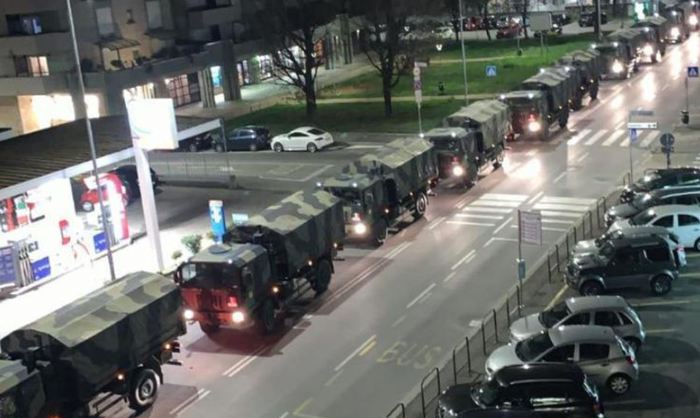
Depends how you look at it.

Take this picture for example

4a5b5c1e80909b151ce8f6b55deb4f0b.JPG


Those tanks are heading out the town of Bergamo (most affected by contagion). They aren't carrying soldiers, nor supplies, but coffins. Hundreds of coffins of people died in a matter of days, being carried away to other town cause there was not enough space in the municipal cemetery.
 
I didn’t mean to downplay their role. Just meaning we don’t need to leave sick people dying in the hallways! They could have different levels of expertise in order to maximize the effectiveness. That’s all.

Everyone step it up. Nurses could be better used doing almost doctor level roles.

In a time of need you do whatever is needed.

This is absolutely true.

As a nation we should look at closing most outpatient/non-critical facilities and certain modalities, the utilizing those professionals to contribute to overcoming this situation.
 
Depends how you look at it.

Take this picture for example

4a5b5c1e80909b151ce8f6b55deb4f0b.JPG


Those tanks are heading out the town of Bergamo (most affected by contagion). They aren't carrying soldiers, nor supplies, but coffins. Hundreds of coffins of people died in a matter of days, being carried away to other town cause there was not enough space in the municipal cemetery.
Thank you for proving my point

why didn’t you zero in on an image from South Korea? o_O
 
Depends how you look at it.

Take this picture for example

4a5b5c1e80909b151ce8f6b55deb4f0b.JPG


Those tanks are heading out the town of Bergamo (most affected by contagion). They aren't carrying soldiers, nor supplies, but coffins. Hundreds of coffins of people died in a matter of days, being carried away to other town cause there was not enough space in the municipal cemetery.

All lined up at once for maximum effect. That's exactly what I would do if I wanted to instill fear in people.
 
Prob 1k affected in my state and I think 3 deaths.......Not warranted
 
Numbers like that frighten me, personally. I'm not super old or sick, but yes, not exactly ok with what's happening globally right now

Im not scared of it either but the idea of spending months inside does really bother me.

Reason why death toll in Italy is higher than China or anywhere else for the moment lies in the fact we got a much older population on average thanks to modern medicine, diet and genetics factors. Most of the deaths are elderly with multiple diseases, but it can kill almost anyone (kids are surprisingly spared, even with immune insufficiency).

I'm 30, I'll probably do well if infected (other than long quarantine), but there's still a chance of 0.5% my lungs get filled with fluid so bad that I die.
 
Stanford Professor: Data Indicates We’re Severely Overreacting To Coronavirus

By James Barrett
DailyWire.com

In an analysis published Tuesday, Stanford’s John P.A. Ioannidis — co-director of the university’s Meta-Research Innovation Center and professor of medicine, biomedical data science, statistics, and epidemiology and population health — suggests that the response to the coronavirus pandemic may be “a fiasco in the making” because we are making seismic decisions based on “utterly unreliable” data. The data we do have, Ioannidis explains, indicates that we are likely severely overreacting.

“The current coronavirus disease, Covid-19, has been called a once-in-a-century pandemic. But it may also be a once-in-a-century evidence fiasco,” Ioannidis writes in an opinion piece published by STAT on Tuesday.

“Draconian countermeasures have been adopted in many countries. If the pandemic dissipates — either on its own or because of these measures — short-term extreme social distancing and lockdowns may be bearable,” the statistician writes. “How long, though, should measures like these be continued if the pandemic churns across the globe unabated? How can policymakers tell if they are doing more good than harm?”

The woefully inadequate data we have so far, the meta-research specialist argues, indicates that the extreme measures taken by many countries are likely way out of line and may result in ultimately unnecessary and catastrophic consequences. Due to extremely limited testing, we are likely missing “the vast majority of infections” from COVID-19, he states, thus making reported fatality rates from the World Health Organization “meaningless.”

“Patients who have been tested for SARS-CoV-2 are disproportionately those with severe symptoms and bad outcomes,” Ioannidis explains. With very limited testing in many health systems, he suggests, that “selection bias” may only get worse going forward.

Ioannidis then zooms in on the “one situation” where “an entire, closed population was tested”: the Diamond Princess cruise ship’s quarantined passengers. While the fatality rate was 1.0%, he points out, the population was largely elderly, the most at-risk demographic. Projected out onto the age structure of the U.S. population, he calculates, the death rate is more like 0.125%, with a range of 0.025% to 0.625% based on the sample size:

Projecting the Diamond Princess mortality rate onto the age structure of the U.S. population, the death rate among people infected with Covid-19 would be 0.125%. But since this estimate is based on extremely thin data — there were just seven deaths among the 700 infected passengers and crew — the real death rate could stretch from five times lower (0.025%) to five times higher (0.625%). It is also possible that some of the passengers who were infected might die later, and that tourists may have different frequencies of chronic diseases — a risk factor for worse outcomes with SARS-CoV-2 infection — than the general population. Adding these extra sources of uncertainty, reasonable estimates for the case fatality ratio in the general U.S. population vary from 0.05% to 1%.

“That huge range markedly affects how severe the pandemic is and what should be done,” Ioannidis stresses. “A population-wide case fatality rate of 0.05% is lower than seasonal influenza. If that is the true rate, locking down the world with potentially tremendous social and financial consequences may be totally irrational. It’s like an elephant being attacked by a house cat. Frustrated and trying to avoid the cat, the elephant accidentally jumps off a cliff and dies.”

For those who argue that the high fatality rate among elderly people indicates that the death rate cannot be as low as 0.05%, the professor notes that “even some so-called mild or common-cold-type coronaviruses that have been known for decades can have case fatality rates as high as 8% when they infect elderly people in nursing homes.” (Read the full opinion piece here.)
 
Back
Top

