Pitavastatin and Lp(a)

RockyP

Member
First and foremost, a massive thank you to @Ghoul for brining lots of information about Pitavastatin to the community. The references I will share here are from him, nothing is original thought on my part, just sharing my experience. If you search Pitavastatin you will find many of his other posts linking very important data such as Pita's uniquely minimal impact on insulin sensitivity over time compared to other statins, as well as potential for increasing the efficacy of the existing HDL particles.

The point of this post however is uniquely related to Pita's impact on Lp(a), which carries independent risk for heart disease.

On 5 mg rosuvastatin, my Lp(a) was mid 30's, still well below the cutoff low-risk range of 75 and under.

After switching to Pitavastatin 2 mg (and while simultaneously increasing total androgen load from 300 to 520 mg per week to include 285 mg Primo), my Lp(a) dropped 65% down to 12. This is noteworthy because most statins tend to increase this value, while Pita is noted to uniquely be neutral or even lowering it slightly. My results seem to be atypical, though this is nevertheless important for anyone out there with elevated levels of Lp(a).

Thank you again to @Ghoul for these most recent references:


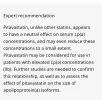
1758316305446.webp
 
I'm surprised this isn't more widely known...my impression is they are still working on drugs that may help target Lp(a) but that statins did not accomplish this. Interesting.

@egruberman was our lipid guru previously though I haven't seen him around in a while.

Guess I'll have to pester my doc for a pitavastatin script eventually.
 
I'm surprised this isn't more widely known...my impression is they are still working on drugs that may help target Lp(a) but that statins did not accomplish this. Interesting.

@egruberman was our lipid guru previously though I haven't seen him around in a while.

Guess I'll have to pester my doc for a pitavastatin script eventually.

It's a relatively minor effect, the Lp(a) targeting drugs will reduce it by 90%.

The thing that surprised me the most about this is that other statins can RAISE Lp(a) by 20%!

Pita is uniquely either Lp(a) neutral, or drops it up to around 10%. So when switching from another statin, the combination of stopping the increase and gaining a small decrease can put a nice dent in Lp(a).
 
First and foremost, a massive thank you to @Ghoul for brining lots of information about Pitavastatin to the community. The references I will share here are from him, nothing is original thought on my part, just sharing my experience. If you search Pitavastatin you will find many of his other posts linking very important data such as Pita's uniquely minimal impact on insulin sensitivity over time compared to other statins, as well as potential for increasing the efficacy of the existing HDL particles.

The point of this post however is uniquely related to Pita's impact on Lp(a), which carries independent risk for heart disease.

On 5 mg rosuvastatin, my Lp(a) was mid 30's, still well below the cutoff low-risk range of 75 and under.

After switching to Pitavastatin 2 mg (and while simultaneously increasing total androgen load from 300 to 520 mg per week to include 285 mg Primo), my Lp(a) dropped 65% down to 12. This is noteworthy because most statins tend to increase this value, while Pita is noted to uniquely be neutral or even lowering it slightly. My results seem to be atypical, though this is nevertheless important for anyone out there with elevated levels of Lp(a).

Thank you again to @Ghoul for these most recent references:


View attachment 348988
Pita is a wonder statin, and to have your numbers drop like that with extra androgenic load is impressive! Did your Lp(a) go up with your previous statin? This was recently discussed this on the Peter Attia sub and nobody was sure if switching to Pita from another statin would reduce levels possibly close to original baseline, so I’m curious.
I'm surprised this isn't more widely known...my impression is they are still working on drugs that may help target Lp(a) but that statins did not accomplish this. Interesting.

@egruberman was our lipid guru previously though I haven't seen him around in a while.

Guess I'll have to pester my doc for a pitavastatin script eventually.
You can use telehealth if that’s an option. It’s what I did for my husband, because I knew he wasn’t going to argue with a dr. I went through Push Health, not the cheapest, but they didn’t require an actual visit and sent a 90 day rx to a local pharmacy. You can request dose and how many days. Now that he’s established and doing well on it, only an idiot dr would try to force him to a more familiar option.
 
Pita is a wonder statin, and to have your numbers drop like that with extra androgenic load is impressive! Did your Lp(a) go up with your previous statin? This was recently discussed this on the Peter Attia sub and nobody was sure if switching to Pita from another statin would reduce levels possibly close to original baseline, so I’m curious.

You can use telehealth if that’s an option. It’s what I did for my husband, because I knew he wasn’t going to argue with a dr. I went through Push Health, not the cheapest, but they didn’t require an actual visit and sent a 90 day rx to a local pharmacy. You can request dose and how many days. Now that he’s established and doing well on it, only an idiot dr would try to force him to a more familiar option.
I don’t think i had baseline Lp(a) prior to starting rosuva. Just the normal lipid panel. Very pleased with the results.
 
@egruberman was our lipid guru previously though I haven't seen him around in a while.

@Ghoul's comments reflect my own. Pitavastatin has shown a minor effect. My opinion is that mitigation of Lp(a) is a binary thing. If it's elevated, pursue targeted treatment with a PCSK9i.

The benefit in the position paper above is largely theoretical. The effect is not statistically significant. Generally, I prefer Rosuvastatin for it's efficacy, but Pitavastatin has a few benefits (raises HDL, doesn't impair metabolic health) at lower doses and when used in poly-pharma approaches.
 
Last edited:
@Ghoul's comments reflect my own. Pitavastatin has shown a minor effect. My opinion is that mitigation of Lp(a) is a binary thing. If it's elevated, pursue targeted treatment with a PCSK9i.

The benefit in the position paper above is largely theoretical. The effect is not statistically significant. Generally, I prefer Rosuvastatin for it's efficacy, but Pitavastatin has a few benefits (raises HDL, doesn't impair metabolic health) at lower doses and when used in poly-pharma approaches.
I wish these Chinese vendors sold these PCSK9i drugs. Curious they don't, but we have Reta in great abundance.
 
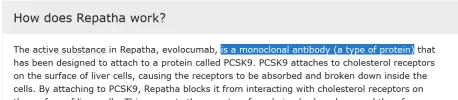
PCSK9i are antibodies..personally i wouldn't take them from any UGL even if it was available..how to get it tested..is another issue..
Wikipedia says it is an enzyme. A protein.

Grok says the molar weight is 3 times rHGH.
 
I wish these Chinese vendors sold these PCSK9i drugs. Curious they don't, but we have Reta in great abundance.

The manufacturing technology required makes rHGH look like instant mashed potatoes by comparison.

No one even seems to even be attempting to copy the current PCSK9 drugs because of the manufacturing complexity,

Repatha has come way down in price since it was $14,000. List price is around $7,000 / yr. Unlike other drugs, it's not cheaper in other countries. Pretty much $7,000 / yr everywhere.

Easiest way to get it is to just find out what the preauthorization requirements are for your insurer, and go through the steps to meet them. It's not very difficult if you have high cholesterol.

Usually it's something like this;

High Cholesterol

Try a statin to bring LDL into range.
"oh my muscles hurt"

Try another statin to bring it into range.
"oh my muscles hurt"

Lower the dose.
"They still hurt "

Give them ezetimebe and bempadoic acid (no muscle sides possible with these). Do blood test six weeks later. Did they bring LDL into range?

No. (because you didn't take them shhhh).

Authorize Repatha prescription.
 
Last edited:
The manufacturing technology required makes rHGH look like instant mashed potatoes by comparison.

No one even seems to even be attempting to copy the current PCSK9 drugs because of the manufacturing complexity,

Repatha has come way down in price since it was $14,000. List price is around $7,000 / yr. Unlike other drugs, it's not cheaper in other countries. Pretty much $7,000 / yr everywhere.

Easiest way to get it is to just find out what the preauthorization requirements are for your insurer, and go through the steps to meet them. It's not very difficult if you have high cholesterol.

Usually it's something like this;

High Cholesterol

Try a statin to bring LDL into range.
"oh my muscles hurt"

Try another statin to bring it into range.
"oh my muscles hurt"

Lower the dose.
"They still hurt "

Give them ezetimebe and bempadoic acid (no muscle sides possible with these). Do blood test six weeks later. Did they bring LDL into range?

No. (because you didn't take them shhhh).

Authorize Repatha prescription.

Thanks.

Are you doing this through a GP?
 
Repatha (evolocumab) is, as you say, impossible to replicate in China. Inclisiran, on the other hand, is a siRNA. I was surprised to learn that folks in China have a very mature siRNA manufacturing capability.
China has plenty of monoclonal antibody manufacturing capability and they've got lots of their own mabs out on the market and in development.


I doubt any of that capacity is available for cloning stuff to sell on the cheap to Americans, though.
 
Back
Top