Climate Change


Worse yet, Bast and Spencer also referenced the Oregon Petition, which can be signed by anyone with just about any college science degree, and which has included “signatures” from fictional characters and Spice Girls.

Over 31,000 scientists signed the OISM Petition Project

The 30,000 scientists and science graduates listed on the OISM petition represent a tiny fraction (0.3%) of all science graduates. More importantly, the OISM list only contains 39 scientists who specialise in climate science.


The Global Warming Petition Project, also known as the Oregon Petition - Oregon Petition - Wikipedia, the free encyclopedia

In 2001, Scientific American took a random sample "of 30 of the 1,400 signatories claiming to hold a Ph.D. in a climate-related science."

Of the 26 we were able to identify in various databases, 11 said they still agreed with the petition —- one was an active climate researcher, two others had relevant expertise, and eight signed based on an informal evaluation. Six said they would not sign the petition today, three did not remember any such petition, one had died, and five did not answer repeated messages. Crudely extrapolating, the petition supporters include a core of about 200 climate researchers – a respectable number, though rather a small fraction of the climatological community.
 

Pimm SL, Jenkins CN, Abell R, et al. The biodiversity of species and their rates of extinction, distribution, and protection. Science 2014;344(6187). The biodiversity of species and their rates of extinction, distribution, and protection

Recent studies clarify where the most vulnerable species live, where and how humanity changes the planet, and how this drives extinctions. We assess key statistics about species, their distribution, and their status. Most are undescribed. Those we know best have large geographical ranges and are often common within them. Most known species have small ranges. The numbers of small-ranged species are increasing quickly, even in well-known taxa. They are geographically concentrated and are disproportionately likely to be threatened or already extinct. Current rates of extinction are about 1000 times the likely background rate of extinction. Future rates depend on many factors and are poised to increase. Although there has been rapid progress in developing protected areas, such efforts are not ecologically representative, nor do they optimally protect biodiversity.
 
Boehner Says He's 'Not Qualified' To Talk About Climate Science. Here's How Scientists Responded. | ThinkProgress

When House Speaker John Boehner told a group of reporters on Thursday that he would not discuss climate change on the grounds that he, himself, was not a scientist, he joined the ranks of other prominent Republican politicians who have refused to talk about the issue on the same grounds.

“I’m not a scientist,” said Florida Governor Rick Scott last week, when asked if he thought man-made climate change was affecting the weather. “I’m not a scientist,” said Sen. Marco Rubio (R-FL) in 2009, his first in a long line of statement denying climate change. “I’m not sure, I’m not a scientist,” said Rep. Michael Grimm (R-NY) said of climate change in 2010 (Grimm changed his mind on the issue this past April).

The tactic is an interesting (and seemingly effective) way for politicians to avoid acknowledging or denying the reality of climate change while still getting to fight against any regulation to stop it. But actual climate scientists say the tactic is irresponsible, dangerous, and ignores the fact that credible scientific information is readily available.

“Personally, I don’t think it proper for any American to use that argument,” said Donald. J Wuebbles, a distinguished professor of atmospheric sciences and coordinating lead author for the U.N. Intergovernmental Panel on Climate Change’s 2013 assessment report.

Wuebbles, who was also a lead author on the recently released National Climate Assessment, said that report was written by scientists and other experts specifically so that members of Congress could understand climate change and how it affects the country. With that report available, he said, climate change should be “readily understood by any policymaker.”

“The assessment represents the latest understanding of the science and is the most comprehensive report ever prepared for the American people on climate change,” Wuebbles said. “The report itself was done for Congress under a law passed by Congress.”

Michael Mann, director of the Earth System Science Center at Pennsylvania State University, went even further, calling Boehner’s comments a “pathetic dodge” that doesn’t make sense in the context of political decision-making.

“What if we asked ‘Senator: do you advocate drinking toxic sludge?’ or ‘Senator: is jumping off the north rim of the Grand Canyon safe?’ or ‘Senator: should I place my head in the jaws of this lion?’,” Mann said. “Would the response still be be ‘I don’t know, I’m not a scientist’?”

Mann noted that politicians have no qualms making statements about other political issues — abortion and public health, for example — because they are supposed to use established science to inform their decisions. Climate change, though, is a different story, he said.

“Why is it somehow different when it comes to the climate change threat and the need to regulate carbon emissions — something opposed by fossil fuel interests like the Koch Brothers who fund so many of these politicians campaigns — why is it in this case different?” he said. “That, of course, is a rhetorical question.”
 
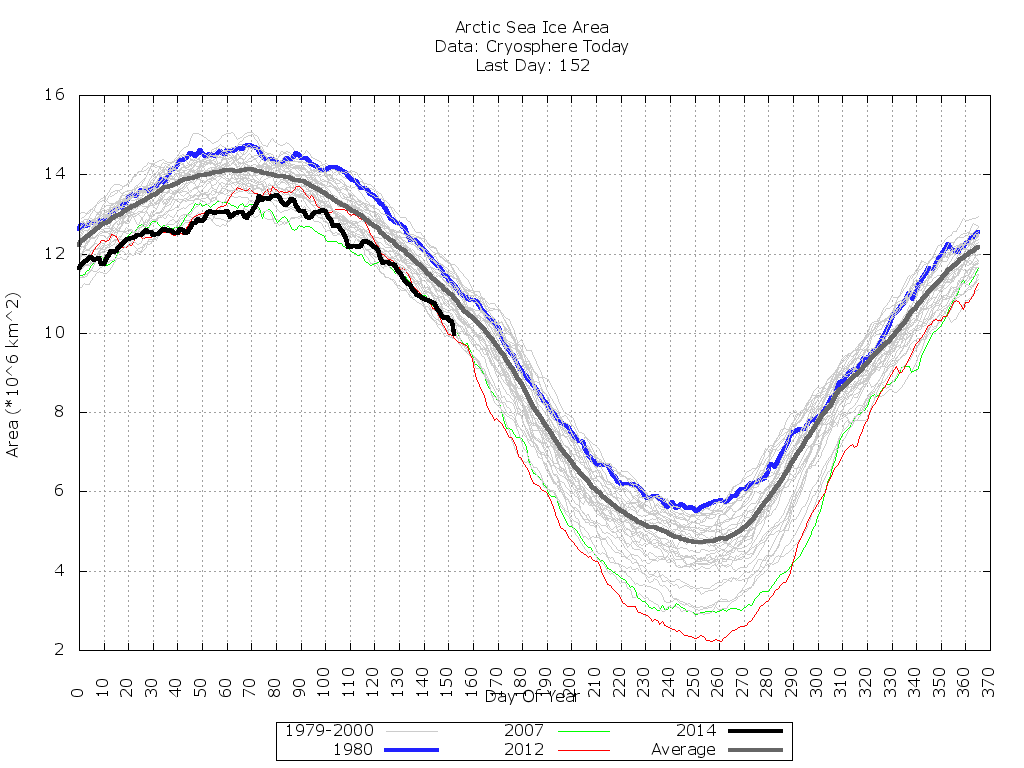
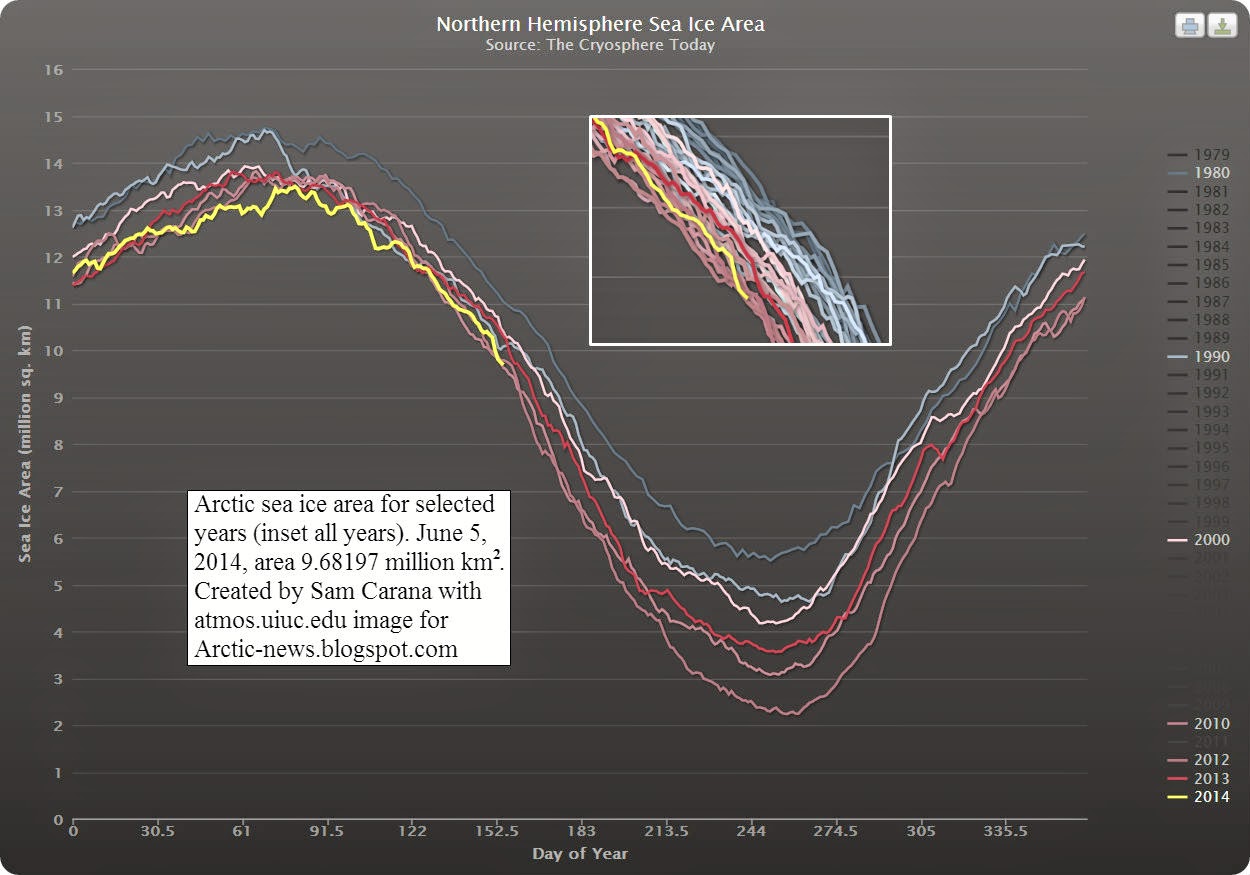
Arctic Sea Ice Loss Goes Vertical: Area the Size of Nevada Gone in One Day
http://robertscribbler.wordpress.co...ical-area-the-size-of-nevada-gone-in-one-day/


sea-ice-area-goes-vertical.png

 
Hoekstra AY, Wiedmann TO. Humanity’s unsustainable environmental footprint. Science 2014;344(6188):1114-7. http://www.sciencemag.org/content/344/6188/1114.abstract

Within the context of Earth’s limited natural resources and assimilation capacity, the current environmental footprint of humankind is not sustainable. Assessing land, water, energy, material, and other footprints along supply chains is paramount in understanding the sustainability, efficiency, and equity of resource use from the perspective of producers, consumers, and government.

We review current footprints and relate those to maximum sustainable levels, highlighting the need for future work on combining footprints, assessing trade-offs between them, improving computational techniques, estimating maximum sustainable footprint levels, and benchmarking efficiency of resource use.

Ultimately, major transformative changes in the global economy are necessary to reduce humanity’s environmental footprint to sustainable levels.


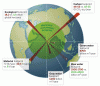
Estimated Global Footprints Versus Their Suggested Maximum Sustainable Level

The inner green shaded circle represents the maximum sustainable footprint. Red bars represent estimates of the current level of each global footprint.

The Ecological Footprint (EF) of 18.2 billion global hectares (in 2008) exceeds the maximum sustainable EF of 12 billion global hectares by about 50%.

The green Water Footprint (WF) has been estimated at 6700 billion m3/year (average for 1996 to 2005); a reference level is not yet available.

Blue WF estimates vary from 1000 to 1700 billion m3/year and should be compared to the global maximum sustainable blue WF of 1100 to 4500 billion m3/year; data on maximum blue WFs per river basin and month are provided by Hoekstra et al. Global monthly water scarcity: Blue water footprints versus blue water availability. PLOS ONE 2012;7:e32688. http://www.plosone.org/article/info:doi/10.1371/journal.pone.0032688

The gray WF has been conservatively estimated at 1400 billion m3/year (average for 1996 to 2005); in two-thirds of the world’s river basins, the pollution assimilation capacity for nitrogen and phosphorus has been fully consumed.

The Carbon or Climate Footprint (CF) of 46 to 55 Gt CO2-equiv./year (in 2010) exceeds by more than a factor of 2 the estimated maximum sustainable CF of 18 to 25 Gt CO2-equiv./year, which must be achieved by 2050 if the maximum 2°C global warming target is to be met.

The Material Footprint (MF) has been estimated at 70 Gt/year [10.5 ton/cap in 2008], and a reduction to 8 ton/cap has been suggested as a sustainable level.

estimated-global-footprints-gif.14406
 

Attachments

  • Estimated-global-footprints.gif
    Estimated-global-footprints.gif
    437.2 KB · Views: 29
Why it's still not "game over" for global warming
http://www.vox.com/2014/6/6/5786318/it-doesnt-make-sense-to-say-weve-failed-at-global-warming

If you haven't read it yet, I'd recommend my colleague Ezra Klein's piece on "7 reasons America will fail at global warming." It's an insightful look at all the ways the US political system is poorly suited to dealing with a massive, long-range problem like climate change

But the underlying premise of the article is a little ill-defined. Climate change isn't an issue with a single point of "success" or a single point of "failure."

What we're facing are (literally) degrees of change. The world will get hotter as we load more greenhouse gases into the atmosphere. And the higher the temperatures, the greater the risks for human civilization. A 2°C rise in global average temperatures would be disruptive. A 4°C rise would be much more disruptive. And 6°C rise would be far, far more drastic still.

At no point here does it make sense to say that we've "failed" once and for all, or that it's (to use Ezra's phrase) "game over." Things can always get worse. And it's still very unclear where we'll end up on that spectrum.
 
Theme for Niels Bugge Cartoon Award in 2014 is OCEANS ARE IN OUR HANDS
http://www.nielsbuggeaward.org/gallery.php

Human being, as all life on earth, came from the stars and landed through the ocean. Ocean is our very first foster mother, much more than the land where we, now, cut trees and plant transgenic corn. But, as we maltreat land, we have been maltreating our spring of life and now oceans are quite ill because of our activities: less fish but more plastic, less pure water but more oil, less coral but more garbage.

That’s why today, not tomorrow, we must do our best to save oceans of ourselves if we still want to have a future on this planet. So, to help people to get more conscience of that, we propose to our friends cartoonists all over the world to participate in our contest on the theme « Oceans ». Obviously, we will do our best to diffuse this exhibition as large as possible.

So, please be great, be free, be creatives and be fun as usual and send us one or two cartoons without words about this very important subject for life on earth: Oceans. http://www.nielsbuggeaward.org/catalogue2014.pdf

slide_352590_3821132_free.jpg
 
Last edited:
Between the Lines: It’s not censorship by ignoring those denying climate change
http://azdailysun.com/news/opinion/...cle_38f02d94-eee1-11e3-8b0b-0019bb2963f4.html

Does denying a seat at the journalistic table to climate change deniers amount to censorship and political correctness, in the sense that unpopular opinions are being silenced? As I am wont to tell some letter writers, you are entitled to your opinions, but not your facts. Let’s save our breath and get on with saving the planet.
 
Climate change could lead to China-India water conflict
http://www.rtcc.org/2014/06/11/climate-change-could-lead-to-china-india-water-conflict/

Melting Himalayan glaciers and erratic rainfall could exacerbate tensions between central Asian countries later this century, warn defence analysts in a http://gmaccc.org/wp-content/uploads/2014/06/AR5_Summary_Defence.pdf.

They say droughts or extreme rains linked to climate change could place growing populations in China, India and Pakistan under increased stress.

Based on latest research by the UN’s http://www.rtcc.org/tag/ipcc/ (IPCC), the study has been published by the Global Military Advisory Council on Climate Change and Cambridge University.

“There are concerns that tensions will increase due to climate driven water variability in the Trans-boundary drainage systems linked to the vast Tibetan plateau in central Asia, where rivers supply more than one billion people with water,” it says.

Around 40% of the world’s population rely on water from the plateau for survival. It is the source of some of the world’s great rivers, including the Indus, Ganges, Irrawaddy, Mekong and Yangtze.
 
A Plan B for Climate Agreements
U.N. negotiations are going nowhere, and greenhouse-gas emissions are soaring. It’s time to move on.
http://www.technologyreview.com/review/528106/a-plan-b-for-climate-agreements/

In 2007, just before he accepted the Nobel Prize on behalf of the U.N.’s Intergovernmental Panel on Climate Change (IPCC), Rajendra Pachauri, the organization’s leader, declared that the world was running out of time to prevent catastrophic global warming. “If there’s no action before 2012, that’s too late,” Pachauri told the New York Times. “What we do in the next two or three years will determine our future. This is the defining moment.”

Even now, Pachauri and some other IPCC leaders remain publicly optimistic, saying it’s still possible to avoid catastrophic climate change if we act “very soon.” But delve into the new IPCC report itself and you’ll find a much less hopeful picture.
 

Sponsors

Back
Top