

Climate Change

Saudi Arabia sees end of oil age on the horizon
http://reneweconomy.com.au/2015/saudi-arabia-sees-end-oil-age-horizon-11769

In 2000, Sheikh Ahmed Zaki Yamani, former oil minister of Saudi Arabia, gave an interview in which he said:

“Thirty years from now there will be a huge amount of oil – and no buyers. Oil will be left in the ground. The Stone Age came to an end, not because we had a lack of stones, and the oil age will come to an end not because we have a lack of oil.”
 
The Pentagon & Climate Change: How Deniers Put National Security at Risk
http://www.rollingstone.com/politics/news/the-pentagon-climate-change-how-climate-deniers-put-national-security-at-risk-20150212
 
Iconic graph at center of climate debate
http://phys.org/news/2015-02-iconic-graph-center-climate-debate.html

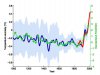
Mann and his coauthors, Raymond S. Bradley and Malcolm K Hughes, created the graph for a paper, "Northern hemisphere temperatures during the past millennium: Inferences, uncertainties, and limitations" which appeared in Geophysical Research Letters in 1999. In 2001, the Intergovernmental Panel on Climate Change published a version of the graph in its report, pushing the hockey stick depiction of temperature trends to the forefront of the climate change discussion.

hockeystickg.jpg
 
Cook BI, Ault TR, Smerdon JE. Unprecedented 21st century drought risk in the American Southwest and Central Plains. Science Advances. 2015;1(1). http://advances.sciencemag.org/content/1/1/e1400082

In the Southwest and Central Plains of Western North America, climate change is expected to increase drought severity in the coming decades.

These regions nevertheless experienced extended Medieval-era droughts that were more persistent than any historical event, providing crucial targets in the paleoclimate record for benchmarking the severity of future drought risks.

We use an empirical drought reconstruction and three soil moisture metrics from 17 state-of-the-art general circulation models to show that these models project significantly drier conditions in the later half of the 21st century compared to the 20th century and earlier paleoclimatic intervals.

This desiccation is consistent across most of the models and moisture balance variables, indicating a coherent and robust drying response to warming despite the diversity of models and metrics analyzed.

Notably, future drought risk will likely exceed even the driest centuries of the Medieval Climate Anomaly (1100–1300 CE) in both moderate (RCP 4.5) and high (RCP 8.5) future emissions scenarios, leading to unprecedented drought conditions during the last millennium.
 
Thanks Dr. Evil! Fossil Fuel Propaganda Misfire Goes Viral
http://climatecrocks.com/2015/02/12/thanks-dr-evil-fossil-fuel-propaganda-misfire-goes-viral/

 
Jury in on climate change, so stop using arguments of convenience and listen to experts
http://www.smh.com.au/comment/jury-...ce-and-listen-to-experts-20150215-13et0j.html

As a Nobel Prize winner, I travel the world meeting all kinds of people.

Most of the policy, business and political leaders I meet immediately apologise for their lack of knowledge of science.

Except when it comes to climate science. Whenever this subject comes up, it never ceases to amaze me how each person I meet suddenly becomes an expert.

Facts are then bandied to fit an argument for or against climate change, and on all sides, misconceptions abound.

...

The body of evidence on climate change is not contained in one paper, one set of observations, or by one person – rather it encompasses thousands of people's ideas and observations.

This is why it is so important for the country's pre-eminent scientific body to write this document, synthesising all of this disparate information into a coherent assessment of the science.

It's much like getting a medical diagnosis from a panel of the country's best doctors. And while some might search around for a different opinion until they get the answer they want to hear, that is not the best way to treat the underlying problem.

Having this information in one place means that the nation's decision-makers have the best scientific opinion on the subject, so that they can stop arguing about the science, and instead focus on their job, which is figuring out the most appropriate policy response to climate change, given the best available knowledge.

The evidence is clear: human activities are changing the Earth's climate, and what we do now and into the future will strongly influence the world's weather in the decades and centuries to come.
 
The Arctic Ocean - Awakening
http://www.economist.com/news/scien...t-sea-stirring-consequences-are-both-good-and


The Arctic, sparsely populated and rarely visited by outsiders, is easily forgotten by those at lower latitudes. But it is where the impact of a warming climate is most vividly seen. A 1°C rise in temperatures at the equator—from, say, 25°C to 26°C—will have effects, but does not change much. A rise from 0°C to 1°C melts the ice. That changes everything, from local biology to global meteorology.

And the Arctic is melting fast.
 
Gramling C. Arctic impact. Science. 2015;347(6224):818-21. http://www.sciencemag.org/content/347/6224/818.full

Against the backdrop of "Snowmageddon" and other powerful winter storms that have blasted the United States, Europe, and Asia in the past few years, a different kind of tempest has been swirling within the Arctic science community. Its core is a flurry of recent research proposing that such extreme weather events in the midlatitudes are linked through the atmosphere with the effects of rapid climate change in the Arctic, such as dwindling sea ice. The idea has galvanized the public and even caught the attention of the White House. But some Arctic researchers say the data don't support it—or that the jury is at least still out. Now, scientists are tackling the issue in earnest, and an increasing number of conferences and workshops are bringing together scientists with a range of viewpoints on this issue, in hopes that a coordinated effort will measure the reach of the north.


Gramling C. The Siberian snow connection. Science. 2015;347(6224):821. http://www.sciencemag.org/content/347/6224/821.full

Climate scientist Judah Cohen envisions a series of causal links between how much snow falls over Siberia each October and weather patterns in the midlatitudes. Siberian snow cover, he says, has been increasing over the past 2 decades. His "six-step" cycle, which progresses from snow cover in Siberia to the breakdown of the stratospheric polar vortex and a more meandering jet stream, also has room for melting sea ice, he says—and he notes that he has successfully used this series of links to predict changes in the polar vortex, including the powerful winter storms of early 2015 in the northeastern United States. But not everyone concurs that snow cover is the silver bullet—or with Cohen's observation that snow cover over Siberia has been on the rise.
 

Attachments

Deeper Ties to Corporate Cash for a Doubtful Climate Scientist
http://www.nytimes.com/2015/02/22/u...-climate-change-researcher-Wei-Hock-Soon.html

For years, politicians wanting to block legislation on climate change have bolstered their arguments by pointing to the work of a handful of scientists who claim that greenhouse gases pose little risk to humanity.

One of the names they invoke most often is Wei-Hock Soon, known as Willie, a scientist at the Harvard-Smithsonian Center for Astrophysics who claims that variations in the sun’s energy can largely explain recent global warming. He has often appeared on conservative news programs, testified before Congress and in state capitals, and starred at conferences of people who deny the risks of global warming.

But newly released documents show the extent to which Dr. Soon’s work has been tied to funding he received from corporate interests.

He has accepted more than $1.2 million in money from the fossil-fuel industry over the last decade while failing to disclose that conflict of interest in most of his scientific papers. At least 11 papers he has published since 2008 omitted such a disclosure, and in at least eight of those cases, he appears to have violated ethical guidelines of the journals that published his work.

 
Divestment: How BB&N can take a stand against
http://www.bbnpov.com/?p=1818

The push for fossil fuel divestment is primarily a moral battle. Universities and organizations would like to believe that they can remain neutral while owning millions of shares in fossil fuel corporations, but holding on to those stocks is choosing an ethical side. Any organization or person that has the ability and the awareness to act and chooses not to is personally accountable for their effect on climate change.
 
THE YEAR THE DAM OF DENIAL BREAKS – READY FOR THE FLOOD?
http://paulgilding.com/2015/02/23/the-year-the-dam-of-denial-breaks-ready-for-the-flood/

This is the year the “dam of denial” will break and the momentum for climate action will become an unstoppable flood. It will be messy, confusing and endlessly debated but with historical hindsight, 2015 will be the year. The year the world turned, primarily because the market woke up to the economic threat posed by climate change and the economic opportunity in the inevitable decline of fossil fuels. That shift will in turn unlock government policy and public opinion because the previous resistance to action argued on economic grounds, will reverse to favour action on economic grounds.
 
Back
Top