Climate Change

The state of California has a globally important economy and a population exceeding 38 million. The state relies on its forested watersheds to support numerous services, such as water provisioning, carbon storage, timber products, ecotourism, and recreation. However, secular changes in air temperature, combined with periodic and prolonged drought, pose a compounding challenge to forest health.

Here we use new remote-sensing and modeling techniques to assess changes in the canopy water content of California’s forests from 2011 to 2015. Our resulting maps of progressive canopy water stress identify at-risk forest landscapes and watersheds at fine resolution, and offer geographically explicit information to support innovative forest management and policies in preparation for climate change.

Asner GP, Brodrick PG, Anderson CB, Vaughn N, Knapp DE, Martin RE. Progressive forest canopy water loss during the 2012-2015 California drought. Proceedings of the National Academy of Sciences. Progressive forest canopy water loss during the 2012–2015 California drought

The 2012–2015 drought has left California with severely reduced snowpack, soil moisture, ground water, and reservoir stocks, but the impact of this estimated millennial-scale event on forest health is unknown. We used airborne laser-guided spectroscopy and satellite-based models to assess losses in canopy water content of California’s forests between 2011 and 2015. Approximately 10.6 million ha of forest containing up to 888 million large trees experienced measurable loss in canopy water content during this drought period. Severe canopy water losses of greater than 30% occurred over 1 million ha, affecting up to 58 million large trees. Our measurements exclude forests affected by fire between 2011 and 2015. If drought conditions continue or reoccur, even with temporary reprieves such as El Niño, we predict substantial future forest change.
 
Waters CN, Zalasiewicz J, Summerhayes C, et al. The Anthropocene is functionally and stratigraphically distinct from the Holocene. Science 2016;351(6269). The Anthropocene is functionally and stratigraphically distinct from the Holocene

Human activity is leaving a pervasive and persistent signature on Earth.

Vigorous debate continues about whether this warrants recognition as a new geologic time unit known as the Anthropocene.

We review anthropogenic markers of functional changes in the Earth system through the stratigraphic record.

The appearance of manufactured materials in sediments, including aluminum, plastics, and concrete, coincides with global spikes in fallout radionuclides and particulates from fossil fuel combustion.

Carbon, nitrogen, and phosphorus cycles have been substantially modified over the past century.

Rates of sea-level rise and the extent of human perturbation of the climate system exceed Late Holocene changes.

Biotic changes include species invasions worldwide and accelerating rates of extinction.

These combined signals render the Anthropocene stratigraphically distinct from the Holocene and earlier epochs.


Global Warming Over The Next Decade: Candidates take note.

The US is engaged in the laborious process of electing a new leader, who will likely be President for 8 years. Climate change has finally become an issue in US electoral politics. The climate policies of the next US President, and the Congress, will have a direct impact on the climate, because those policies will affect how much fossil carbon is put into the atmosphere over coming decades. So it is vital to consider what the climate may do during the next administration and the longer period that will include that administration’s effective legacy period, more or less the next decade starting now.

There is evidence that the ongoing warming of the planet’s surface is likely accelerate to in the near future. Recent decades have seen the Earth’s surface temperatures go up at a relatively slower than average rate compared to earlier decades. The best available science suggests that this rate is about to increase. We can expect a series of mostly record breaking months and years that will add up to an alarmingly warm planet.

...
 
COP21: Paris deal far too weak to prevent devastating climate change, academics warn
Paris climate deal 'far too weak to prevent devastating global warming'

The Paris Agreement to tackle global warming has actually dealt a major setback to the fight against climate change, leading academics will warn.

The deal may have been trumpeted by world leaders but is far too weak to do help prevent devastating harm to the Earth, it is claimed.

In a joint letter to The Independent, some of the world’s top climate scientists launch a blistering attack on the deal, warning that it offers “false hope” that could ultimately prove to be counterproductive in the battle to curb global warming.

The letter, which carries eleven signatures including professors Peter Wadhams and Stephen Salter, of the universities of Cambridge and Edinburgh, warns that the Paris Agreement is dangerously inadequate.

Because of the Paris failure, the academics say the world’s only chance of saving itself from rampant global warming is a giant push into controversial and largely untested geo-engineering technologies that seek to cool the planet by manipulating the Earth’s climate system.
 
Highlights
· Think-tank contrarian information has increased exponentially over 1998–2013.
· Sceptical themes are diverse and range from scientific integrity to policy.
· Science-related discourse has grown relative to policy in key sceptic organizations.
· Think-tank discourse is highly influenced by external factors.
· We generate longitudinal data on think-tank contrarian themes over a 16 year period.

Boussalis C, Coan TG. Text-mining the signals of climate change doubt. Global Environmental Change 2016;36:89-100. Text-mining the signals of climate change doubt

Climate scientists overwhelmingly agree that the Earth is getting warmer and that the rise in average global temperature is predominantly due to human activity. Yet a significant proportion of the American public, as well as a considerable number of legislators in the U.S. Congress, continue to reject the “consensus view.”

While the source of the disagreement is varied, one prominent explanation centres on the activities of a coordinated and well-funded countermovement of climate sceptics. This study contributes to the literature on organized climate scepticism by providing the first systematic overview of conservative think tank sceptical discourse in nearly 15 years.

Specifically, we
(1) compile the largest corpus of contrarian literature to date, collecting over 16,000 documents from 19 organizations over the period 1998–2013;
(2) introduce a methodology to measure key themes in the corpus which scales to the substantial increase in content generated by conservative think tanks over the past decade; and
(3) leverage this new methodology to shed light on the relative prevalence of science- and policy-related discussion among conservative think tanks.

We find little support for the claim that “the era of science denial is over”—instead, discussion of climate science has generally increased over the sample period.
 
Coal to remain king in China, despite ambitious climate policies

The success of the recent COP21 climate deal will depend on efforts by China to reduce its greenhouse gas emissions. The world’s largest consumer of coal and emitter of carbon dioxide (CO2) recently introduced a set of initiatives aimed at a “green energy” transformation. These measures, however, conflict with China’s more basic economic imperatives and the realities of the country’s energy sector. As Chinese leaders seek to protect their legitimacy, they will probably prioritize economic growth, even if that means shelving the most far-reaching energy reforms.

China is the single most influential player on global energy markets, and that will remain true for decades to come. The country is already the world’s largest consumer, producer and importer of coal. It uses nearly as much coal as the rest of the world combined and produces more energy than the entire oil output of the Middle East.

China has seen tremendous growth in energy production over the past 10 years, up to 80 percent of which was based on coal-fired power generation. Between 2000 and 2012, the country doubled its coal consumption. In 2005, Beijing set a limit of 2.6 billion tons on its planned coal output for 2010. The actual production figure for that year was more than 4 billion tons.

China is already the world’s largest consumer, producer and importer of coal. It uses nearly as much coal as the rest of the world combined and produces more energy than the entire oil output of the Middle East

Reliance on coal poses a direct challenge to climate protection. Coal burning produces 44 percent of all energy-related CO2 emissions – ahead of oil and natural gas with 35 and 20 percent, respectively. Environmental groups have increasingly criticized coal-based energy production as the major obstacle to keeping the average increase in global temperatures below 2 degrees Celsius. They are demanding an end to state support for coal projects. Several of China’s recent energy initiatives have fueled speculation that the country is already on the path toward phasing out coal. But a look at its economy and energy sector tells a different story.

‘War on pollution’

In 2006, China became the world’s largest air polluter, surpassing the United States. Its growing emissions have accelerated global warming and caused serious environmental problems domestically. According to British medical journal The Lancet, air pollution in China contributed to as many as 1.2 million premature deaths in 2010. Research from an institute under China’s Ministry of Environmental Protection found environmental degradation cost the country about 3.5 percent of its gross domestic product that same year. Coal alone is believed to account for at least 60 percent of airborne pollutant emissions.

Recent reforms, including huge new subsidies for domestic and foreign firms, have made China the world’s biggest investor in renewable energy. Nevertheless, it is doubtful that Beijing can meet its own targets for energy efficiency and reductions in greenhouse gas emissions by 2020. Despite the new energy efficiency and climate change mitigation policies, the country could still end up emitting 50 percent more greenhouse gases by 2030 than it does today.

Deteriorating air quality has jolted Chinese leaders into action. In the spring of 2014, China declared a “war on pollution” with plans to reduce CO2 emissions per capita by 40 to 45 percent from 2005 levels by 2020.

Ambitious targets

Still, China will remain the world’s largest greenhouse gas emitter through 2040. It already produced 60 percent more greenhouse gases than the United States in 2012 and may be producing at twice the U.S. rate by 2030. In 2014, China surpassed the European Union in CO2 emissions per capita – 7.2 tons versus 6.8 tons, respectively. Its total emissions that year outstripped those of the EU and U.S. combined. Greenhouse gases have increased by 40 percent over the past four years.

The air pollution crisis has stirred a national debate. Chinese leadership has become unnerved by expressions of public concern over the issue, especially after such high-profile events as the August 2015 warehouse explosion in the port of Tianjin (which spewed toxic chemicals into the air) and the release of the independent Chinese documentary “Under the Dome,” which highlights the health problems caused by air pollution.

In June 2015, China unveiled new pledges on climate change for the medium term (see fact box at right). Meeting the targets will require huge investments in new “green” infrastructure such as smart power grids, high-speed rail networks and charging systems for electric vehicles. The country has also announced that it will improve its methods for compiling environmental data. China lacks transparency in this area and still does not publish any official annual figures on greenhouse gas emissions.

Adopting new targets will be insufficient. China still has to cope with impotent regulators and ineffective national legislation. The central government must show the political will to ensure that the targets are implemented on the provincial and local levels. So far, Beijing has mostly failed at this task. Local administrations have not been held accountable for failure to obey the law. Financial sanctions have been limited.

Peak coal

China has officially declared that its coal consumption and CO2 emissions will peak in 2030. However, in a November 2014 joint announcement with the U.S. on climate change, Beijing said it would “make best efforts to peak early.” That statement, along with the new climate and renewable energy initiatives, have led some observers to speculate about whether the high point may come before the target date. Slowing economic growth, manufacturers beginning to relocate to other countries in the region, and low oil and gas prices have all been used as arguments that Chinese coal consumption and emissions may begin to decline after 2020.

But while growth in coal-fired power generation is set to slow from more than 11 percent in the decade prior to 2012 to just 0.6 percent between 2030 and 2040, China will still remain the world’s largest producer of coal-derived energy by volume, even as coal’s share in its total energy budget drops.

The capacity of China’s coal-fired plants is projected to increase by a further 420-600 gigawatts (GW) by 2040 – the total combined coal-fired generation capacity of the U.S., the EU and Japan. The country is building 50 coal gasification plants, which could produce an estimated 1.1 billion tons of CO2 per year. The plan will reduce air pollution in China’s largest cities, but mostly by shifting the emissions to other regions.

China is also seeking to reduce emissions and air pollution by increasing the efficiency of its coal-fired plants and installing modern scrubbers. Domestic generators have already reached 37 percent efficiency, higher than the global average of 33 percent.

King coal

While coal’s contribution to Chinese power output could drop to about 50 percent by 2040, it cannot be replaced by gas or renewables. For the medium term, it will remain the country’s most reliable fuel and the main guarantor of stable supply to the domestic power grid. The earliest realistic date for phasing out coal-fired output is probably around 2050.

In the years ahead, both demand and production may grow due to programs for converting coal into synthetic natural gas, coal liquefaction and production of coal-bed methane. While these technologies promise substantial reductions of CO2 emissions and air pollution, they bring a different set of environmental problems, including intensive use of energy and water.

Peak coal consumption will not necessarily coincide with a peak in greenhouse gas emissions, so long as Chinese demand for oil and gas continues to grow rapidly. And while renewable energy sources, natural gas and hydropower have seen impressive expansion, the new coal production capacity added to the grid in 2014 exceeded that of hydropower by more than 300 percent, wind energy by more than 400 percent and solar energy by 1,700 percent.

Scenarios

Against this background, three potential scenarios materialize. In the best-case scenario, China will be able to implement all of its new climate and energy policy initiatives and will hasten its green energy transformation. Combined with structural changes in the economy and slower growth, these initiatives would allow greenhouse gas emissions to peak by 2020. Coal consumption would rapidly decline thanks to energy-sector innovations such as cost-effective battery storage.

In a second, worst-case scenario, China will face increasing economic difficulties after 2020. Despite Beijing’s official pledges at the COP21 summit, the party’s Politburo will be unwilling to sacrifice economic growth simply to meet international climate obligations. As a transformation of the energy sector becomes too expensive to implement, the government will fall back on “cheap” coal.

The third, most probable scenario assumes only a very gradual decrease in coal consumption. The latest figures show coal-fired generating capacity undergoing a boom in the first half of 2015, as construction jumped 55 percent from a year earlier. Approved new capacity (some 200 GW) exceeded the total from the previous three years. According to the five-year plan for 2011-2015, about 860 million tons of new coal production capacity and 300 GW of new coal-fired power capacity have been brought on line. In 2015, Beijing approved some 155 new coal projects – equivalent to 15 percent of China’s total coal-fired power capacity, or almost 40 percent of the capacity of all operational coal plants in the U.S.

Since most of China’s coal power plants were built after 2000, they are relatively new and may continue to operate commercially for another 40 to 60 years. Taking this into account, almost all forecasts for China project that consumption of fossil fuels will keep growing until about 2040, when they will still generate most of the country’s electric power. Significantly reducing the reliance on coal would require a much more radical shakeup of electricity markets and a major boost in renewable energy investments.

It should also be remembered that, for China and its leaders, fighting climate change and curbing air pollution are not the same thing. The collision between the two goals is shown by the widespread installation of energy-intensive scrubbers, which improve air quality even as they increase carbon emissions. While Beijing has important domestic reasons for pollution abatement, especially in urban areas, it will not be so keen to make sacrifices on climate change, which has not yet become a real concern for the Chinese public.

 
A Terrifying Jump in Global Temperatures — December of 2015 at 1.4 C Above 1890
http://robertscribbler.com/2016/01/14/december-of-2015-at-1-4-c-above-1890-is-a-terrifying-new-jump-in-global-temperatures/


A monster El Nino firing off in the Pacific. A massive fossil fuel driven accumulation of greenhouse gasses in the atmosphere pushing CO2 levels well above 400 parts per million. The contribution of other greenhouse gasses pushing the total global heat forcing into the range of 485 parts per million CO2e. Given this stark context, we knew the numbers were probably going to be bad. We just didn’t know how bad. And, looking at the initial measures coming in, we can definitely say that this is serious.

According to today’s report from Japan’s Meteorological Agency, global temperatures jumped by a ridiculous 0.36 degrees Celsius from the period of December 2014 — the previous hottest December in the global climate record — through December 2015 — the new hottest December by one heck of a long shot. To put such an amazing year-on-year monthly jump in global temperatures into context, the average decadal rate of global temperature increase has been in the range of 0.15 C every ten years for the past three and a half decades. It’s as if you lumped 20 years of human forced warming all into one 12 month differential.


Climate change disaster is biggest threat to global economy in 2016, say experts

A catastrophe caused by climate change is seen as the biggest potential threat to the global economy in 2016, according to a survey of 750 experts conducted by the World Economic Forum.

The annual assessment of risks conducted by the WEF before its annual meeting in Davos on 20-23 January showed that global warming had catapulted its way to the top of the list of concerns.

A failure of climate change mitigation and adaptation was seen as likely to have a bigger impact than the spread of weapons of mass destruction, water crises, mass involuntary migration and a severe energy price shock – the first time in the 11 years of the Global Risks report that the environment has been in first place.

The report, prepared by the WEF in collaboration with risk specialists Marsh & McLennan and Zurich Insurance Group, comes a month after the deal signed in Paris to reduce carbon emissions. The WEF said evidence was mounting that inter-connections between risks were becoming stronger. It cited links between climate change and involuntary migration or international security, noting that these often had “major and unpredictable impacts”.

...

 
Low Oil Prices – Why Worry?
Low Oil Prices - Why Worry?

Most people believe that low oil prices are good for the United States, since the discretionary income of consumers will rise. There is the added benefit that Peak Oil must be far off in the distance, since “Peak Oilers” talked about high oil prices. Thus, low oil prices are viewed as an all around benefit.

In fact, nothing could be further from the truth. The Peak Oil story we have been told is wrong. The collapse in oil production comes from oil prices that are too low, not too high. If oil prices or prices of other commodities are too low, production will slow and eventually stop. Growth in the world economy will slow, lowering inflation rates as well as economic growth rates. We encountered this kind of the problem in the 1930s. We seem to be headed in the same direction today.

...
 
When the End of Human Civilization Is Your Day Job

For more than thirty years, climate scientists have been living a surreal existence. A vast and ever-growing body of research shows that warming is tracking the rise of greenhouse gases exactly as their models predicted. The physical evidence becomes more dramatic every year: forests retreating, animals moving north, glaciers melting, wildfire seasons getting longer, higher rates of droughts, floods, and storms—five times as many in the 2000s as in the 1970s. In the blunt words of the 2014 National Climate Assessment, conducted by three hundred of America's most distinguished experts at the request of the U. S. government, human-induced climate change is real—U. S. temperatures have gone up between 1.3 and 1.9 degrees, mostly since 1970—and the change is already affecting "agriculture, water, human health, energy, transportation, forests, and ecosystems." But that's not the worst of it. Arctic air temperatures are increasing at twice the rate of the rest of the world—a study by the U. S. Navy says that the Arctic could lose its summer sea ice by next year, eighty-four years ahead of the models—and evidence little more than a year old suggests the West Antarctic Ice Sheet is doomed, which will add between twenty and twenty-five feet to ocean levels. The one hundred million people in Bangladesh will need another place to live and coastal cities globally will be forced to relocate, a task complicated by economic crisis and famine—with continental interiors drying out, the chief scientist at the U. S. State Department in 2009 predicted a billion people will suffer famine within twenty or thirty years. And yet, despite some encouraging developments in renewable energy and some breakthroughs in international leadership, carbon emissions continue to rise at a steady rate, and for their pains the scientists themselves—the cruelest blow of all—have been the targets of an unrelenting and well-organized attack that includes death threats, summonses from a hostile Congress, attempts to get them fired, legal harassment, and intrusive discovery demands so severe they had to start their own legal-defense fund, all amplified by a relentless propaganda campaign nakedly financed by the fossil-fuel companies.
 
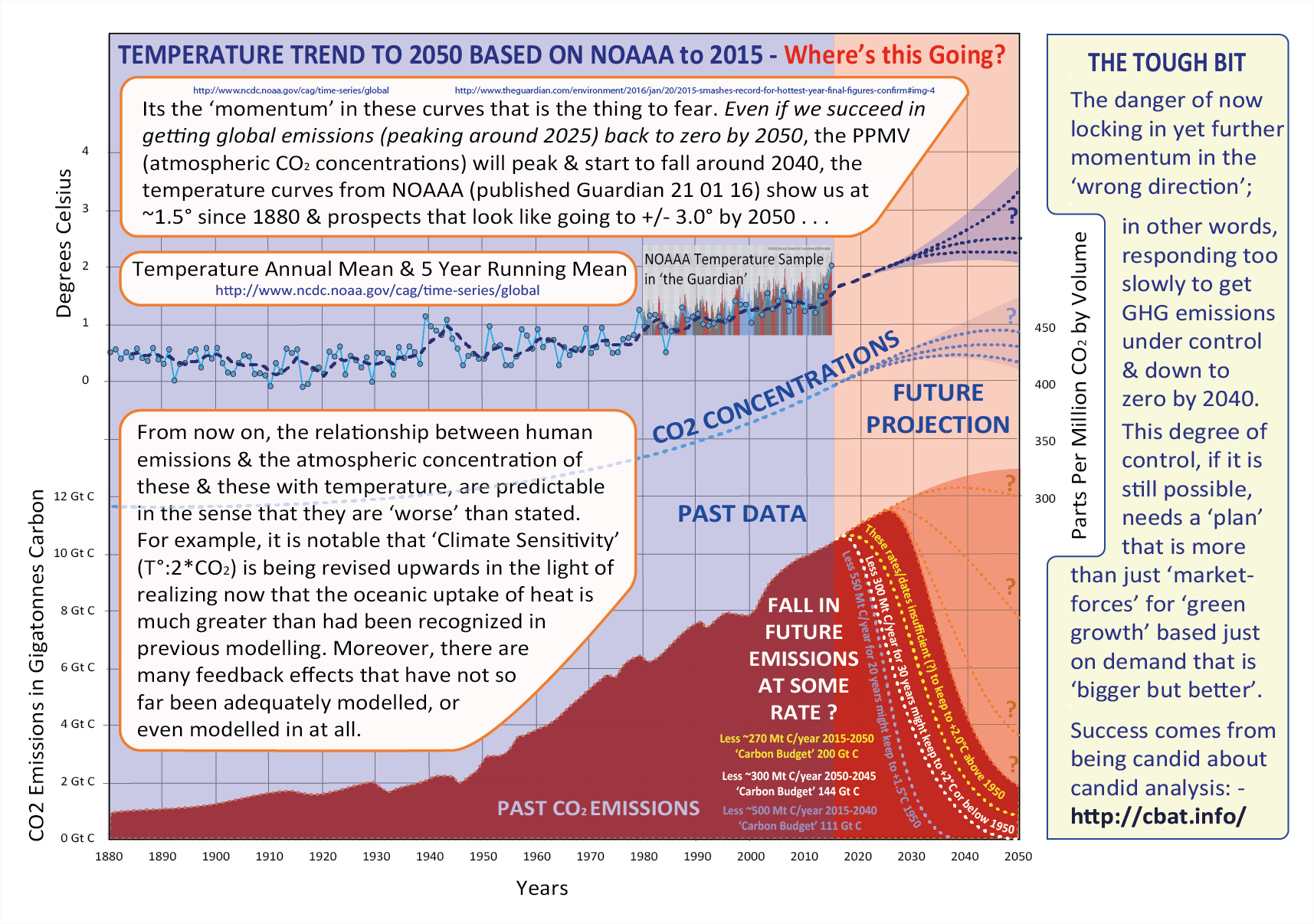
It is the ‘momentum’ in these curves that is the thing to fear. Even if we succeed in getting global emissions (peaking around 2025) back to zero by 2050, with PPMV (atmospheric CO2 concentrations) peaking and perhaps starting to fall around 2040, the temperature curves from NOAAA (published Guardian 21 01 16) show us now up by ~1.5° since 1880 & look like going to +/- 3.0° by 2050 . . .

help.png
 
The $2 trillion stranded assets danger zone: How fossil fuel firms risk destroying investor returns


There is a clear danger zone above a 2°C scenario where excess capex and CO2 emissions need to be avoided. All energy players have the chance to navigate around this by staying within the carbon budget. This will give the world an opportunity to reach the ultimate destination – a world that has prevented dangerous levels of climate change. Our analysis here focuses on the marginal production between the IEA 450 Scenario and business as usualfor the coal, gas and oil sectors to 2035.
 

Sponsors

Latest posts

Back
Top