

MESO-Rx
Anabolic Steroids

Navigation
Install the app
How to install the app on iOS
Follow along with the video below to see how to install our site as a web app on your home screen.
Note: This feature may not be available in some browsers.
More options
Style variation
Guest viewing limit reached
- You have reached the maximum number of guest views allowed
- Please register below to remove this limitation
- Already a member? Click here to login
You are using an out of date browser. It may not display this or other websites correctly.
You should upgrade or use an alternative browser.
You should upgrade or use an alternative browser.
Climate Change
- Thread starter Michael Scally MD
- Start date

This thread is a classic example of denial. You’re desperate to jamb a square peg in a round hole. Because you don’t like the truth
Big oil and coal are protecting their interests with disinformation and doubt. The current administration looks very short term at personal profits.
Keep in mind climate deniers are a tiny slice of the global viewpoint. Thankfully most of the world sees the problem as it really is.
Big oil and coal are protecting their interests with disinformation and doubt. The current administration looks very short term at personal profits.
Keep in mind climate deniers are a tiny slice of the global viewpoint. Thankfully most of the world sees the problem as it really is.
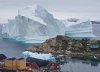
A 100-metre (330ft) high iceberg has drifted close to a tiny settlement on Greenland’s west coast, prompting fears of a tsunami if it breaks up.
Authorities have told residents of the Innaarsuit island settlement living near the shore to move to higher ground.
“We fear the iceberg could calve [break apart] and send a flood towards the village,” said Lina Davidsen of Greenland police.
Susanne Eliassen, a member of Innaarsuit’s council, said it was not unusual for large icebergs to be seen close to the community.
“But this iceberg is the biggest we have seen ... and there are cracks and holes that make us fear it can calve anytime,” she said.
…
Last year, four people died and 11 were injured after a landslide caused a tsunami off another island settlement called Nuugaatsiaq, sending several houses crashing into the sea. Four people missing after possible tsunami hits remote Greenland village
Does a slow AMOC increase the rate of global warming?
Does a slow AMOC increase the rate of global warming?
Chen X, Tung K-K. Global surface warming enhanced by weak Atlantic overturning circulation. Nature 2018;559:387-91. Global surface warming enhanced by weak Atlantic overturning circulation
Evidence from palaeoclimatology suggests that abrupt Northern Hemisphere cold events are linked to weakening of the Atlantic Meridional Overturning Circulation (AMOC)1, potentially by excess inputs of fresh water2. But these insights—often derived from model runs under preindustrial conditions—may not apply to the modern era with our rapid emissions of greenhouse gases. If they do, then a weakened AMOC, as in 1975–1998, should have led to Northern Hemisphere cooling. Here we show that, instead, the AMOC minimum was a period of rapid surface warming. More generally, in the presence of greenhouse-gas heating, the AMOC’s dominant role changed from transporting surface heat northwards, warming Europe and North America, to storing heat in the deeper Atlantic, buffering surface warming for the planet as a whole. During an accelerating phase from the mid-1990s to the early 2000s, the AMOC stored about half of excess heat globally, contributing to the global-warming slowdown. By contrast, since mooring observations began3–5 in 2004, the AMOC and oceanic heat uptake have weakened. Our results, based on several independent indices, show that AMOC changes since the 1940s are best explained by multidecadal variability6, rather than an anthropogenically forced trend. Leading indicators in the subpolar North Atlantic today suggest that the current AMOC decline is ending. We expect a prolonged AMOC minimum, probably lasting about two decades. If prior patterns hold, the resulting low levels of oceanic heat uptake will manifest as a period of rapid global surface warming.
Does a slow AMOC increase the rate of global warming?
Chen X, Tung K-K. Global surface warming enhanced by weak Atlantic overturning circulation. Nature 2018;559:387-91. Global surface warming enhanced by weak Atlantic overturning circulation
Evidence from palaeoclimatology suggests that abrupt Northern Hemisphere cold events are linked to weakening of the Atlantic Meridional Overturning Circulation (AMOC)1, potentially by excess inputs of fresh water2. But these insights—often derived from model runs under preindustrial conditions—may not apply to the modern era with our rapid emissions of greenhouse gases. If they do, then a weakened AMOC, as in 1975–1998, should have led to Northern Hemisphere cooling. Here we show that, instead, the AMOC minimum was a period of rapid surface warming. More generally, in the presence of greenhouse-gas heating, the AMOC’s dominant role changed from transporting surface heat northwards, warming Europe and North America, to storing heat in the deeper Atlantic, buffering surface warming for the planet as a whole. During an accelerating phase from the mid-1990s to the early 2000s, the AMOC stored about half of excess heat globally, contributing to the global-warming slowdown. By contrast, since mooring observations began3–5 in 2004, the AMOC and oceanic heat uptake have weakened. Our results, based on several independent indices, show that AMOC changes since the 1940s are best explained by multidecadal variability6, rather than an anthropogenically forced trend. Leading indicators in the subpolar North Atlantic today suggest that the current AMOC decline is ending. We expect a prolonged AMOC minimum, probably lasting about two decades. If prior patterns hold, the resulting low levels of oceanic heat uptake will manifest as a period of rapid global surface warming.
This narrative by Nathaniel Rich is a work of history, addressing the 10-year period from 1979 to 1989: the decisive decade when humankind first came to a broad understanding of the causes and dangers of climate change. Complementing the text is a series of aerial photographs and videos, all shot over the past year by George Steinmetz. With support from the Pulitzer Center, this two-part article is based on 18 months of reporting and well over a hundred interviews. It tracks the efforts of a small group of American scientists, activists and politicians to raise the alarm and stave off catastrophe. It will come as a revelation to many readers — an agonizing revelation — to understand how thoroughly they grasped the problem and how close they came to solving it.
The world has warmed more than one degree Celsius since the Industrial Revolution. The Paris climate agreement — the nonbinding, unenforceable and already unheeded treaty signed on Earth Day in 2016 — hoped to restrict warming to two degrees. The odds of succeeding, according to a recent study based on current emissions trends, are one in 20.
If by miracle we are able to limit warming to two degrees, we will only have to negotiate the extinction of the world’s tropical reefs, sea-level rise of several meters and the abandonment of the Persian Gulf. The climate scientist James Hansen has called two-degree warming “a prescription for long-term disaster.” Long-term disaster is now the best-case scenario.
Three-degree warming is a prescription for short-term disaster: forests in the Arctic and the loss of most coastal cities. Robert Watson, a former director of the United Nations Intergovernmental Panel on Climate Change, has argued that three-degree warming is the realistic minimum.
Four degrees: Europe in permanent drought; vast areas of China, India and Bangladesh claimed by desert; Polynesia swallowed by the sea; the Colorado River thinned to a trickle; the American Southwest largely uninhabitable.
The prospect of a five-degree warming has prompted some of the world’s leading climate scientists to warn of the end of human civilization.
This narrative by Nathaniel Rich is a work of history, addressing the 10-year period from 1979 to 1989: the decisive decade when humankind first came to a broad understanding of the causes and dangers of climate change. Complementing the text is a series of aerial photographs and videos, all shot over the past year by George Steinmetz. With support from the Pulitzer Center, this two-part article is based on 18 months of reporting and well over a hundred interviews. It tracks the efforts of a small group of American scientists, activists and politicians to raise the alarm and stave off catastrophe. It will come as a revelation to many readers — an agonizing revelation — to understand how thoroughly they grasped the problem and how close they came to solving it.
The world has warmed more than one degree Celsius since the Industrial Revolution. The Paris climate agreement — the nonbinding, unenforceable and already unheeded treaty signed on Earth Day in 2016 — hoped to restrict warming to two degrees. The odds of succeeding, according to a recent study based on current emissions trends, are one in 20.
If by miracle we are able to limit warming to two degrees, we will only have to negotiate the extinction of the world’s tropical reefs, sea-level rise of several meters and the abandonment of the Persian Gulf. The climate scientist James Hansen has called two-degree warming “a prescription for long-term disaster.” Long-term disaster is now the best-case scenario.
Three-degree warming is a prescription for short-term disaster: forests in the Arctic and the loss of most coastal cities. Robert Watson, a former director of the United Nations Intergovernmental Panel on Climate Change, has argued that three-degree warming is the realistic minimum.
Four degrees: Europe in permanent drought; vast areas of China, India and Bangladesh claimed by desert; Polynesia swallowed by the sea; the Colorado River thinned to a trickle; the American Southwest largely uninhabitable.
The prospect of a five-degree warming has prompted some of the world’s leading climate scientists to warn of the end of human civilization.
This narrative by Nathaniel Rich is a work of history, addressing the 10-year period from 1979 to 1989: the decisive decade when humankind first came to a broad understanding of the causes and dangers of climate change. Complementing the text is a series of aerial photographs and videos, all shot over the past year by George Steinmetz. With support from the Pulitzer Center, this two-part article is based on 18 months of reporting and well over a hundred interviews. It tracks the efforts of a small group of American scientists, activists and politicians to raise the alarm and stave off catastrophe. It will come as a revelation to many readers — an agonizing revelation — to understand how thoroughly they grasped the problem and how close they came to solving it.
The world has warmed more than one degree Celsius since the Industrial Revolution. The Paris climate agreement — the nonbinding, unenforceable and already unheeded treaty signed on Earth Day in 2016 — hoped to restrict warming to two degrees. The odds of succeeding, according to a recent study based on current emissions trends, are one in 20.
If by miracle we are able to limit warming to two degrees, we will only have to negotiate the extinction of the world’s tropical reefs, sea-level rise of several meters and the abandonment of the Persian Gulf. The climate scientist James Hansen has called two-degree warming “a prescription for long-term disaster.” Long-term disaster is now the best-case scenario.
Three-degree warming is a prescription for short-term disaster: forests in the Arctic and the loss of most coastal cities. Robert Watson, a former director of the United Nations Intergovernmental Panel on Climate Change, has argued that three-degree warming is the realistic minimum.
Four degrees: Europe in permanent drought; vast areas of China, India and Bangladesh claimed by desert; Polynesia swallowed by the sea; the Colorado River thinned to a trickle; the American Southwest largely uninhabitable.
The prospect of a five-degree warming has prompted some of the world’s leading climate scientists to warn of the end of human civilization.
This narrative by Nathaniel Rich is a work of history, addressing the 10-year period from 1979 to 1989: the decisive decade when humankind first came to a broad understanding of the causes and dangers of climate change. Complementing the text is a series of aerial photographs and videos, all shot over the past year by George Steinmetz. With support from the Pulitzer Center, this two-part article is based on 18 months of reporting and well over a hundred interviews. It tracks the efforts of a small group of American scientists, activists and politicians to raise the alarm and stave off catastrophe. It will come as a revelation to many readers — an agonizing revelation — to understand how thoroughly they grasped the problem and how close they came to solving it.
The world has warmed more than one degree Celsius since the Industrial Revolution. The Paris climate agreement — the nonbinding, unenforceable and already unheeded treaty signed on Earth Day in 2016 — hoped to restrict warming to two degrees. The odds of succeeding, according to a recent study based on current emissions trends, are one in 20.
If by miracle we are able to limit warming to two degrees, we will only have to negotiate the extinction of the world’s tropical reefs, sea-level rise of several meters and the abandonment of the Persian Gulf. The climate scientist James Hansen has called two-degree warming “a prescription for long-term disaster.” Long-term disaster is now the best-case scenario.
Three-degree warming is a prescription for short-term disaster: forests in the Arctic and the loss of most coastal cities. Robert Watson, a former director of the United Nations Intergovernmental Panel on Climate Change, has argued that three-degree warming is the realistic minimum.
Four degrees: Europe in permanent drought; vast areas of China, India and Bangladesh claimed by desert; Polynesia swallowed by the sea; the Colorado River thinned to a trickle; the American Southwest largely uninhabitable.
The prospect of a five-degree warming has prompted some of the world’s leading climate scientists to warn of the end of human civilization.
Similar threads

- Replies
- 12
- Views
- 5K

- Replies
- 98
- Views
- 5K


- Replies
- 0
- Views
- 644


