Climate Change

http://www.nytimes.com/2013/09/21/s...w-but-long-term-decline-may-continue.html?hpw

Sea ice in the Arctic Ocean underwent a sharp recovery this year from the record-low levels of 2012, with 50 percent more ice surviving the summer melt season, scientists said Friday. It is the largest one-year increase in Arctic ice since satellite tracking began in 1978.

The experts added, however, that much of the ice remains thin and slushy, a far cry from the thick Arctic pack ice of the past. Because thin ice is subject to rapid future melting, the scientists said this year’s recovery was unlikely to portend any change in the relentless long-term decline of Arctic sea ice.

“I’m not at all surprised there was a jump upward — we’ve never set two record lows in a row,” said Walt Meier, a NASA scientist who has monitored sea ice for years. “I would say I’m a little surprised the jump is as big as it is.”

Last year’s ice extent was so low that this year’s recovery looks larger by comparison, Dr. Meier said. The main reason for this year’s growth, Dr. Meier added, was that the region was colder and cloudier through the spring and summer than in the recent past.

“We had cool conditions, cooler than the long-term average, and yet it is still going to be the sixth-lowest ice minimum on record,” Dr. Meier said.

Playing out over a generation, the decline of the Arctic ice cap has been one of the most striking effects of global warming, a change in the planetary aspect so large it would have been visible to an observer on the moon. “We could be looking at summers with essentially no sea ice on the Arctic Ocean only a few decades from now,” said Mark Serreze, director of the National Snow and Ice Data Center in Boulder, Colo., in a statement.

Contrary to popular impression, the melting of sea ice does not cause a rise of sea level, since the ice is already floating and displacing its weight in water. But the replacement of white ice with dark water does mean the surface of the Arctic Ocean can absorb far more heat in the summer, which could contribute to the melting of nearby land ice in Greenland, raising sea level.

During the winter, the Arctic plunges into near-darkness 24 hours a day, and a skin of ice grows across most of the ocean surface. But during the summer, the sun shines continuously. The key to the status of the ice cap is how much of it survives the summer melt season to become thick, resilient ice.

When satellite monitoring began in the late 1970s, about half the surface of the Arctic Ocean would be covered by ice at the end of the melt season, which usually occurs in September. By last year, that figure had fallen to 24 percent of the ocean surface, rising this year to 36 percent.

The National Snow and Ice Data Center announced Friday that the low point in sea ice this year had occurred on Sept. 13. The timing varies from year to year, and the agency always waits several days before making an announcement to be certain the ice pack has begun to regrow.

Lately, a new low in summer sea ice has been set every few years, followed by a few years of recovery, followed by yet another low that typically exceeds the previous one by a substantial margin.

Is Annual Arctic Sea Ice On Decent Track For A Change? – Greg Laden's Blog
 
Last edited:
Why We Should Choose Science over Beliefs
Ideology needs to give way
Why We Should Choose Science over Beliefs: Scientific American

My libertarianism also once clouded my analysis of climate change. I was a longtime skeptic, mainly because it seemed to me that liberals were exaggerating the case for global warming as a kind of secular millenarianism—an environmental apocalypse requiring drastic government action to save us from doomsday through countless regulations that would handcuff the economy and restrain capitalism, which I hold to be the greatest enemy of poverty. Then I went to the primary scientific literature on climate and discovered that there is convergent evidence from multiple lines of inquiry that global warming is real and human-caused: temperatures increasing, glaciers melting, Arctic ice vanishing, Antarctic ice cap shrinking, sea-level rise corresponding with the amount of melting ice and thermal expansion, carbon dioxide touching the level of 400 parts per million (the highest in at least 800,000 years and the fastest increase ever), and the confirmed prediction that if anthropogenic global warming is real the stratosphere and upper troposphere should cool while the lower troposphere should warm, which is the case.
 
Fifth Assessment Report (AR5)
IPCC - Intergovernmental Panel on Climate Change

A total of 209 Lead Authors and 50 Review Editors from 39 countries and more than 600 Contributing Authors from 32 countries contributed to the preparation of WGI AR5.

The Final Draft of the Working Group I contribution to the IPCC Fifth Assessment Report will be available here on 30 September.
 
Humans blamed for ‘unequivocal’ global warming
Humans blamed for ‘unequivocal’ global warming - FT.com

It is now virtually certain that humans have been the main cause of the “unequivocal” global warming recorded in the past 60 years, according to a landmark climate science report likely to rekindle debate over the fossil fuels powering the world’s economies.

If industrial greenhouse gas emissions keep rising, they are likely to cause more global warming that will lead to shifts in global sea levels, ice cover and other aspects of the climate already changing in ways not seen for thousands of years, warns the report by the UN’s Intergovernmental Panel on Climate Change.
 
Global Warming and Extreme Weather – #climate #agw – Greg Laden's Blog

We call it “weather whiplash.” This is not just meteorologists being funny. It is a phenomenon that perhaps has always been with us to some degree, but that has recently become much more common, apparently. If you were under the impression that there is a lot of strange weather going on out there, you may be right, and weather whiplash may be the phenomenon you’ve noticed. Importantly, there is good reason to believe that weather whiplash is the result of anthropogenic global warming. In other words, it’s your fault, so please do pay attention.

Linking Weather Extremes to Global Warming – Greg Laden's Blog

In the case of the atmosphere of Earth’s Northern Hemisphere, global warming has changed the dynamic of the northern Jet Stream, and this has resulted in changes in weather extremes. This would apply to heat waves, cold snaps, and the distribution of precipitation. The phenomenon that is increasingly being called “Weather Whiplash” … more extremes in all directions, heat vs cold and wet vs. dry, is largely caused by this effect, it would seem.

This study is somewhat limited because it covers only a 32 year period, but the findings of the study are in accord with expectations based on what we know about how the Earth’s climate system works, and the modeling matches empirical reality quite well.

Quasiresonant amplification of planetary waves and recent Northern Hemisphere weather extremes

IPS – Killer Heat Waves and Floods Linked to Climate Change | Inter Press Service

Killer heat waves, floods and storms are increasingly caused by climate change, new research reveals.

Scientists in Germany say they have found how greenhouse gases from burning fossil fuels are helping to trap the jet stream, resulting in extraordinary weather such as the 2010 Pakistan flood and the 2011 heat wave in the United States.

Human-driven climate change repeatedly disturbs the flow of atmospheric waves around the globe’s Northern hemisphere, said lead author Vladimir Petoukhov of the Potsdam Institute for Climate Impact Research (PIK) in Germany.

Giant atmospheric waves called Rossby waves are meanders in the strong, high-altitude winds known as jet streams and have a major influence on weather. These wave movements are caused by the difference in temperatures between the cold air from the Arctic and hot air from the tropics.

When the waves shift north, they suck warm air from the tropics to Europe, Russia, or the U.S., and when they swing down, they do the same thing with cold air from the Arctic, said Petoukhov.

IPS – Ice-Free Arctic Is “Uncharted Territory” | Inter Press Service

The melt of Arctic sea ice has reached its lowest point this year, shrinking 18 percent from last year’s near-record low.

Summer ice this year is half what it was 30 years ago and is now affecting weather patterns. The massive declines in ice in recent summers have shocked scientists and Arctic experts. Some predict that in just a few years we will witness an event that hasn’t happened in millions of years: the complete loss of summer ice.

“We are now in uncharted territory,” said Mark Serreze, director of the National Snow and Ice Data Center (NSIDC) in Colorado.

“Few of us were prepared for how rapidly the changes would actually occur” as a result of the burning fossil fuels that are warming the planet, said Serreze.

“We could see an essentially ice-free Arctic ocean in late summer by the year 2030,” he told IPS.

Not long ago experts thought the soonest the Arctic would be ice-free was 2070. Now it’s anywhere from four to 18 years away.

IPS – Crops Failing as U.S. Simmers in Record Heat Wave | Inter Press Service
 

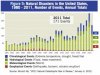
Attachments

  • NaturalDisastersInUS_1980-2011-640x483.jpg
    NaturalDisastersInUS_1980-2011-640x483.jpg
    20.4 KB · Views: 1
11522
 

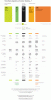
Attachments

  • 1276_gigatons_CO2.gif
    1276_gigatons_CO2.gif
    132.7 KB · Views: 17
WGI AR5 Final Draft (version 7 June 2013)
http://www.climatechange2013.org/report/review-drafts/

The Final Draft Report, dated 7 June 2013, of the Working Group I contribution to the IPCC Fifth Assessment Report Climate Change 2013: The Physical Science Basis was accepted but not approved in detail by the Twelfth Session of Working Group I and the Thirty-Sixth Session of the IPCC on 26 September 2013 in Stockholm, Sweden. It consists of the full scientific and technical assessment undertaken by Working Group I.

The Final Draft Report has to be read in conjunction with the document entitled “Climate Change 2013: The Physical Science Basis. Working Group I Contribution to the IPCC 5th Assessment Report - Changes to the Underlying Scientific/Technical Assessment” to ensure consistency with the approved Summary for Policymakers (IPCC-XXVI/Doc.4) and presented to the Panel at its Thirty-Sixth Session. This document lists the changes necessary to ensure consistency between the full Report and the Summary for Policymakers, which was approved line-by-line by Working Group I and accepted by the Panel at the above-mentioned Sessions.

Before publication the Final Draft will undergo copyediting as well as any error correction as necessary, consistent with the IPCC Protocol for Addressing Possible Errors. Publication of the Report is foreseen in January 2014.

http://www.climatechange2013.org/report/review-comments-disclaimer
 
Global warming debunked: NASA report verifies carbon dioxide actually cools atmosphere

Practically everything you have been told by the mainstream scientific community and the media about the alleged detriments of greenhouse gases, and particularly carbon dioxide, appears to be false, according to new data compiled by NASA's Langley Research Center. As it turns out, all those atmospheric greenhouse gases that Al Gore and all the other global warming hoaxers have long claimed are overheating and destroying our planet are actually cooling it, based on the latest evidence.

http://newsbusters.org/blogs/noel-sheppard/2012/07/11/new-study-thoroughly-debunks-global-warming-will-media-notice

A new study measuring temperatures over the past two millennia has concluded that in fact the temperatures seen in the last decade are far from being the hottest in history.

Check out that graph a little further down on the page, too.

I read all the different opinions and studies and such, and then something like this pops up and it reminds me that I just can't trust anything anyone is telling me. We, as humans, think so highly of our understanding of the world around us and the universe, but every once in a while, something is learned that proves that all we really know is that we know nothing. Just look back 50 years to what we "knew" about genetics.

UN report glosses over 15 years without global warming | The Daily Caller

A U.N. bureaucracy’s newly released assessment on global warming does little to address the break in warming that has now lasted 15 years

Wikipedia said:
Since the early 20th century, Earth's mean surface temperature has increased by about 0.8 °C (1.4 °F)

I'm not alarmed by 1.4 degrees in 100 years. Should I be? To think that the earth's temperature is naturally absolutely constant would be foolhardy, in my opinion. But, then again, I'm just a guy with no agenda. :rolleyes:
 
Global warming debunked: NASA report verifies carbon dioxide actually cools atmosphere


http://newsbusters.org/blogs/noel-sheppard/2012/07/11/new-study-thoroughly-debunks-global-warming-will-media-notice


Check out that graph a little further down on the page, too.

I read all the different opinions and studies and such, and then something like this pops up and it reminds me that I just can't trust anything anyone is telling me. We, as humans, think so highly of our understanding of the world around us and the universe, but every once in a while, something is learned that proves that all we really know is that we know nothing. Just look back 50 years to what we "knew" about genetics.

UN report glosses over 15 years without global warming | The Daily Caller


I'm not alarmed by 1.4 degrees in 100 years. Should I be? To think that the earth's temperature is naturally absolutely constant would be foolhardy, in my opinion. But, then again, I'm just a guy with no agenda. :rolleyes:

This IS why lay people have no business interpreting science. Your first link about NASA "debunking" the role of CO2 is inaccurate, NOT WHAT THE ARTICLE SAID and precisely why the internet perpetuates bullshit. There is A LOT of subtle nuance in science - this takes PhD's years in the field to get a handle on it and the average reporter/lay person has NO IDEA what they're even looking at!

A misinterpreted claim about a NASA press release, CO2, solar flares, and the thermosphere is making the rounds | Watts Up With That?

As for your second link they very clearly stated there is natural variation and 15 years isn't long enough to call the "pause" a truly significant trend. The inability to explain this in concrete terms does NOT detract from the validity of this report IMO.

BBC News - IPCC climate report: humans 'dominant cause' of warming
 
Last edited:
Is Antarctica losing or gaining ice?

Skeptic arguments that Antarctica is gaining ice frequently hinge on an error of omission, namely ignoring the difference between land ice and sea ice.

n glaciology and particularly with respect to Antarctic ice, not all things are created equal. Let us consider the following differences. Antarctic land ice is the ice which has accumulated over thousands of years on the Antarctica landmass itself through snowfall. This land ice therefore is actually stored ocean water that once fell as precipitation. Sea ice in Antarctica is quite different as it is ice which forms in salt water primarily during the winter months. When land ice melts and flows into the oceans global sea levels rise on average; when sea ice melts sea levels do not change measurably.

In Antarctica, sea ice grows quite extensively during winter but nearly completely melts away during the summer (Figure 1). That is where the important difference between Antarctic and Arctic sea ice exists as much of the Arctic's sea ice lasts all the year round. During the winter months it increases and before decreasing during the summer months, but an ice cover does in fact remain in the North which includes quite a bit of ice from previous years (Figure 1). Essentially Arctic sea ice is more important for the earth's energy balance because when it increasingly melts, more sunlight is absorbed by the oceans whereas Antarctic sea ice normally melts each summer leaving the earth's energy balance largely unchanged.

One must also be careful how you interpret trends in Antarctic sea ice. Currently this ice is increasing overall and has been for years but is this the smoking gun against climate change? Not quite. Antarctic sea ice is gaining because of many different reasons but the most accepted recent explanations are listed below:

i) Ozone levels over Antarctica have dropped causing stratospheric cooling and increasing winds which lead to more areas of open water that can be frozen (Gillet 2003, Thompson 2002, Turner 2009).

and

ii) The Southern Ocean is freshening because of increased rain and snowfall as well as an increase in meltwater coming from the edges of Antarctica's land ice (Zhang 2007, Bintanga et al. 2013). Together, these change the composition of the different layers in the ocean there causing less mixing between warm and cold layers and thus less melted sea and coastal land ice.

All the sea ice talk aside, it is quite clear that really when it comes to Antarctic ice and sea levels, sea ice is not the most important thing to measure. In Antarctica, the largest and most important ice mass is the land ice of the West Antarctic and East Antarctic ice sheets.

Therefore, how is Antarctic land ice doing?

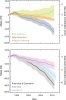
Figure 2: Estimates of total Antarctic land ice changes and approximate sea level contributions using a combination of different measurement techniques (Shepherd, 2012). Shaded areas represent the estimate uncertainty (1-sigma).

Estimates of recent changes in Antarctic land ice (Figure 2, bottom panel) show an increasing contribution to sea level with time, although not as fast a rate or acceleration as Greenland. Between 1992 and 2011, the Antarctic Ice Sheets overall lost 1350 giga-tonnes (Gt) or 1,350,000,000,000 tonnes into the oceans, at an average rate of 70 Gt per year (Gt/yr). Because a reduction in mass of 360 Gt/year represents an annual global-average sea level rise of 1 mm, these estimates equate to an increase in global-average sea levels by 0.19 mm/yr.

There is variation between regions within Antarctica (Figure 2, top panel), with the West Antarctic Ice Sheet and the Antarctic Peninsula Ice Sheet losing ice mass, and with an increasing rate. The East Antarctic Ice Sheet is growing slightly over this period but not enough to offset the other losses. There are of course uncertainties in the estimation methods but independent data from multiple measurement techniques (explained here) all show the same thing, Antarctica is losing land ice as a whole, and these losses are accelerating quickly.
 

Attachments

  • F5.large.jpg
    F5.large.jpg
    94.1 KB · Views: 2
Sorry, Arctic sea ice isn’t really ‘recovering’

Since things can vary a fair bit year to year, the Met Office advises looking at longer-term trends. And those are easy to see. There was less Arctic ice, on average, in the 2000s than there was in the 1990s. And there was less ice, on average, in the 1990s than there was in the 1980s.

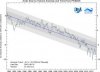
Clearly the ice is disappearing. Since 1979, Arctic sea-ice extent has been shrinking by about 4 percent per decade, with summer lows getting about 11 percent smaller each decade. And the volume of Arctic sea ice — which is trickier to measure — also keeps tumbling downward:
 

Attachments

  • 6a0133f03a1e37970b019aff3bba46970d-800wi.jpg
    6a0133f03a1e37970b019aff3bba46970d-800wi.jpg
    14.6 KB · Views: 2

RPD you have to pick some different shit to read.....lol. This is exactly what I'm talking about. Shitty reporters take an idea and sensationalize it to sell magazine on drive online sales. Sure it's easy if you don't have a clue think gee if the sea ice increased last year there must not be a problem even though this is the completely incorrect conclusion. We are a world of "arm-chair" science experts spreading half-truths to propagate our agenda and it's a WASTE of everyone's time IMO.
 
RPD you have to pick some different shit to read.....lol. This is exactly what I'm talking about. Shitty reporters take an idea and sensationalize it to sell magazine on drive online sales. Sure it's easy if you don't have a clue think gee if the sea ice increased last year there must not be a problem even though this is the completely incorrect conclusion. We are a world of "arm-chair" science experts spreading half-truths to propagate our agenda and it's a WASTE of everyone's time IMO.

The first article is an analysis of what really happened, and is widely reported to have happened - that was just one source of the same data. The second article cites an expert that states that said ice was on a trend to disappear completely very soon. Not sure how this is "shit". I was trying to just make a point about how even the most short-term predictions can easily be completely wrong because there are so many factors at play.

I'll agree about the "arm-chair scientists" analogy, and I also agree that it's very easy to confuse reporting with commentary or opinion (I think that's the point you were making). The contrast between the two seems to be slowly blurring to an almost indistinguishable grey.
 
Back
Top