Climate Change

Capitalism and the Destruction of Life on Earth: Six Theses on Saving the Humans

Crossing this threshold has fueled fears that we are fast approaching "tipping points" - melting of the subarctic tundra or thawing and releasing the vast quantities of methane in the Arctic sea bottom - that will accelerate global warming beyond any human capacity to stop it: "I wish it weren't true, but it looks like the world is going to blow through the 400-ppm level without losing a beat," said Scripps Institute geochemist Ralph Keeling, whose father, Charles, set up the first monitoring stations in 1958: "At this pace, we'll hit 450 ppm within a few decades."

"It feels like the inevitable march toward disaster," said Maureen E. Raymo, a scientist at the Lamont-Doherty Earth Observatory, a unit of Columbia University.[2]

Why are we marching to disaster, "sleepwalking to extinction" as The Guardian's George Monbiot once put it? Why can't we slam on the brakes before we ride off the cliff to collapse? I'm going to argue here that the problem is rooted in the requirements of capitalist reproduction, that large corporations are destroying life on Earth, that they can't help themselves, they can't change or change very much, that so long as we live under this system we have little choice but to go along in this destruction, to keep pouring on the gas instead of slamming on the brakes.
 
Climate Denial Crock of the Week
http://climatecrocks.com/2013/11/25/new-video-links-between-big-tobacco-and-climate-denial-rhymes-with-smoky-joe/

[ame]https://www.youtube.com/watch?v=Dj0PYdl99tI[/ame]
 
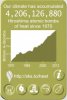
How much global warming is there in terms of atomic bombs? The Hiroshima Widget. – Greg Laden's Blog

One Hiroshima, Two Hiroshimas, Three Hirosimas, Four

On August 6th, 1945, the United States military detonated what was to date the largest and most terrible bomb ever created by humanity in the city of Hiroshima Japan. Since that time, the word “Hiroshima” has come to mean awesome power. In fact, the energy released by this bomb is beyond comprehension by the average person. Aside from the unbelievable power associated with that one human made machine, we also think, when we think of the bomb dropped on Hiroshima, of horrible consequences arising from human activity. It does not matter what one thinks today of whether or not that bomb should have been dropped or how the bombing of Hiroshima and Nagasaki influenced the end of World War II in the Pacific; the war was a horrible thing, and in both Germany and Japan and their captured territories the loss of human life and destruction of property needed to end the fascist regimes that controlled those countries was beyond measure.

For these reasons it seems appropriate to describe what humans are now doing with many of their other machines to the planet and by extension to themselves with the virtually unchecked alteration of the chemistry of the Earth’s atmosphere in terms of Hiroshimas. And when we do this, the result is astounding. The addition of extra greenhouse gases to the atmosphere by burning fossil fuels causes the atmosphere to retain more heat than it otherwise would. This has enormous consequences. A huge amount of the world’s water is normally trapped in glaciers, and these glaciers are melting. The ocean absorbs about 90% of this extra heat, which causes it to expand in size. Between the melting of the glaciers into the sea and the expansion of size from heat, unchecked emission of greenhouse gas will eventually cause sea level rise to the extent that most of the world’s large settlements will be inundated, and huge expanses of cropland that supply our food will be ruined. Accelerated melting of the Arctic has caused a change in weather patterns that causes “stalling” and “blocking” events to occur many times a year instead of now and then. These events cause huge floods in some areas and “flash droughts” in other areas. The additional energy added by this accidental and catastrophic transformation of our planet to the atmosphere and the sea has caused an increase in the frequency of major storms and has increased the strength of these storms on average, and in addition, tropical storms of a given magnitude have more severe effects because of sea level rise. And more problems beyond this have happened and will happen in the future.

So, how do we describe this awesome (and I use the term “awesome” with its more traditional definition, not as a good thing) increase in energy in terms of “Hiroshimas” … how many atomic bombs per unit time is equivalent to the increase in additional, unwanted energy in our atmosphere?

One a year?
Ten a year?
Two a month?
One a day?
Ten a day?
One an hour?
Ten an hour?
One a second?

No. None of those numbers. The actual amount of energy added to our atmosphere because of the effects of human-caused changes in its chemistry is four. Four Hiroshimas per second.

New widget counts global warming happening at 4 Hiroshima atomic bombs per second | Dana Nuccitelli | Environment | theguardian.com

Global warming is happening at a rate of about 2 Hurricane Sandys worth of energy per second
 

Attachments

  • HiroshimaWidget.jpg
    HiroshimaWidget.jpg
    10 KB · Views: 3
Bruce Molnia's Repeat Photos of Alaska, and What He Says They Reveal About Our World
http://www.weather.com/news/science/environment/alaskas-glaciers-capturing-earth-changing-our-eyes-20131125
 

By his own words "climate change may or may not be occurring"
So if it could or could not be happening (Then how can we know what
we could or could not do to turn back this climate change clock)
What steps can we take to stop something that is such an enigma
that we cant see, hear or feel it?
The sky is falling, lets all run around in circles. At least we will be doing something.

BOOM! There is his hole for his silly self important theory........... Still looking for the guy to stop China from polluting.
 
Jeff Skoll to produce "Merchants of Doubt" film based on the bestselling book about how fossil fuel funded climate change deniers have adopted the same techniques as the tobacco industry in influencing public opinion.

Ex-eBay president and activist Jeff Skoll on making movies with a message
Ex-Ebay president and activist Jeff Skoll on making movies with a message | Guardian Sustainable Business | Guardian Professional
Blood And Gore: Making A Killing On Anti-Carbon Investment Hype - Forbes

The Greening Of Gore's Bank Account Larry Bell Larry Bell Contributor
Al Gore's Oil-Fueled Al-Jazeera Deal Follows A String Of Green Energy Fiascos Larry Bell Larry Bell Contributor
An Uncritical View Of EPA: Why I Agree With Obama Larry Bell Larry Bell Contributor
IPCC In A Stew: How They Cooked Their Latest Climate Books Larry Bell Larry Bell Contributor

Of course this carbon regulation is posited upon saving the Earth based upon a “consensus within the scientific community that increasing the global temperature by more than 2oC will likely cause devastating and irreversible damage to the planet.” And where it comes to promulgating and capitalizing upon carbon-climate-crazed sociopolitical pressure, you would be hard-pressed to find two better authorities.

Gore and Blood, the former chief of Goldman Sachs Asset Management (GSAM), co-founded London-based GIM in 2004. Between 2008 and 2011 the company had raised profits of nearly $218 million from institutions and wealthy investors. By 2008 Gore was able to put $35 million into hedge funds and private partnerships through the Capricorn Investment Group, a Palo Alto company founded by his Canadian billionaire buddy Jeffrey Skoll, the first president of EBay Inc. It was Skoll’s Participant Media that produced Gore’s feverishly frightening 2006 horror film, “An Inconvenient Truth”.

In 2007, following an investigation of the movie, Sir Michael Burton, a judge in London’s High Court, ruled that it can be shown in secondary schools only if accompanied by guidance notes for teachers to balance Mr. Gore’s “one-sided” views. Judge Barton pointed out that its “apocalyptical vision” was politically partisan, and not an impartial analysis. He stated: “It is built around the charismatic presence of the ex-vice president Al Gore, whose crusade is to persuade the world of the dangers of climate change caused by global warming…It is now common ground that this is not simply a science film- although it is based substantially on science research and opinion, but it is [clearly] a political film.”

One only needs to follow the money trail to get to the truth of climate change.
These are shameless people. Peddlers of fear.
 
[ame=http://www.youtube.com/watch?v=6yiTZm0y1YA]Climate Change 2013 Working Group I: The Physical Science Basis - YouTube[/ame]
 
The Science of Abrupt Climate Change: Should we be worried?
http://www.wunderground.com/resources/climate/abruptclimate.asp

The historical records shows us that abrupt climate change is not only possible--it is the normal state of affairs. The present warm, stable climate is a rare anomaly. It behooves us to learn as much as we can about the climate system so that we may be able to predict when the next abrupt shift in climate will come. Until we know better when this might happen, it would be wise to stop pouring so much carbon dioxide into the air. A nasty surprise might be lurking just around the corner. In the words of Dr. Wally Broecker, "the climate system is an angry beast, and we are poking it."
 
Abrupt Impacts of Climate Change: Anticipating Surprises (2013)
Abrupt Impacts of Climate Change: Anticipating Surprises

Climate is changing, forced out of the range of the past million years by levels of carbon dioxide and other greenhouse gases not seen in the Earth s atmosphere for a very, very long time. Lacking action by the world s nations, it is clear that the planet will be warmer, sea level will rise, and patterns of rainfall will change. But the future is also partly uncertain - there is considerable uncertainty about how we will arrive at that different climate. Will the changes be gradual, allowing natural systems and societal infrastructure to adjust in a timely fashion? Or will some of the changes be more abrupt, crossing some threshold or tipping point to change so fast that the time between when a problem is recognized and when action is required shrinks to the point where orderly adaptation is not possible?

Abrupt Impacts of Climate Change is an updated look at the issue of abrupt climate change and its potential impacts. This study differs from previous treatments of abrupt changes by focusing on abrupt climate changes and also abrupt climate impacts that have the potential to severely affect the physical climate system, natural systems, or human systems, often affecting multiple interconnected areas of concern. The primary timescale of concern is years to decades. A key characteristic of these changes is that they can come faster than expected, planned, or budgeted for, forcing more reactive, rather than proactive, modes of behavior.

Abrupt Impacts of Climate Change summarizes the state of our knowledge about potential abrupt changes and abrupt climate impacts and categorizes changes that are already occurring, have a high probability of occurrence, or are unlikely to occur. Because of the substantial risks to society and nature posed by abrupt changes, this report recommends the development of an Abrupt Change Early Warning System that would allow for the prediction and possible mitigation of such changes before their societal impacts are severe. Identifying key vulnerabilities can help guide efforts to increase resiliency and avoid large damages from abrupt change in the climate system, or in abrupt impacts of gradual changes in the climate system, and facilitate more informed decisions on the proper balance between mitigation and adaptation. Although there is still much to learn about abrupt climate change and abrupt climate impacts, to willfully ignore the threat of abrupt change could lead to more costs, loss of life, suffering, and environmental degradation. Abrupt Impacts of Climate Change makes the case that the time is here to be serious about the threat of tipping points so as to better anticipate and prepare ourselves for the inevitable surprises.
 
I just wanted to throw in there that I believe climate change as far as an aggressive shift is more so due tp cyclic external planetary mechanics and forces.I do agree a growing population and a growing amount of waste from consumption has consequences and that things should be done differently as far as use and disuse of resources and materials.There are many factors involved and again on cyclic patterns over peroids of time and also counting lifecycles of everything involved within our solar system.Our star sol has a lot to do with our earth changes in ways not even known.For instance there is a huge debate over the sun being a different color then it was when viewed by the naked eye in the 1980's.I can remember the sun looking orange and so can thousands of others,now the sun is very bright almost a white light.That will tell you it is burning a different fuel.Also the radiation we are being bombarded with by the sun now is increasing.Maybee its not too far fetched that the sun could emit particles that send our core into a whirlwind of shit as was depicted in the 2012 film.On another note our solar system is apparently moving torward the entry to a photon belt that is also a cyclic process that happens and there is no stopping it.It is unknown and only speculated of the effects we may encounter with the climate or electromagnetically.All of that radiation could heat things up a bit.
 
Hansen J, Kharecha P, Sato M, et al. Assessing “Dangerous Climate Change”: Required Reduction of Carbon Emissions to Protect Young People, Future Generations and Nature. PLoS ONE 2013;8(12):e81648. PLOS ONE: Assessing “Dangerous Climate Change”: Required Reduction of Carbon Emissions to Protect Young People, Future Generations and Nature

We assess climate impacts of global warming using ongoing observations and paleoclimate data. We use Earth’s measured energy imbalance, paleoclimate data, and simple representations of the global carbon cycle and temperature to define emission reductions needed to stabilize climate and avoid potentially disastrous impacts on today’s young people, future generations, and nature. A cumulative industrial-era limit of ~500 GtC fossil fuel emissions and 100 GtC storage in the biosphere and soil would keep climate close to the Holocene range to which humanity and other species are adapted. Cumulative emissions of ~1000 GtC, sometimes associated with 2°C global warming, would spur “slow” feedbacks and eventual warming of 3–4°C with disastrous consequences. Rapid emissions reduction is required to restore Earth’s energy balance and avoid ocean heat uptake that would practically guarantee irreversible effects. Continuation of high fossil fuel emissions, given current knowledge of the consequences, would be an act of extraordinary witting intergenerational injustice. Responsible policymaking requires a rising price on carbon emissions that would preclude emissions from most remaining coal and unconventional fossil fuels and phase down emissions from conventional fossil fuels.
 
http://www.nytimes.com/2013/12/04/s...sks-sudden-deep-changes.html?hpw&rref=science

Continued global warming poses a risk of rapid, drastic changes in some human and natural systems, a scientific panel warned Tuesday, citing the possible collapse of polar sea ice, the potential for a mass extinction of plant and animal life and the threat of immense dead zones in the ocean.

At the same time, some worst-case fears about climate change that have entered the popular imagination can be ruled out as unlikely, at least over the next century, the panel found. These include a sudden belch of methane from the ocean or the Arctic that would fry the planet, as well as a shutdown of the heat circulation in the Atlantic Ocean that would chill nearby land areas — the fear on which the 2004 movie “The Day After Tomorrow” was loosely based.

In a report released Tuesday, the panel appointed by the National Research Council called for the creation of an early warning system to alert society well in advance to changes capable of producing chaos. Nasty climate surprises have occurred already, and more seem inevitable, perhaps within decades, panel members warned. But, they said, little has been done to prepare.

“The reality is that the climate is changing,” said James W. C. White, a paleoclimatologist at the University of Colorado Boulder who headed the committee on abrupt impacts of climate change. “It’s going to continue to happen, and it’s going to be part of everyday life for centuries to come — perhaps longer than that.”

While most climate scientists believe the human release of greenhouse gases has made immense changes in the earth inevitable, they hope many of these will happen slowly enough that society can adapt.

The document the panel released Tuesday is the latest in a string of reports to consider whether some changes could occur so suddenly as to produce profound social or environmental stress, even collapse. Like previous reports, the new one considers many potential possibilities and dismisses most of them as unlikely — at least in the near term.

But some of the risks are real, the panel found, and in several cases have happened already.

It cited the outbreak of mountain pine beetles in the American West and in Canada. The disappearance of bitterly cold winter nights that used to kill off the beetles has allowed them to ravage tens of millions of acres of forests, damage so severe it can be seen from space.

Likewise, a drastic decline of summer sea ice in the Arctic has occurred much faster than scientists expected. The panel warned that Arctic sea ice could disappear in the summer within several decades, with severe impacts on wildlife and human communities in the region, and unknown effects on the world’s weather patterns.

Among the greatest risks in coming years, the panel said, is that climate change could greatly increase the extinction rate of plants and animals, essentially provoking the sixth mass extinction in the earth’s history. The panel said many of the world’s coral reefs, a vital source of fish that feed millions of people, already seemed fated to die within decades.

Another risk, judged to be moderately likely over the coming century, is that rising heat in the upper ocean could result in reduced oxygen in the deep. The worst-case scenario would be the creation of huge zones with too little oxygen for sea creatures to survive, with unknown consequences for the overall ecology of the ocean, the panel said.

It considered the possibility that a collapse of the West Antarctic ice sheet, believed to be especially vulnerable to a warming ocean, would greatly increase the rate of sea level rise. It found that risk, in the near term, to be “unknown but probably low.”

The National Research Council is a nonprofit group in Washington that frequently oversees studies on major scientific questions; this study was commissioned by several government agencies.

Abrupt Impacts of Climate Change: Anticipating Surprises
Abrupt Impacts of Climate Change: Anticipating Surprises ( 2013 )
 
Oh I suspect you can prove anything with ice data 100,000 years old, next the "end times" are nigh, lol
 
Back
Top