Climate Change


Like I said above, and I'll keep reposting this shit every single damn time if I have to. This is not science: increases in extreme weather? Global warming? Decreases in extreme weather? Global warming! Getting warmer? Global warming! Going through a record breaking cold snap? Global warming! Increase in earthquake activity (or decrease)? Global warming!

It's not science if it cannot make predictions which can be tested. It is not science if a hypothesis and its antithesis can both be blamed on the so-called science.

Get it yet? Figuring it out yet?

What does fit the bill of trying to be all things to everyone?

POLITICS.

AGW believers are political animals, not scientists.

Lesson over.

Next.
 
Ah, what a lovely holiday this is turning out to be. First Obambicare is headed for a cliff and now global warming alarmism is dying on the vine. Whose the idiot now? I love the very last sentence: "The other witnesses on the panel did not refute Pielke's data". That being said, the whole thing is worth a lead as more and more scientists are jumping off the bandwagon. Thank God for that. Now we just have to get rid of the lying POS President and gut the EPA. Time to get back to being a real country with a future.

For your reading pleasure: Seven global warming alarmist setbacks in 2013 | The Daily Caller

Hold your champagne glasses high this holiday season, because the end of 2013 marks the 17th year without global warming.

This year has been trying for climate scientists and environmentalists who have been trying hard to explain away the 17-year hiatus in global warming and link “extreme weather” to rising greenhouse gas emissions — despite strong evidence to the contrary. There has been a breakdown in the manmade global warming consensus, and some even argue we are headed for an ice age.

In honor of the 17th year without global warming, The Daily Caller News Foundation has put together seven setbacks for global warming alarmism.

1) Studies show that the world was warmer than it is today during the Roman Empire and when the Vikings were plundering Europe and North America. In fact, even in the 19th Century, there were discussions surrounding the fact that the Vikings could settle the northernmost reaches of Greenland and North America because there was less ice coverage.

2) During the second week in December, the U.S. saw more than 2000 record low temperatures and record snowfalls, according to the National Weather Service and HamWeather records center. There were 606 record low temperatures, 1,234 low maximum temperatures and 285 record snowfalls across the country. In the meantime there were only 98 high temperature records and 141 high minimum temperature records.

3) Satellite data shows that the polar bears have at least one reason to be happy this year – Arctic sea ice coverage was up 50 percent over last year’s record low coverage. Contrary to Al Gore’s prediction that there would be no polar ice cap by this year, sea ice coverage spanned nearly 2,100 cubic miles by the end of this year’s melting season, up from about 1,400 cubic last year.

4) Global cooling is on the way, according to an increasing number of scientists. German scientists have predicted that based on declining sunspot activity and natural climate oscillation the world will cool over the next century. Temperatures will eventually drop to levels corresponding with the “little ice age” of 1870.

5) Other scientists have also been coming around to the global cooling side of things. The BBC reported that Professor Mike Lockwood of the Reading University predicts that at the current rate of decline in solar activity, another “Little Ice Age” could envelope Northern Europe.

6) The United Nations climate bureaucracy’s latest global warming report was called “hilarious” by a leading scientist from the Massachusetts Institute of Technology. Dr. Richard Lindzen said the UN’s report “has truly sunk to level of hilarious incoherence” because they continue to proclaim with ever greater certainty that mankind is causing global warming, despite their models continually being wrong.

“Their excuse for the absence of warming over the past 17 years is that the heat is hiding in the deep ocean,” Lindzen said. “However, this is simply an admission that the models fail to simulate the exchanges of heat between the surface layers and the deeper oceans.”

7) The Senate testimony of Dr. Roger Pielke of the University of Colorado completely undercut environmentalists and Democrats trying to claim that global warming was causing “extreme weather.”

“It is misleading and just plain incorrect to claim that disasters associated with hurricanes, tornadoes, floods or droughts have increased on climate timescales either in the United States or globally,” Pielke said. “It is further incorrect to associate the increasing costs of disasters with the emission of greenhouse gases.”

The other witnesses on the panel did not refute Pielke’s data.

 
Ah yea hold those beer glasses a long while because what you believe those scientists are apt to return those research dollars? NOT !!!

Oh no, because right around the corner is the antithesis of GLOBAL WARMING, you know that worrisome phenomenon of the Haight Ashbury era, GLOBAL COOLING!!! So begin purchasing blankets, coal, petroleum distillates and all that other junk which increases "our" damn CARBON FOOTPRINT [:o)]

Oh crap if any of this BUNK was legit the human life expectancy should be shortened rather than lengthened :bullshit::wtf:

jimmy
 
Conservative groups spend up to $1bn a year to fight action on climate change
• Author: 'I call it the climate-change counter movement'
• Study focuses on groups opposing US political action

Conservative groups spend up to $1bn a year to fight action on climate change | Environment | theguardian.com

Conservative groups may have spent up to $1bn a year on the effort to deny science and oppose action on climate change, according to the first extensive study into the anatomy of the anti-climate effort.

The anti-climate effort has been largely underwritten by conservative billionaires, often working through secretive funding networks. They have displaced corporations as the prime supporters of 91 think tanks, advocacy groups and industry associations which have worked to block action on climate change. Such financial support has hardened conservative opposition to climate policy, ultimately dooming any chances of action from Congress to cut greenhouse gas emissions that are warming the planet, the study found.


Brulle R. Institutionalizing delay: foundation funding and the creation of U.S. climate change counter-movement organizations. Climatic Change 2013:1-14. Institutionalizing delay: foundation funding and the creation of U.S. climate change counter-movement organizations - Online First - Springer

This paper conducts an analysis of the financial resource mobilization of the organizations that make up the climate change counter-movement (CCCM) in the United States. Utilizing IRS data, total annual income is compiled for a sample of CCCM organizations (including advocacy organizations, think tanks, and trade associations). These data are coupled with IRS data on philanthropic foundation funding of these CCCM organizations contained in the Foundation Center’s data base. This results in a data sample that contains financial information for the time period 2003 to 2010 on the annual income of 91 CCCM organizations funded by 140 different foundations. An examination of these data shows that these 91 CCCM organizations have an annual income of just over 900 million, with an annual average of 64 million in identifiable foundation support. The overwhelming majority of the philanthropic support comes from conservative foundations. Additionally, there is evidence of a trend toward concealing the sources of CCCM funding through the use of donor directed philanthropies.
 
Last edited:
Conservative groups often provide a tincture of sanity to that which is being propped by liberal groups on the topic of global warming, IMO

Some call it "unjustifiable" I call it well NEEDED balance, in one screwed up political system!
 
Conservative groups may have spent up to $1bn a year on the effort to deny science and oppose action on climate change, according to the first extensive study into the anatomy of the anti-climate effort.

The anti-climate effort has been largely underwritten by conservative billionaires, often working through secretive funding networks. They have displaced corporations as the prime supporters of 91 think tanks, advocacy groups and industry associations which have worked to block action on climate change. Such financial support has hardened conservative opposition to climate policy, ultimately dooming any chances of action from Congress to cut greenhouse gas emissions that are warming the planet, the study found.

Winner of stupidest argument of the year.

Who funds climate research? Governments and billionaires (Al Gore and Hollywood). Wanna keep that grant money? Better tell the grantor what they want to hear. That is why AGW believers are nothing short of a cult. Give me a break. You think conservative billionaires are bankrolling the EPA or hockey stick dolt Michael Mann? The IPCC? The UN? Princeton? Bullshit, bullshit, bullshit. The above quote from the OP is short on facts and fails the test of being reasonably believable. As physicist Wolfgang Pauli used to say to those who screwed things up royally, "Your not even wrong".

Any half-wit knows governments - liberal, I want to control every aspect of you life by making shit up governments - have far more income at their disposal than these evil billionaires who are doing nothing but attempting to stop another ObamaCare fiasco that hits the energy sector, costs you money and freedom, and is based on big government fantasies and programs that fail and fail big.

The UN had a report leaked that showed the warming trend stopped. Two questions for the OP of the comment above. Did conservatives pay for the UN report? I'll let you figure that one out.

Second question. Why did the report have to be leaked? Why did the UN not just release it?

Here are a few other questions: How much money does England and America spend on grants to so-called climate studies? Hint: it blows away meager amount from your so-called billionaires. A single block of grants in one month will do that.

And you keep ignoring climategate. Commented code where the comment explicitly stated the following code uses the mathematical method to hide the decline. Or how the leaked emails show a concerted and coordinated effort to discredit and ruin the careers of those who hold opposing viewpoints.

And this just in. In another attempt to revive their failing campaign, global warming alarmist are back to blaming cow farts: Alarmists Coming for Your Steak Next | National Review Online. And no, this is not a joke. Actually, it is to me, but these idiots are grasping big time. Maybe they can team up with ObamaCare and euthanize anyone with Chrohn's disease who farts too much. All in the name of saving the planet man!

Like a dog learns by repetition, I will repeat it once again in the hopes it will stick sooner or later to those who seem to forget how science is done and what constitutes science:

AGW is not science. Increases in extreme weather? Global warming! Decreases in extreme weather? Global warming! Getting warmer? Global warming! Going through a record breaking cold snap? Global warming! Increase in earthquake activity (or decrease)? Global warming!

It's not science if it cannot make predictions which can be tested. It is not science if a hypothesis and its antithesis can both be blamed on the so-called science.

Get it yet? Figuring it out yet?

What does fit the bill of trying to be all things to everyone?

POLITICS.

AGW believers are political animals, not scientists.

Repeated lesson over.

Next.
 
Last edited:
AGW are "scientific" political animals? There, that sounds more acceptable, although inaccurate :)
 
Schurer AP, Tett SFB, Hegerl GC. Small influence of solar variability on climate over the past millennium. Nature Geosci;advance online publication. http://www.nature.com/ngeo/journal/vaop/ncurrent/full/ngeo2040.html

The climate of the past millennium was marked by substantial decadal and centennial scale variability in the Northern Hemisphere. Low solar activity has been linked to cooling during the Little Ice Age (AD?1450–1850) and there may have been solar forcing of regional warmth during the Medieval Climate Anomaly (AD?950–1250).

The amplitude of the associated changes is, however, poorly constrained, with estimates of solar forcing spanning almost an order of magnitude. Numerical simulations tentatively indicate that a small amplitude best agrees with available temperature reconstructions.

Here we compare the climatic fingerprints of high and low solar forcing derived from model simulations with an ensemble of surface air temperature reconstructions for the past millennium. Our methodology also accounts for internal climate variability and other external drivers such as volcanic eruptions, as well as uncertainties in the proxy reconstructions and model output. We find that neither a high magnitude of solar forcing nor a strong climate effect of that forcing agree with the temperature reconstructions.

We instead conclude that solar forcing probably had a minor effect on Northern Hemisphere climate over the past 1,000 years, while, volcanic eruptions and changes in greenhouse gas concentrations seem to be the most important influence over this period.
 
12283
 

Attachments

  • ArcticEscalatorv2.gif
    ArcticEscalatorv2.gif
    432.5 KB · Views: 20
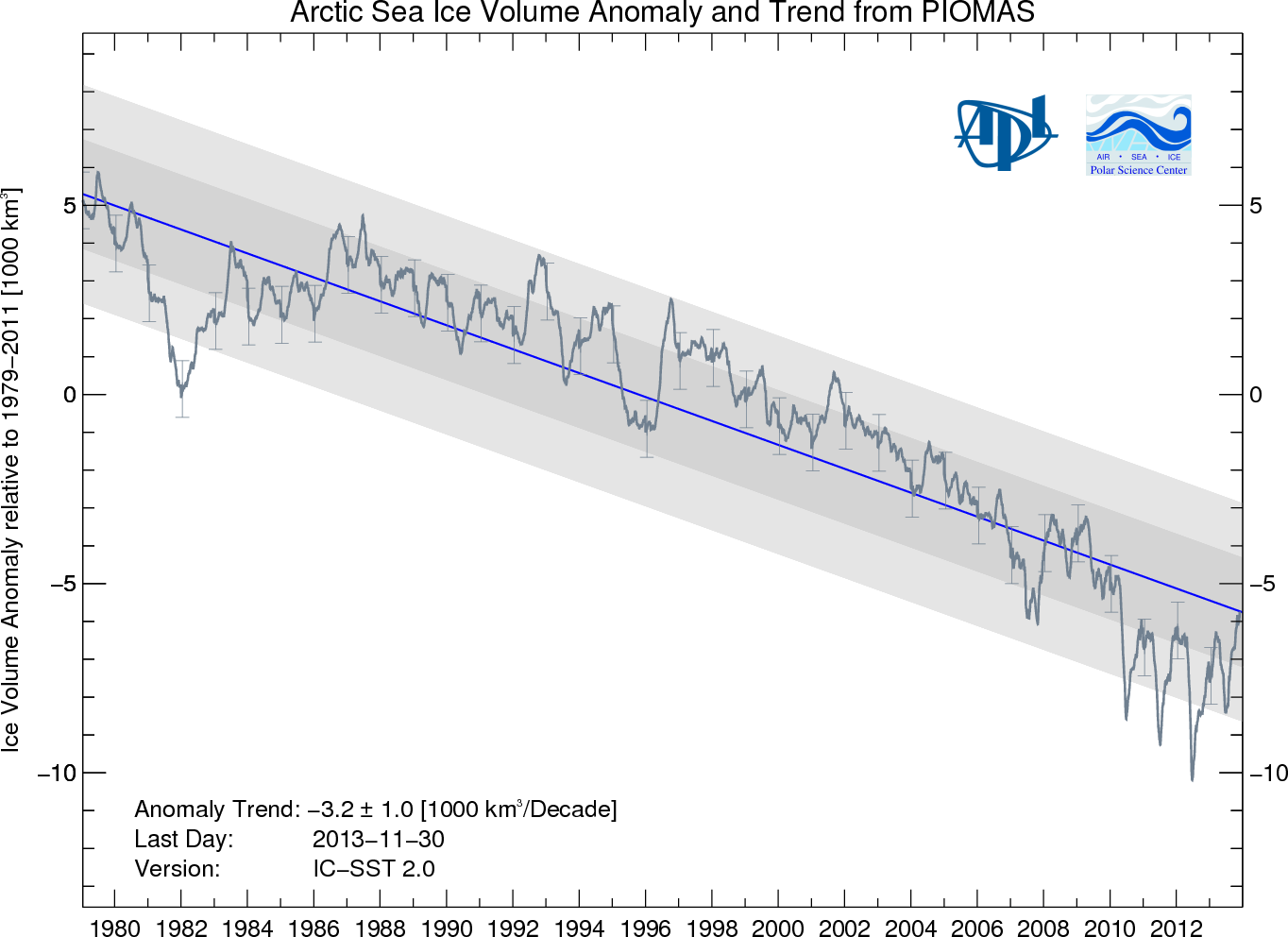
Arctic Sea Ice: Less in December 2013 than Summers Before 2007
Arctic Sea Ice: Less in December 2013 than Summers Before 2007 | Ramez Naam

The Arctic is melting. That's a problem.

Ice reflects 90% of the energy of the sunlight that hits it. The dark waters of the Arctic Ocean below it absorb 90% of that energy instead.

If the sea ice is gone in the height of summer, the additional sunlight captured would be enough to warm the whole planet substantially. Exactly how much we don't know, but perhaps as much to keep raising the planet's temperature as much each year as all the human-released carbon in the atmosphere.

Additionally, the regional warming effect would be even greater, which would accelerate the melt of permafrost near the Arctic, and the release of buried carbon there, much of it will come out as extremely dangerous methane. The melting Arctic is an extremely dangerous climate feedback loop.

We usually hear about Arctic sea ice in terms of the area it covers. Every winter almost the whole Arctic freezes over. That's changed very little. But in summers less and less is left. But what's even scarier is that the ice is also thinner by about half.

When we look at it in terms of volume, in the height of summer, three quarters of the ice volume from the 1980s is gone. Three quarters.

There's ice still covering water, but it's thin, and fragile.

Another way to think of it – today, in December of 2013, in a year when ice coverage has rebounded, there's less ice (by volume) left in the Arctic than in any summer prior to 2007, going back for at least thousands of years.

BPIOMASIceVolumeAnomalyCurrentV2.png
 
Blowin’ in the Wind: Short-Term Weather and Belief in Anthropogenic Climate Change

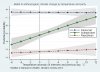
A series of polls provides new tests for how weather influences public beliefs about climate change. Statewide data from 5000 random-sample telephone interviews conducted on 99 days over 2.5 yr (2010–12) are merged with temperature and precipitation indicators derived from U.S. Historical Climatology Network (USHCN) station records.

The surveys carry a question designed around scientific consensus statements that climate change is happening now, caused mainly by human activities. Alternatively, respondents can state that climate change is not happening, or that it is happening but mainly for natural reasons.

Belief that humans are changing the climate is predicted by temperature anomalies on the interview day and the previous day, controlling for season, survey, and individual characteristics.

Temperature effects concentrate among one subgroup, however: individuals who identify themselves as independent, rather than aligned with a political party. Interviewed on unseasonably warm days, independents tend to agree with the scientific consensus regarding anthropogenic climate change. On unseasonably cool days, they tend not to agree. Although temperature effects are sharpest for just a 2-day window, positive effects are seen for longer windows as well.

As future climate change shifts the distribution of anomalies and extremes, this will first affect beliefs among unaligned voters.

Hamilton LC, Stampone MD. Blowin’ in the Wind: Short-Term Weather and Belief in Anthropogenic Climate Change. Weather, Climate, and Society 2013;5(2):112-9. An Error Occurred Setting Your User Cookie

12323
 

Attachments

  • hamilton_stampone_2013.jpg
    hamilton_stampone_2013.jpg
    54.5 KB · Views: 23
Water Risk as World Warms. First comprehensive global-impact project shows that water scarcity is a major worry.
Water risk as world warms : Nature News & Comment

Although many researchers had modelled various aspects of the global-warming elephant, there had been no comprehensive assessment of what warming will really mean for human societies and vital natural resources.

But that changed last year when Schellnhuber, director of the Potsdam Institute for Climate Impact Research in Germany, and other leading climate-impact researchers launched the Inter-Sectoral Impact Model Intercomparison Project.

This aims to produce a set of harmonized global-impact reports based on the same set of climate data, which will for the first time allow models to be directly compared.

Last month it published its initial results in four reports in Proceedings of the National Academy of Science.

These suggest that even modest climate change might drastically affect the living conditions of billions of people, whether through water scarcity, crop shortages or extremes of weather.
 
Planet likely to warm by 4C by 2100, scientists warn
New climate model taking greater account of cloud changes indicates heating will be at higher end of expectations
Planet likely to warm by 4C by 2100, scientists warn | Environment | theguardian.com

Sherwood SC, Bony S, Dufresne J-L. Spread in model climate sensitivity traced to atmospheric convective mixing. Nature 2013;505(7481):37-42. http://www.nature.com/nature/journal/v505/n7481/full/nature12829.html

Equilibrium climate sensitivity refers to the ultimate change in global mean temperature in response to a change in external forcing. Despite decades of research attempting to narrow uncertainties, equilibrium climate sensitivity estimates from climate models still span roughly 1.5 to 5 degrees Celsius for a doubling of atmospheric carbon dioxide concentration, precluding accurate projections of future climate. The spread arises largely from differences in the feedback from low clouds, for reasons not yet understood. Here we show that differences in the simulated strength of convective mixing between the lower and middle tropical troposphere explain about half of the variance in climate sensitivity estimated by 43 climate models. The apparent mechanism is that such mixing dehydrates the low-cloud layer at a rate that increases as the climate warms, and this rate of increase depends on the initial mixing strength, linking the mixing to cloud feedback. The mixing inferred from observations appears to be sufficiently strong to imply a climate sensitivity of more than 3 degrees for a doubling of carbon dioxide. This is significantly higher than the currently accepted lower bound of 1.5 degrees, thereby constraining model projections towards relatively severe future warming.
 
Apocalypse Never: why we’ll never know when climate change has ‘arrived’
Urban MythPrint: Apocalypse Never: why we’ll never know when climate change has ‘arrived’

Climate change is often perceived as a single event that will happen at some point in the future, whereupon all the world’s weather systems will suddenly, simultaneously go haywire.

All the ice will melt, and sea levels will rise and instantly flood through our city centres; tsunamis, hurricanes and forest fires will terrorise the coasts and countryside; and we’ll finally know – once and for all – that this anthropogenic climate change thing scientists have been warning us about, was real all along.

Except that won’t happen.

Climate systems are more complex than that, and changes will probably occur over long periods of time, and even rates of change won’t be constant.

We’re currently living through a period of gradual atmospheric shifts, witnessing the biosphere mutate around us.

But it’s very difficult to see this happening.

This is dangerous, because if we’re always waiting for the ‘aftermath’ of some grand catastrophe, we’ll end up waiting forever, whilst the harmful consequences of global warming and unstable weather patterns continue to build incrementally around us.

There will be no ‘after’ – only an increasingly unpleasant ‘during’.
 
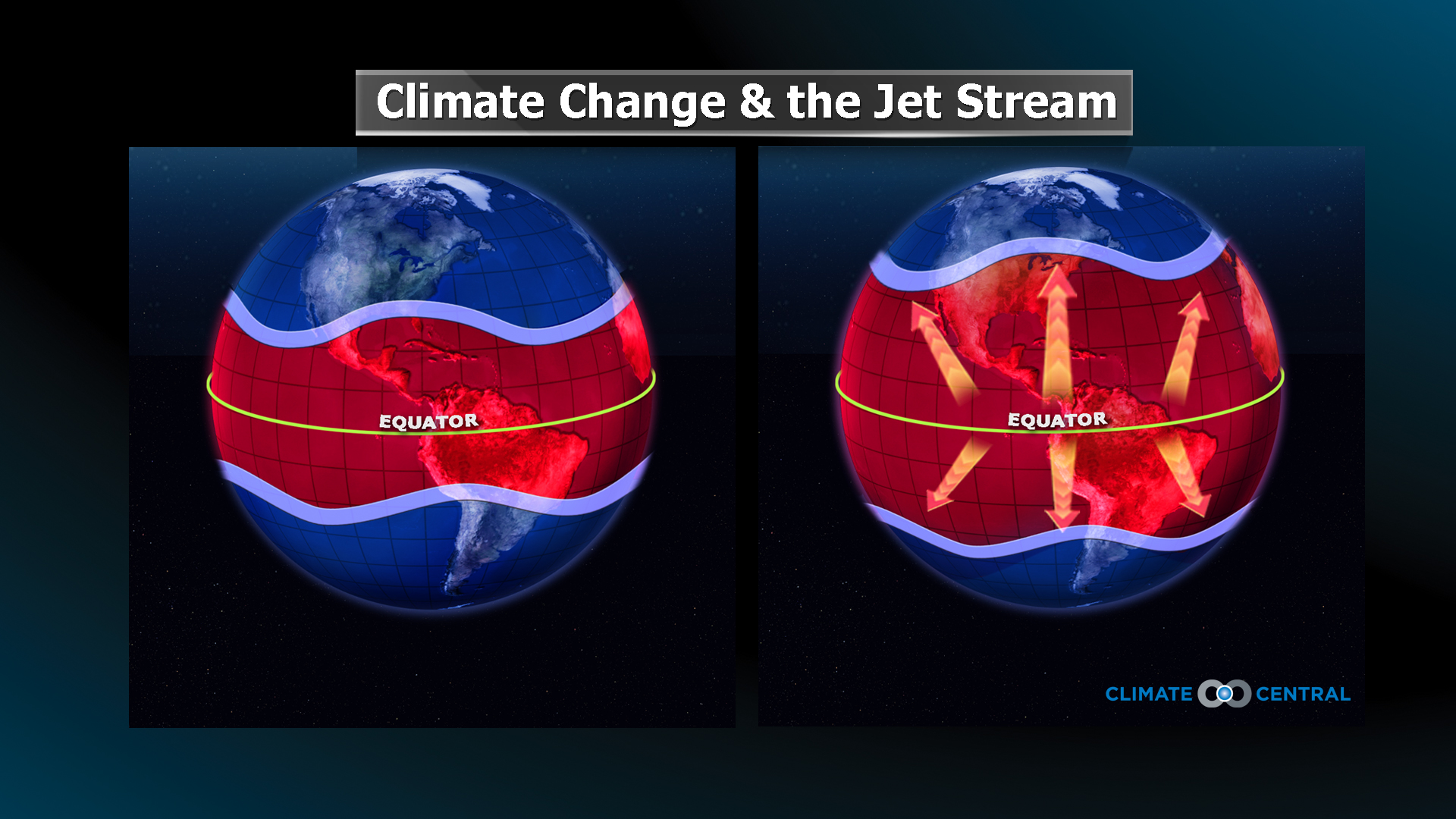
Climate Change & The Jet Stream
http://www.climatecentral.org/gallery/graphics/climate-change-the-jet-stream

JetStreamBoth.jpg


The jet stream. It’s what drives our weather patterns, transporting air masses and creating clashing zones for storm formation. This is the time of year when the jet stream in the Northern Hemisphere makes its seasonal southward shift, sparking extreme swings in the weather – such as an EF-4 in Iowa, record rainfall in Texas, and four feet of snow in South Dakota. Scientists have only recently begun to detect changes in the jet stream that may be tied to global warming. Unraveling the complexities of this emerging scientific research is critical to understanding where our weather is headed.
 
Back
Top