Climate Change


In the Netherlands, an iconic skating race — and a way of life — faces extinction from climate change.

LEEUWARDEN, Netherlands - On a balmy winter day, Klaas Einte Adema lugged his ice skates from car to rink to continue his training for a race that might never come. The 36-year-old has spent the better part of his adult life doing this — showing up at the rink six days a week, skating laps, honing technique and waiting for the weather to someday cooperate.

“When it’s coming, I’m ready,” he says of the country’s most storied and near-mythical sporting event.

The Elfstedentocht translates to “eleven cities tour.” It’s an ice skating race that measures about 135 miles and takes place on the canals that connect the 11 cities in the Friesland province of the Netherlands. The 110-year-old event is wildly popular — the next race is expected to attract 26,000 participants, 2 million spectators and 3,000 journalists and will surely draw the attention of nearly every person in the country — largely because of the long wait and grim forecast associated with it.

The race only takes place when conditions allow; when extreme winter bowls over the region, the temperatures drop, and the canals freeze over. But the Netherlands is no longer a romantic wintry wonderland, and there hasn’t been an Elfstedentocht since 1997, marking the longest drought ever between races. Climate change has endangered the race and is slowly dousing hopes across the province.

 
Trends in Atmospheric Carbon Dioxide

At this rate, CO2 450 ppm will be here is less than 15 years, possibly in a decade. I do not think we have anywhere near fully grasped the shit storm we are facing.

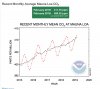
February 2019: 411.75
February 2018: 408.32

Confirmed: Atmospheric CO2, measured at Mauna Loa, hit 411.75 ppm last month, already beating last year's record (411.2 ppm, May), and probably the highest in 2 million years too. +3.4 ppm higher than last year, and that's a lot.

D0__Ny8WkAAIFpG.jpg
 
Mauna Loa carbon dioxide forecast for 2019

We forecast the annual average CO2 concentration at Mauna Loa to be 2.75 ± 0.58 parts per million (PPM) higher in 2019 than in 2018.


CO2 PPM at Mauna Loa crossed:
320 May 1960
330 May 1972
340 March 1980
350 May 1986
360 May 1993
370 April 1999
380 April 2004
390 May 2009
400 April 2014
410 April 2018

Years to drive up CO2 by 10 PPM:
320 → 330: 12
330 → 340: 8
340 → 350: 6
350 → 360: 7
360 → 370: 6
370 → 380: 5
380 → 390: 5
390 → 400: 5
400 → 410: 4
410 → 420: ?3

Note:
414.27 PPM on February 9, 2019 (NOAA-ESRL)
414.12 PPM on February 28 2019 (NOAA-ESRL)
413.96 PPM on January 22, 2019 (Scripps)
Daily CO2


Let there be no mistake: Nuclear power plants can generate enormous amounts of carbon-free electricity. A rapid increase in nuclear energy would slash emissions from the power sector, as the French example makes clear. Even today, France’s carbon density—its carbon emissions per capita—ranks well below that of Germany, the United Kingdom, and the United States, according to the Global Carbon Atlas.

But you can’t put a nuclear reactor in a tractor-trailer or a steel plant. Nuclear can only reduce emissions from the power sector, and “the energy system is bigger than just electricity,” says Sam Ori, the executive director of the Energy Policy Institute at the University of Chicago. “While I think nuclear has real potential as a means to decarbonizing electricity, you still have a lot of sectors to worry about.”

In fact, electricity makes up a smaller and smaller part of the climate problem. Right now, the power sector contributes only about a third of annual U.S. carbon emissions related to energy production. When you factor in land change and agriculture (read: deforestation and all those pesky cows), electricity is responsible for only about a quarter of annual U.S. emissions. And its share is declining. Carbon emissions from the U.S. power sector have fallen 28 percent since 2005. Meanwhile, emissions from other parts of the economy—transportation, agriculture, industry—have fallen by only 5 percent.

“Even if you figure out electricity, you still have to figure out industry. You still have to figure out transportation,” Ori told me. Although we have partial answers to some of the problems posed by those sectors—everyone could buy electric cars, for instance, and charge them off the new nuclear-powered grid—we don’t have total ones. We still have no electrified way of moving around freight. Electrified air travel remains notional. All the nuclear plants in the world could not reduce the importance of oil in steel production. Solving all these problems will require some kind of public policy, Ori said; even electric cars won’t replace their gas-powered brethren without a regulatory nudge. Sullivan’s nuclear build-out has nothing to say about such challenges.

Yet a Green New Deal does. If you look at Representative Alexandria Ocasio-Cortez’s actual Green New Deal resolution, you’ll see that its vision extends far beyond the power sector. It pledges to invest in U.S. industry and manufacturing so as to remove “pollution and greenhouse gas emissions … as much as is technologically feasible.” It makes an almost identical promise for the agricultural sector. The resolution is notably imprecise in how it will accomplish those goals, but it was written as a list of goals, not policies. At least it recognizes that those sectors exist. (The Washington Post editorial board’s “efficient, effective, and focused” Green New Deal also makes passing mention of them.)
 
Last edited:
Storlazzi CD, Gingerich SB, van Dongeren A, et al. Most atolls will be uninhabitable by the mid-21st century because of sea-level rise exacerbating wave-driven flooding. Science Advances 2018;4:eaap9741. http://advances.sciencemag.org/content/4/4/eaap9741.abstract

Sea levels are rising, with the highest rates in the tropics, where thousands of low-lying coral atoll islands are located. Most studies on the resilience of these islands to sea-level rise have projected that they will experience minimal inundation impacts until at least the end of the 21st century. However, these have not taken into account the additional hazard of wave-driven overwash or its impact on freshwater availability. We project the impact of sea-level rise and wave-driven flooding on atoll infrastructure and freshwater availability under a variety of climate change scenarios. We show that, on the basis of current greenhouse gas emission rates, the nonlinear interactions between sea-level rise and wave dynamics over reefs will lead to the annual wave-driven overwash of most atoll islands by the mid-21st century. This annual flooding will result in the islands becoming uninhabitable because of frequent damage to infrastructure and the inability of their freshwater aquifers to recover between overwash events. This study provides critical information for understanding the timing and magnitude of climate change impacts on atoll islands that will result in significant, unavoidable geopolitical issues if it becomes necessary to abandon and relocate low-lying island states.


Storlazzi CD, Elias EPL, Berkowitz P. Many Atolls May be Uninhabitable Within Decades Due to Climate Change. Scientific Reports 2015;5:14546. https://doi.org/10.1038/srep14546

Observations show global sea level is rising due to climate change, with the highest rates in the tropical Pacific Ocean where many of the world’s low-lying atolls are located. Sea-level rise is particularly critical for low-lying carbonate reef-lined atoll islands; these islands have limited land and water available for human habitation, water and food sources, and ecosystems that are vulnerable to inundation from sea-level rise. Here we demonstrate that sea-level rise will result in larger waves and higher wave-driven water levels along atoll islands’ shorelines than at present. Numerical model results reveal waves will synergistically interact with sea-level rise, causing twice as much land forecast to be flooded for a given value of sea-level rise than currently predicted by current models that do not take wave-driven water levels into account. Atolls with islands close to the shallow reef crest are more likely to be subjected to greater wave-induced run-up and flooding due to sea-level rise than those with deeper reef crests farther from the islands’ shorelines. It appears that many atoll islands will be flooded annually, salinizing the limited freshwater resources and thus likely forcing inhabitants to abandon their islands in decades, not centuries, as previously thought.


Ultimately, if we are concerned about mass migration, we have little choice but to face up to the fact that it is a symptom of a deepening ecological crisis that is a direct consequence of the way our societies function today.

Burying our heads in the sand, shouting the odds, blaming foreigners, complaining about the bureaucratic tyranny of the EU, and pulling up the drawbridge, is not going to change this. What it will do is change the very fabric of our societies and set us on a path toward the termination of democracy as we know it: a far-right dream come true.

The other alternative is to grow up, face reality, and get to work on rapidly pushing through the wide-ranging social, economic, and cultural transformations necessary to end our dependence on fossil fuels, draw-down carbon emissions, and to begin the task of repairing the damage we’ve done and healing the planet. That is the only true path to prosperity, freedom and stability. Anything else is little more than the madness of self-delusion.


Peak indifference is a coinage of the sci-fi writer, blogger, and activist Cory Doctorow (who is, full disclosure, a friend). You can think of it this way: Often, when society is facing a problem that’s terrible but slow-growing, we ignore it. We’re indifferent to the problem. Climate change isn’t the only example (think of digital privacy or income inequality), but it’s perhaps the toughest to crack.

The psychologist Robert Gifford once enumerated the “seven dragons of inaction” on climate, from ingrained habits (car culture) to lack of trust (in, say, scientists) to numbness (statistics overload). As the crisis grows, our indifference grows too.

But at some point, a crisis gets so bad that it becomes unignorable. Our indifference reaches a peak, begins to decline—and panic emerges. This could describe what we’re now seeing in the climate polling. Media coverage and real-life events have finally broken through to folks: “Increasingly they’re saying, ‘Wait a minute, this is happening right here, right now,’ ” Leiserowitz says.

This is great for anyone who wants to fix the problem, yes? Society is finally ready!

But Doctorow’s theory also predicts another psychological hazard: When we ignore trouble for so long, we can slip quickly into nihilism. It’s too late. We missed our chance to take action.

That means the current political moment is incredibly interesting. Anyone who wants to deal with climate change may have only a brief window to sell the public on a plan. In his new book The Uninhabitable Earth: Life After Warming, the writer David Wallace-Wells talks about the value of panic to pushing collective action; Doctorow says it’s the point “where you divert your energy from convincing people there’s a problem to convincing them there’s a solution.”


Netflix’s Our Planet Says What Other Nature Series Have Omitted
In a groundbreaking move, the beautiful but uncomfortable documentary forces viewers to acknowledge their own complicity in the decline of nature.
Netflix’s ‘Our Planet’ Says What Other Nature Series Have Omitted

Onscreen eagles lock talons in aerial combat, and humpback whales engulf herring by the shoal. Birds of paradise, hunting dogs, leafcutter ants—they’re all there. This is Our Planet—Netflix’s new, big-budget nature documentary—and, without the sound on, viewers could easily think that they’re watching Planet Earth III.

The resemblance to the oeuvre of the BBC’s renowned Natural History Unit is striking. The series is produced by Alastair Fothergill, who was also responsible for the original Planet Earth. Everything is narrated by David Attenborough, whose unctuous tones, somehow both silky and gravelly, have become synonymous with wildlife films.

But this time, the messages delivered by that familiar voice are different. Here, much of the awe is tinged with guilt, the wonder with concern, the entertainment with discomfort.

Repeatedly, unambiguously, and urgently, Our Planet reminds its viewers that the wonders they are witnessing are imperiled by human action. After seeing a pair of mating fossas—a giant, lemur-hunting, Madagascan mongoose—we’re told that the very forests we just saw have since been destroyed. After meeting the endearing orangutans Louie, Eden, and Pluto, we are told that 100 of these apes die every week through human activity. We see Borneo’s jungle transforming into oil-palm monocultures in a time-lapse shot that is almost painful to watch. We’re told that Louie and Eden’s generation could be the last for wild orangutans.

If you muted the series, it would look almost identical to any other wildlife documentary. You could sit back, content and relaxed, gawping at nature’s splendor. But Our Planet seems to have no interest in letting you be contented. Though the film is still entertaining and beautiful, its narration imparts its shots with a more complex emotional flavor. It’s like watching an American drug ad during which a voice-over reads out lists of horrific side effects over footage of frolicking, picnicking families.

Frankly, it’s about time.

 
Back
Top