Climate Change

The rate of increase I last recall reported was ~2 ppm from 2017-2018. This would put 450 ppm in ~20 years.

2018-2019 for January is close to 3 ppm. This makes 450 ppm by about 2030.

If this rate of acceleration holds, the dominoes will fall quickly. If it increases, hold on. It will not be pretty.


Recent Monthly Average Mauna Loa CO2
January 2019: 410.83 ppm
January 2018: 407.96 ppm

ESRL Global Monitoring Division - Global Greenhouse Gas Reference Network


February 9, 2019
414.27 ppm

Scripps

February 9, 2018
408.99 ppm
NOAA-ESRL
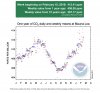
Daily CO2


413.69 parts per million (ppm) CO2 in air 09-Feb-2019
The Keeling Curve



All around the world students are ditching school to demand action on climate change. They know that we are facing a climate emergency, time is running out. i-D spoke to 8 youth activists from all over the globe, about why they're taking drastic action.


When I first catch sight of Greta Thunberg, it is eight in the morning, and a small crowd has already gathered. It is a Friday, her day of protest, and the 16-year-old is standing outside the rose-coloured parliament building, next to a beaten-up sign that says “School strike for climate” in Swedish.

The February sun has barely risen over Stockholm. Thunberg is slightly hard to spot, because she is so little — less than five feet tall. Her face peeks out between a big hat and a thick scarf. “Well, it’s warm today,” she says with a smile, when I ask how the protest is going. It is 5C and doesn’t feel very warm to me.

This is the 26th week of her school strike, which has taken place every Friday since school started last August — including vacations. During that time she has rocketed to a level of fame and influence that pretty much nobody, including herself, expected.

Over the past six months, she has become a superstar of the climate change movement. Her school strike, which started out with her sitting alone on a camping mat next to parliament, was swiftly highlighted by the media. Then came a Ted talk, speeches at rallies, and an invitation to address last December’s UN climate talks in Poland. Inspired by her example, the number of student strikers across Europe swelled into the thousands, then the tens of thousands — and all because of the bundled-up teenager in front of me with her hair in plaits.

For years climate change has been a big issue in search of a leader. Politicians, celebrities and naturalists have taken up the cause — think Al Gore, Leonardo DiCaprio, Jane Goodall. But no one has captured the spirit of what is happening to the Earth as much as this autistic teenager, with her simple message: you are stealing my future.


The ostensible argument of this piece — that voters who favor serious action on climate change should be wary of supporting Bernie Sanders because the socialist senator insisted on a slightly less carbon-efficient mode of flying in 2016 — is a parody of environmentalist appeals to conscious consumption.

If Donald Trump had a morbid fear of flying and traveled everywhere by Tesla, would that make his presidency less damaging for the climate, in any meaningful sense? If not, then what relevance does Bernie’s affinity for private planes have on his credentials as a climate candidate?

America doesn’t need a president who composts. It needs one willing to prioritize decarbonization over deficit reduction, the profitability of entrenched industries, and other geopolitical goals. If such a president also likes to “roll coal” on the weekends, no one who accepts the reality of climate change should care.

Now, none of this is to say that Sanders is an ideal climate candidate. His private plane use is of no real consequence, but his past opposition to nuclear power certainly could be. Similarly, Drum is right that progressives do not behave as though they believe their own rhetoric on climate change. But this hypocrisy isn’t demonstrated by their refusal to forgo air-conditioning; it’s demonstrated by their failure to organize hunger strikes on the White House lawn.

With a problem like climate, the personal isn’t political. And the political is what’s critical.
 
Back
Top