Climate Change


Current models of greenhouse-gas release and climate assume that permafrost thaws gradually from the surface downwards. Deeper layers of organic matter are exposed over decades or even centuries, and some models are beginning to track these slow changes.

But models are ignoring an even more troubling problem. Frozen soil doesn’t just lock up carbon — it physically holds the landscape together. Across the Arctic and Boreal regions, permafrost is collapsing suddenly as pockets of ice within it melt. Instead of a few centimetres of soil thawing each year, several metres of soil can become destabilized within days or weeks. The land can sink and be inundated by swelling lakes and wetlands.

Abrupt thawing of permafrost is dramatic to watch. Returning to field sites in Alaska, for example, we often find that lands that were forested a year ago are now covered with lakes2. Rivers that once ran clear are thick with sediment. Hillsides can liquefy, sometimes taking sensitive scientific equipment with them.

This type of thawing is a serious problem for communities living around the Arctic (see ‘Arctic permafrost’). Roads buckle, houses become unstable. Access to traditional foods is changing, because it is becoming dangerous to travel across the land to hunt. Families cannot reach lines of game traps that have supported them for generations.

In short, permafrost is thawing much more quickly than models have predicted, with unknown consequences for greenhouse-gas release. Researchers urgently need to learn more about it. Here we outline how.


450 ppm by 2030 …
If LV is offering the bet, I would be a taker.


All-Time Record Highs for CO2 Daily Averages
415.09 ppm on May 3, 2019 (Scripps)
414.94 ppm on May 1, 2019 (Scripps)
414.88 ppm on May 1, 2019 (NOAA-ESRL)
414.84 ppm on March 18, 2019 (NOAA-ESRL) & May 2, 2019 (Scripps)

***409.22 ppm on May 3, 2018 (NOAA-ESRL)
2018 High - 412.60 ppm on May 14 (Scripps)


Daily CO2


CO2 415.09 3 May 2019

The Keeling Curve


On April 26, 1986, the Chernobyl Nuclear Power Plant in Ukraine, Soviet Union suffered a massive explosion that released radioactive material across Belarus, Russia and Ukraine and as far as Scandinavia and western Europe.

Chernobyl dramatizes the story of the 1986 accident, one of the worst man-made catastrophes in history, and the sacrifices made to save Europe from the unimaginable disaster.
 
Renewables Are Dead
Renewables Are Dead - The Automatic Earth

If I’ve said once that those among us who tout renewable energy should pay more attention to the 2nd law of Thermodynamics, I must have said it a hundred times. But I hardly ever get the impression that people understand why. And it seems so obvious. A quote I often use from Herman Daly and Ken Townsend, when I talk about energy, really says it all:

“Erwin Schrodinger (1945) has described life as a system in steady-state thermodynamic disequilibrium that maintains its constant distance from equilibrium (death) by feeding on low entropy from its environment – that is, by exchanging high-entropy outputs for low-entropy inputs. The same statement would hold verbatium as a physical description of our economic process. A corollary of this statement is that an organism cannot live in a medium of its own waste products.”

Using energy produces waste. Using more energy produces more waste. It doesn’t matter -much- what kind of energy is used, or what kind of waste is produced. The energy WE use produces waste, in a medium of which WE cannot survive. The only way to escape this is to use less energy. And because we have used such an enormous amount of energy the past 100 years, we must use a whole lot less in the next 100.

We use about 100 times more energy per person, and a whole lot more in the west, than our own labor can produce. We use the equivalent of what 500 billion people can produce without the aid of fossil fuel-powered machines. We won’t solve this problem with wind turbines or solar panels. There really is one way only: cut down on energy use.

Because it’s exceedingly rare to see this discussed, even among physicists, who should know better since they know thermodynamics, it’s good to hear it from someone else. An article in Forbes today discusses a May 3 article in German magazine Der Spiegel on the problems with the Energiewende, the country’s drastic turn towards renewables. ...


For background about Germany's botched #Energiewende, and some solid arguments about the intrinsic physical limitations of renewables (it's all a matter of energy density), see @ShellenbergerMD's article in @forbes.

The Reason Renewables Can’t Power Modern Civilization Is Because They Were Never Meant To
The Reason Renewables Can't Power Modern Civilization Is Because They Were Never Meant To


A Botched Job in Germany
Energy transition threatens to fail
The conversion of the German energy system lacks power plants, grids and storage. The state has wasted billions.
https://docs.google.com/document/d/148Lym3a487S8lha50QXGJfjQ1HmlNyj3QfLqAt0k0ng/edit#


Leaked German govt report: emissions target will be missed despite on-target renewables
Leaked German govt report: emissions target will be missed despite on-target renewables - Energy Post
 
Last edited:


Why Are Americans Ignoring the Most Important Movie of Their Times, China's The Wandering Earth?
https://www.thestranger.com/slog/20...vie-of-their-times-chinas-the-wandering-earth

What we see in this film—which is loud, frenetic, and filled with sublime industrial and cosmic moments, blasts for fire and rockets, falling boulders and chunks of ice and blocks of concrete—is that humanity will be saved by the Chinese. The Russians are given some credit. The French are handed an important role late in the film. But the US? Almost nothing beyond a nod to the villain of Stanley Kubrick's 2001, HAL (in Wandering it's called MOSS—it speaks robotic Chinese and American English). The ideological rupture in this work is that the US does not even come close to saving the world.

Americans may not be prepared for a future depicted in this way. Also, this audience will find its subject matter—which is, of course, life after the Earth's climate has irrevocably changed—not gripping enough. But make no mistake, The Wandering Earth is about climate change, and it makes it clear that the US is just too out of it to guide humanity through the crisis. The world will have to turn to a form of leadership that, the film believes, can break with moribund American capitalism. This is the Communist Party of China speaking, and the fascinating thing is that it does so without making it clear how Chinese communism is fundamentally distinct from the form of history, capitalist, that brought it to world-historical prominence. But what's certain is that the film is selling the world, or at least China's huge population, the idea that the gears of the future are now in the political economic couplet of Beijing/Shanghai.

What is advertised in The Wandering Earth is that China can do something about climate change, and the US cannot.


Could 'The Wandering Earth' Actually Happen? Here's What a NASA Scientist Says
"The science in it is compelling," says a senior NASA engineer.
Could 'The Wandering Earth' Actually Happen? A NASA Scientist Explains How | Inverse


What If Netflix Released a $700 Million Blockbuster and No One Noticed? Oh Wait, It Just Did


Carbon dioxide levels in Earth's atmosphere hit a stunning new milestone over the weekend.

Data from the Mauna Loa Observatory in Hawaii showed that carbon dioxide levels surpassed 415 parts per million on Friday.

"We don't know a planet like this," Eric Holthaus, a meteorologist and writer at Grist, wrote on Twitter.

Carbon dioxide (CO2) concentrations have skyrocketed far higher than any levels in the last 800,000 years, data from the Scripps Institution of Oceanography at the University of California - San Diego show, and levels have not been this high for millions of years, Holthaus said.

"This is the first time in human history our planet's atmosphere has had more than 415ppm CO2," he tweeted. "Not just in recorded history, not just since the invention of agriculture 10,000 years ago. Since before modern humans existed millions of years ago."


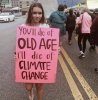
“Can you hear me?” Greta Thunberg asks the 150 members and advisers in the U.K. Houses of Parliament. She taps the microphone as if to check if it’s on, but the gesture is meant as a rebuke; she’s asking if they’re listening. She asks again later in her speech. “Did you hear what I just said? Is my English O.K.? Is my microphone on? Because I’m beginning to wonder.” There is laughter, but it’s unclear if it’s amused or awkward. Thunberg is not smiling. She’s here to talk climate; a catastrophe is looming, her generation will bear it, and she knows whom to blame. “You did not act in time,” she declares.

Castigating the powerful has become routine for the 16-year-old. In December, she addressed the U.N. Climate Change Conference in Poland; in January she berated billionaires at the World Economic Forum in Davos, Switzerland. Her London speech was the last stop of a tour that included meeting the Pope. (“Continue to work, continue,” he told her, ending with, “Go along, go ahead.” It was an exhortation, not a dismissal.)

Just nine months ago, Thunberg had no such audiences. She was a lone figure sitting outside the Swedish Parliament in Stockholm, carrying a sign emblazoned with Skolstrejk for Klimatet (School Strike for Climate). She was there for a reason that felt primal and personal. While Thunberg was studying climate change in school at the age of 11, she reacted in a surprisingly intense way: she suffered an episode of severe depression. After a time it lifted, only to resurface last spring.

“I felt everything was meaningless and there was no point going to school if there was no future,” Thunberg says. But this time, rather than suffer the pain, she decided to push back at its cause, channeling her sadness into action. “I promised myself I was going to do everything I could do to make a difference,” she says.

Inspired by the survivors of February 2018’s school shooting in Parkland, Fla., she began a weekly schoolwork strike every Friday, turning to social media to implore politicians to support and take steps toward halting carbon emissions. Since the U.N. Climate Change Conference in December, Thunberg’s Twitter following has grown by nearly 4,000% to reach 612,000; many have also followed her lead offline, striking to demand change. “Before, I never really spoke when I was in my lessons or with my classmates,” she told me shortly after her London speech. “But now I am speaking to the whole world.”


60241520_830554920645663_2408041708777373696_n.jpg


The globe just experienced its second-warmest April since reliable instrument data began in 1880, according to NASA and the Japan Meteorological Agency.

Why it matters: The unusually warm April follows a top 3 hottest March, and indicates that the Earth is headed for yet another top 3 warmest year on record. This follows recent news that carbon dioxide levels in the atmosphere edged past 415 parts per million for the first time in human history, likely becoming the highest level on record in at least 3 million years.

Human activities, such as burning fossil fuels for energy and chopping down forests, are causing carbon dioxide levels to increase at a quickening pace.

Details: According to NASA, April saw a global temperature anomaly of 0.99ºC, or 1.8ºF, above the 20th century average. This was cooler than only April 2016, when a powerful El Niño event in the Pacific Ocean helped add to a natural boost in global temperatures that were already elevated due to human-caused climate change.
  • Right now, a weak El Niño event, featuring unusually warm water in the tropical Pacific Ocean along with an increase in showers and thunderstorm activity near the equator, is helping to add additional heat to the atmosphere.
The Arctic, including Greenland and Siberia, was particularly mild during April, and the Greenland melt season got off to an especially early start.
  • A recent study found that the world's largest island has shed ice nearly 6 times faster in the past decade when compared to the 1980s.
The context: Last year was Earth's 4th-warmest year on record, coming in behind 2016 — the planet's warmest recorded year — as well as 2015 and 2017.
  • The world's 5 warmest years have all occurred since 2014.
  • 9 of the 10 warmest years on record since reliable data began in 1880 have occurred since 2005.
  • Global carbon dioxide emissions from the burning of fossil fuels such as coal, oil and natural gas ticked up in 2018to the highest levels in recorded history, according to the Global Carbon Project and the International Energy Agency.
  • According to Berkeley Earth researcher Robert Rohde, carbon dioxide levels have "increased more in the last 15 years than they did in over 9,000 years prior" to when fossil fuels were first introduced.
  • Climate scientists have shown that urgent, significant cuts to greenhouse gases are needed in order to prevent global warming from causing potentially devastating impacts around the world.
 
Fyke J, Matthews HD. A probabilistic analysis of cumulative carbon emissions and long-term planetary warming. Environmental Research Letters 2015;10:115007. http://dx.doi.org/10.1088/1748-9326/10/11/115007

Efforts to mitigate and adapt to long-term climate change could benefit greatly from probabilistic estimates of cumulative carbon emissions due to fossil fuel burning and resulting CO2-induced planetary warming. Here we demonstrate the use of a reduced-form model to project these variables. We performed simulations using a large-ensemble framework with parametric uncertainty sampled to produce distributions of future cumulative emissions and consequent planetary warming. A hind-cast ensemble of simulations captured 1980–2012 historical CO2 emissions trends and an ensemble of future projection simulations generated a distribution of emission scenarios that qualitatively resembled the suite of Representative and Extended Concentration Pathways. The resulting cumulative carbon emission and temperature change distributions are characterized by 5–95th percentile ranges of 0.96–4.9 teratonnes C (Tt C) and 1.4 °C–8.5 °C, respectively, with 50th percentiles at 3.1 Tt C and 4.7 °C. Within the wide range of policy-related parameter combinations that produced these distributions, we found that low-emission simulations were characterized by both high carbon prices and low costs of non-fossil fuel energy sources, suggesting the importance of these two policy levers in particular for avoiding dangerous levels of climate warming. With this analysis we demonstrate a probabilistic approach to the challenge of identifying strategies for limiting cumulative carbon emissions and assessing likelihoods of surpassing dangerous temperature thresholds.


You don’t have to be a physicist or geologist to know that the Earth’s climate is changing in ways that are destined to make the landscape less hospitable for humans. Just look around. The dangers are evident.

In the final weeks of May, tornadoes ripped through the center of the United States day after day, destroying homes and schools, hurling trees as if they were mere matchsticks, inflicting countless injuries across communities and leaving some families to mourn their dead. This virulent tornado season is just one example of extreme weather: The past few months have also seen record cold, record heat and record flooding.

If human beings were rational, our top scientists and political leaders would be huddled together, hashing out plans and policies to try to mitigate the damage from greenhouse gases — with the goal of salvaging human life. Faced with an existential threat, a fierce peril that will alter the planet in significant ways, presidents and premiers and prime ministers would overcome their traditional enmities, as they do in the movies, and come together to save humanity.

Alas, that has not happened. Human beings, it turns out, are deeply irrational, tribal, ignorant, greedy and selfish. Sometimes, we are just plain crazy. President Donald Trump has reversed a series of steps taken by his predecessors to ameliorate climate change and has commenced initiatives that will further damage the environment. Moreover, the president has launched a war on the science of climate change and the experts who practice it, trying to create widespread doubts about their expertise.
 
Back
Top